A themed haunted house maze is a different purchase decision than a generic inflatable maze or fun house: the theming affects sourcing timeline, the walk-through design has different safety and crowd-flow considerations than an open bounce unit, and the seasonal nature of the demand changes how you should think about ordering timeline entirely.
This isn't a general maze buyer's guide — our inflatable maze and fun house guide covers generic maze construction and layout. Our Halloween peak-season sourcing guide covers the broader Halloween product category and shipping timeline. This one is specifically about the themed haunted house format: what makes it different to source, and the crowd-flow and lighting considerations a plain maze doesn't need to worry about.
A themed haunted house adds custom-printed exterior graphics (tombstones, fog, monster artwork covering the full structure surface) rather than a plain-colored maze shell, which means the same proofing-cycle and artwork-approval considerations that apply to any custom-printed inflatable apply here — budget for a proofing round separate from production time, and lock artwork early enough that revisions don't eat into your pre-Halloween delivery window. A generic maze in stock colors can often ship faster than a themed haunted house precisely because there's no custom artwork stage to wait on. For the full-surface digital printing process that this theming relies on, see our custom printing production timeline guide, which covers proofing and approval workflow in more depth.
A haunted house walk-through is designed for one-directional flow with intentional pacing (narrow turns to create anticipation, dead-end pockets for jump-scare moments) rather than a maze's open multi-path puzzle layout — this affects both the footprint you need and how you staff the attraction. Confirm the unit's walk-through capacity per hour against your expected visitor volume before your event date; a haunted house sized for casual foot traffic will create a bottleneck line at a well-promoted Halloween event, while a unit sized for high throughput may feel rushed and undersell the atmosphere at a smaller gathering.
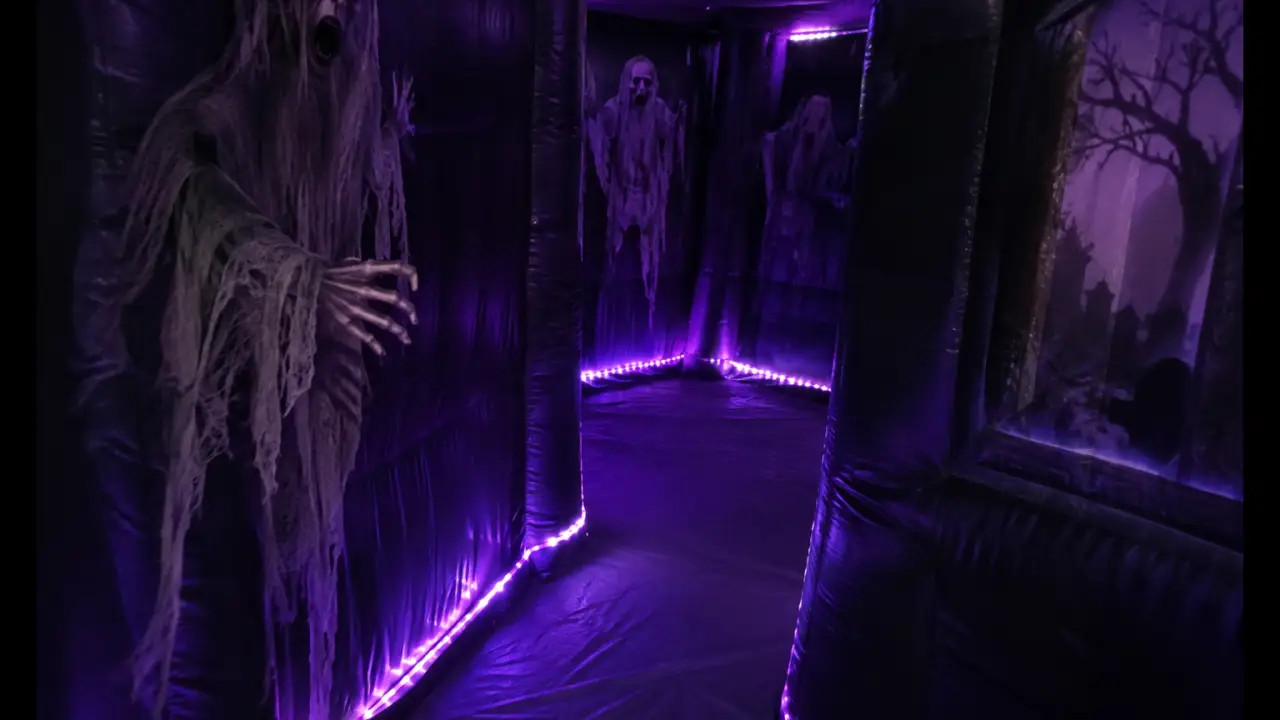
Interior lighting is a genuine safety consideration for a walk-through attraction in a way it isn't for an open bounce unit — enough low-level lighting or glow elements are needed for participants to see turns and steps even in a deliberately dark-themed interior. Confirm what lighting solution (built-in LED strips, glow paint, or operator-supplied battery lighting) the unit is designed around before ordering, since retrofitting adequate lighting into a unit not designed for it is a harder fix after delivery than specifying it upfront.
Because this is a hard-deadline seasonal product, work backward from your event date with real buffer: artwork approval (1-2 weeks), production (3-4 weeks for a themed unit), and freight (5-7 weeks sea, 1-2 weeks air) add up fast against a late-October target if you're starting the order process in September. Ordering by early-to-mid summer for sea freight, or accepting the air-freight premium for a later order, are the two realistic paths to a confirmed October delivery.
A single haunted house rarely fills an entire event by itself — most successful Halloween events pair it with a lighter-atmosphere attraction (a themed bounce unit or slide from our Halloween inflatables category) so younger or more easily-spooked visitors have an alternative, while the haunted house handles the older-kid and adult crowd specifically seeking the scare factor. Planning your attraction mix, not just the haunted house purchase in isolation, is what keeps a Halloween event's overall visitor satisfaction high across a mixed-age crowd.
Can a haunted house unit be reused with different theming in future years?
The structural shell can often be reused, but full-surface custom artwork is typically permanent to that shell — if you want to refresh theming in future seasons, ask your supplier about a separate lower-cost re-skin option versus a full structural reorder.
How many staff does a haunted house attraction typically need versus a standard maze?
Generally more, since the one-directional pacing and jump-scare pockets benefit from a staff member managing entry flow and monitoring for participants who get stuck or overwhelmed — budget staffing accordingly rather than assuming maze-level supervision is sufficient.
Is a haunted house unit usable for non-Halloween events?
The structural shell can work for other walk-through attraction concepts, but the exterior theming is Halloween-specific by design — if year-round use matters to you, discuss a less holiday-specific theme option with your supplier upfront.
Confirm crowd-flow capacity against your expected volume, lock artwork early to protect your October delivery window, and specify interior lighting explicitly — get those three right and a themed haunted house becomes your event's centerpiece attraction instead of a bottleneck. Get in touch with your event date and expected volume for a season-timed quote.