Italy and the German-speaking markets are the two largest advertising-inflatable regions we ship into, and they are not the same order. Italian buyers generally come through event and brand-activation agencies, order fewer units with more custom shaping, and care most about how a unit photographs in a piazza. German and Austrian buyers usually order through retail, trade-fair and sports-club channels, want standardised formats that repeat across a season, and ask for documentation before they ask for a price. This guide covers both, because the specification decisions that follow from each pattern are different.
For the format fundamentals — which shape suits which deployment — our outdoor advertising inflatables guide is the better starting point. What follows is market-specific.
The Italian market rewards custom work. Orders we see from Italian agencies are disproportionately shaped balloons — a product replica, a bottle, an abstract brand form — rather than a printed sphere. That changes the specification priorities: seam layout and panel break-up matter more than diameter, because a shaped unit is read at close range by people standing in the square, not at distance from a passing car.
Practically, this means two things for an Italian order. Get the 3D reference in early, because shaped units cannot be redrawn cheaply after tooling. And specify the print method for close-range viewing — full-surface digital print with tight registration, not a banner panel stitched to a blank body. A shaped balloon that reads well at 3 m is the whole point; a banner panel defeats it.
Italian buyers also tend to order anchoring hardware with the unit rather than sourcing it locally. That is sensible: on cold-air advertising balloons, the factory will size the ballast and the tether points to the envelope, and mismatching those later is a common cause of tether failure.
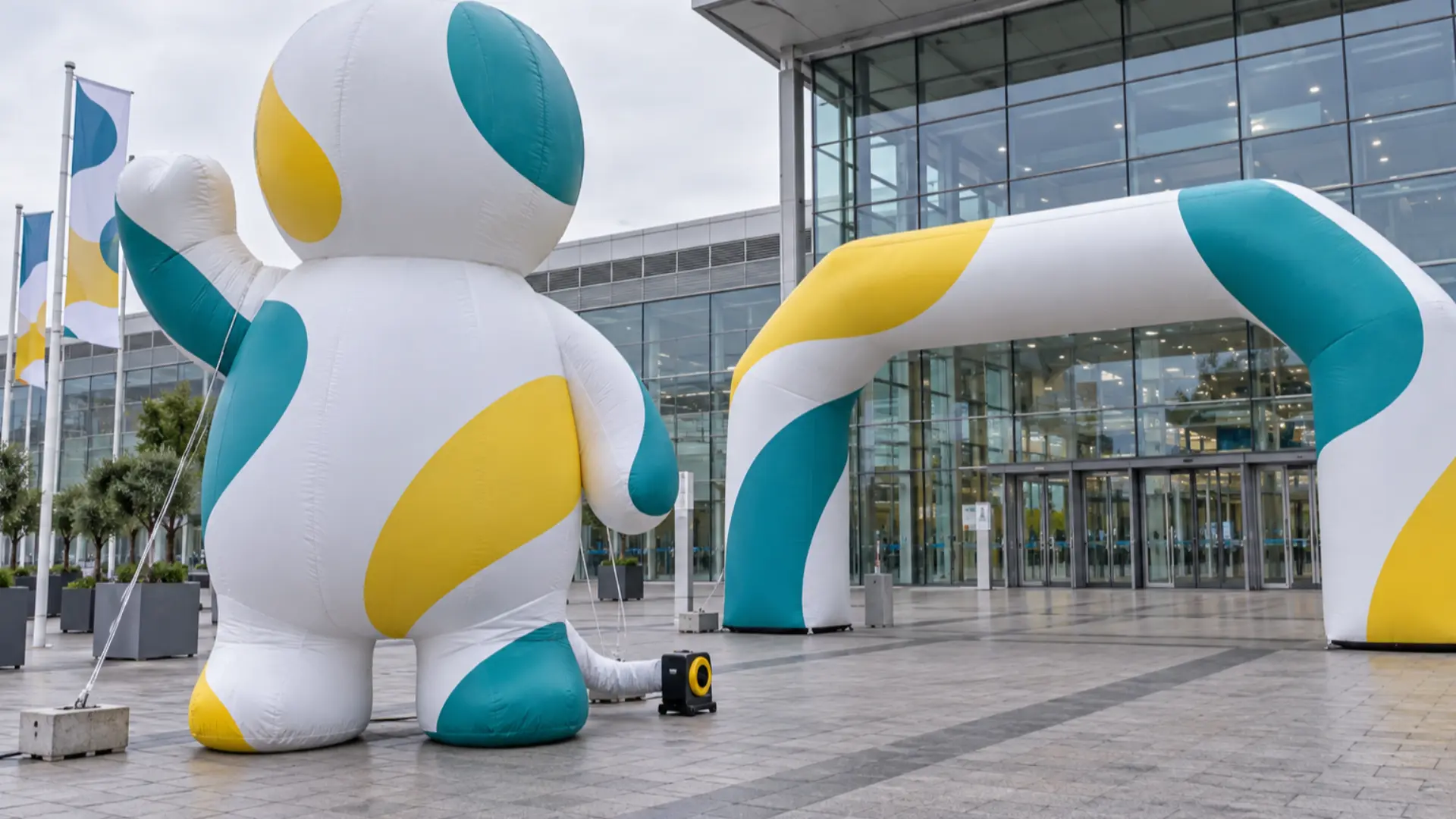
The German-speaking market's signature request is the Werbefigur — an oversized figure of a mascot, a product, or a brand character, typically between 3 m and 6 m, built to be inflated and deflated repeatedly across a season of trade fairs and store openings. The design brief is usually far more finished than an Italian one: German buyers tend to arrive with vector artwork, defined brand colours and a target installation date already agreed with the venue.
What they ask for that Italian buyers rarely do is documentation. Expect requests for the blower's CE declaration of conformity, a material datasheet, a stated maximum operating wind speed and a repair procedure. Our inflatable cartoon and character range is built to that documentation standard, and it is worth being explicit about it at enquiry stage rather than at delivery — retro-fitting paperwork onto a finished unit is where delays happen.
A category that sits between product groups and gets mis-specified often: the inflatable advertising tent. German and Austrian buyers use these for trade-fair stands, sponsor villages and product launch pavilions, where the structure itself carries the branding and the inside is working space.
Two decisions dominate. Air-sealed versus constant-air construction: an air-sealed tent holds pressure without a running blower, which makes it viable for indoor exhibition halls where noise and cable runs are a problem, but it is heavier and slower to erect. Constant-air is cheaper, faster and needs power on site. And roof loading for suspended branding — if the brief includes hanging a screen or a light rig inside, that has to be in the structural spec from the start. Our inflatable tent range covers both constructions and is the right place to start that comparison.
This comes up on almost every DACH enquiry and is worth clarifying early, because it is a frequent source of stalled orders. TÜV is a testing organisation, not a standard. There is no single "TÜV certificate" that makes an advertising inflatable compliant — and importantly, EN 14960, which is what most German buyers are actually thinking of, covers inflatable play equipment, not advertising inflatables. A decorative figure or a branded arch for adult visitors is not play equipment.
What genuinely applies is narrower and more concrete: a CE-marked blower conforming to the Low Voltage and EMC directives, a documented wind rating for the unit, and — where the public enters the structure or where a German event organiser carries the risk-assessment obligation under DGUV accident-prevention rules — a written risk assessment with a stated shutdown wind speed. Ask for those four items as documents. If a supplier's answer to "TÜV?" is a scanned logo rather than paperwork, that is worth noting.
For custom-shaped units specifically, our mascot and custom replica guide walks through the design-to-delivery timeline in detail.
Custom work dominates this category, so plan on 25–40 days in production rather than the two-to-three weeks a stock unit needs. Standard printed spheres and arches can be considerably faster. MOQ is typically one unit for large cold-air balloons and custom figures, rising where the unit is small and setup cost dominates.
On routing, Italian buyers are best served through Genoa, La Spezia or Trieste; German and Austrian buyers through Hamburg or Bremerhaven, with Koper a practical alternative for Austria and southern Germany. Ocean transit runs 28–38 days to the Mediterranean and 30–40 days to North Sea ports, with customs clearance on top.
One timing note specific to this market pair: the DACH trade-fair calendar clusters in spring and autumn, and Italian brand-activation campaigns cluster around the summer season. Both create order pile-ups at the factory in the two months before. If your installation date is fixed, place the order three months out and lock artwork before production starts, not during.
Do inflatable advertising products need TÜV certification for Germany?
There is no single TÜV certificate for advertising inflatables. What you need is a CE-marked blower with a declaration of conformity, a documented wind rating, a material datasheet and — for units the public enters, or where the organiser's risk assessment applies — a written risk assessment with a shutdown wind speed. EN 14960 applies to inflatable play equipment, not advertising inflatables.
Is a shaped custom balloon worth the extra cost for an Italian campaign?
For close-range activation in a piazza or at a store opening, usually yes — the shaped unit is the brand asset and it photographs better. For distance visibility from a road or from across a car park, a printed sphere or a blimp format delivers more readable area per euro and is faster to produce.
How long does an Italian or German campaign order take?
Plan on 25–40 days production for custom work, plus 28–38 days ocean transit to Genoa, La Spezia or Trieste, or 30–40 days to Hamburg or Bremerhaven, plus clearance. Three months from order to installation is a comfortable working assumption for a custom-printed unit.
Running an Italian or DACH campaign and need formats, documentation and timing mapped to your venue? Send us the site, the campaign window and the artwork status.