
In most Latin American markets the sourcing question arrives before the specification question. A rental operator in Monterrey or a distributor in Lima who has decided to add commercial inflatables usually starts from the same place: buy locally from a distributor who already holds stock, or import directly from a Chinese factory. Both routes are legitimate. The right answer depends on numbers that are easy to get wrong, and the most common mistake is comparing a factory unit price against a distributor's retail price as though those were the same kind of figure.
This guide lays out what each route actually costs and requires, so the comparison is made on landed cost rather than on the headline number on a quotation.
A distributor earns their margin by holding stock, carrying the import risk, and being reachable when something breaks. In practice that means their price is typically two to four times the factory unit price for comparable specification. For a single unit, or a first purchase when you have a date to hit, that premium can be worth paying — what you are buying is time and risk transfer, not just the unit.
The trade-offs are structural rather than incidental. A distributor carries the formats that sell in volume — standard bouncers, the popular castle sizes — and rarely the custom colours, branded panels or unusual dimensions. Lead time is measured in days rather than weeks. After-sales runs through a local company, in your language, on local payment terms.
The limits appear as you scale. Once you are buying a fleet rather than a unit, and once your requirements drift away from the catalogue, the distributor's advantage in time and risk stops compensating for the price gap.
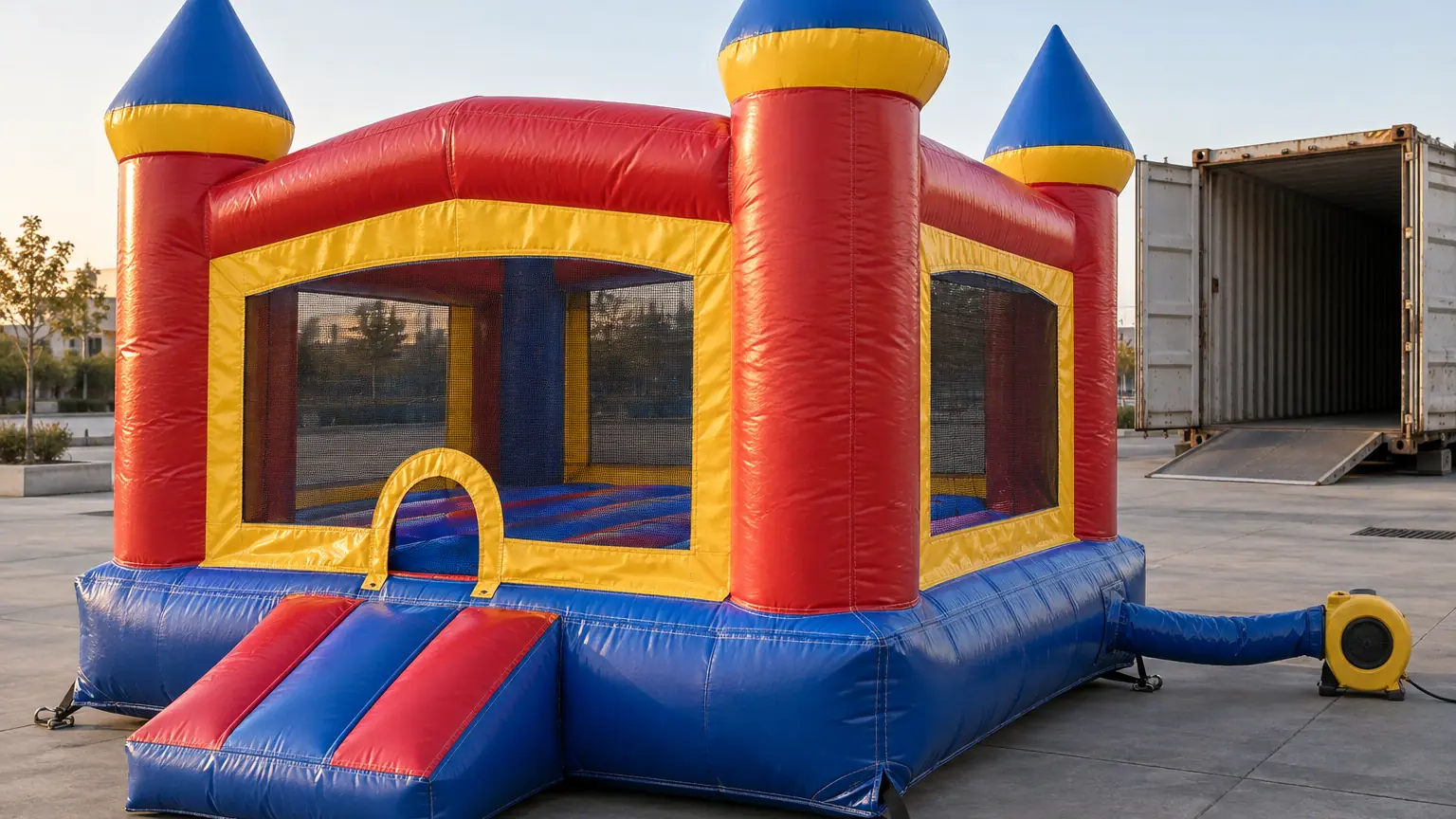
Importing directly moves four responsibilities onto you: production planning, freight, customs, and after-sales. Production for commercial units runs roughly 25–45 days depending on whether the unit is a stock item or custom-printed. Ocean transit to Latin American ports adds roughly 25–40 days from Chinese ports, shorter to the Pacific coast and longer to the Atlantic. Customs clearance sits on top, and its duration depends far more on your documentation than on the port.
The administrative side is where first-time importers lose time. You need a customs broker, a tax ID able to import, and a clear HS classification. Commercial inflatables usually land under 9503 or 9506 depending on how the unit is presented — as a toy, or as play and sports equipment — and that single choice can move your duty rate by several percentage points in either direction. Getting it wrong is expensive both ways. Our guide to import duties and landed cost breaks the components down.
The pattern we see across Latin American buyers is consistent enough to state plainly:
Local distributor wins when you need one or two units quickly, when you have no import experience or broker relationship, and when the unit is a standard format the distributor already stocks.
Direct import wins when you are buying a fleet rather than a unit, when you need custom branding or non-standard dimensions, when your target market is far from the distributor's catalogue, or when the local distributor is effectively a competitor and you would rather not fund them.
Both, in sequence, is the route most successful operators actually take: buy locally to start trading and learn the market, then move to direct import once volumes justify the fixed costs of setting up a clearance path.
Format matters here more than most buyers expect. A large castle or a multi-element funland consumes container space in a way a compact bouncer does not, which changes the freight per unit sharply. If you are still choosing formats, the commercial inflatable bouncers and inflatable castles ranges show the size spread you should be pricing against, and the combo units are worth costing too, since they often carry more sellable play area per cubic metre of container.
The factory unit price is the least useful number in the comparison. Landed cost is the sum of the FOB unit price, ocean freight, marine insurance, import duty, value-added tax or IVA, customs broker fees, port and terminal charges, and inland transport to your warehouse. On a mid-size order the non-unit components add a substantial share on top of FOB — and they are exactly the part a distributor has already absorbed into their price.
The practical consequence is that direct import wins on volume and loses on small orders. A single unit shipped LCL frequently lands close to, or above, the local distributor price once every fee is counted. A full container changes the arithmetic completely: freight per unit falls sharply and the factory price advantage survives intact. The break-even question is really a container-utilisation question, which is why asking for packed dimensions and weight per unit before you commit is the single highest-value thing you can do at quotation stage.
Certification is the most common reason an imported container sits at port. EN 14960 is the European play-equipment standard and is not automatically recognised across Latin America; several countries apply their own regimes, and the requirement can differ by market and by whether the unit is sold for public commercial use or private use. Confirm with your broker, and where applicable your national standards body, what will be requested at entry before you place the order rather than after.
Ask the factory for the documents that support both the classification and the safety file: a material datasheet stating PVC grade and thickness, the blower's conformity documents, a packing list with dimensions and weights per unit, and a certificate of origin. Our Latin America sourcing guide covers categories, certification and container logistics for the region in more detail.
Start with one unit bought locally to begin trading, and plan the first direct import as a container rather than as a single shipment. Many first-time buyers either ship LCL or share a container with another operator in the same city to rehearse the process — broker, clearance, inland transport — before committing to a full load of their own.
Confirm three things before you sign: MOQ, packed volume per unit, and whether blowers, anchors and repair kits ship inside the same load or separately. Those details determine your true landed cost far more than the headline unit price. Specify spare parts in the first order as well — a repair kit and a spare blower cost very little at the factory and a great deal once you are waiting on an international parcel mid-season.
Importing a first fleet into a Latin American market and unsure which route fits your volume? Send us your target fleet size, your market and your timeline, and we will price it both ways so the comparison is made on landed cost rather than on a unit price.
Is buying direct from a Chinese factory actually cheaper than a local distributor?
Per unit, usually yes — but the gap narrows once freight, duty, IVA, broker fees and inland transport are counted. On a single LCL shipment the landed cost often comes close to the distributor price. On a full container the factory advantage holds clearly, which is why the break-even is a volume question rather than a price question.
What documentation do I need to import inflatables into Latin America?
At minimum a commercial invoice, packing list, bill of lading and certificate of origin, plus whatever safety or conformity documentation your country requests on entry. Ask the factory for a material datasheet with PVC grade and thickness, the blower's conformity documents, and packed dimensions and weights per unit. Confirm the HS classification with your broker before shipment, not after arrival.
Can I start importing with a small order?
Yes. MOQ is typically one unit for large commercial pieces, so a small first order is possible. The constraint is freight economics rather than minimum order quantity: LCL carries a high cost per cubic metre, so a single unit can land at a price close to local retail. Shipping LCL, or sharing a container with another operator, is the usual way to test the process without over-committing.