
The Latin America inflatable market is one of the fastest-growing and most fragmented opportunities for importers today. Birthday-party rental fleets, hotel and resort entertainment, water parks, and event-rental chains are all expanding across Mexico, Brazil, Colombia, Argentina and beyond. But the region is not one market — it is twenty-plus economies with different ports, voltages, languages and clearance rules. Successful importing here depends on three things: choosing the right product categories, mapping a defensible certification path, and controlling ocean freight and customs clearance. This guide walks distributors and importers through each.
Demand across the region concentrates in a few proven categories. Knowing which units rotate fastest in your local market protects cash flow and keeps a rental fleet earning.
The backbone of almost every rental operation. The classic castillos inflables — bounce castles, often with an attached slide as a "combo" — are the highest-utilization units in birthday-party and municipal-event rentals. They are compact to ship, fast to set up, and forgiving on labor. For a wholesale buyer building a starter fleet, a mix of standard castles and combo units is the safest first order. See the full range on the inflatable castles category to compare sizes and configurations.
In tropical and coastal markets — Brazil's northeast, the Mexican Caribbean, Central America — water units run nearly year-round. A single large tobogán commands a higher rental rate than a dry bouncer and differentiates a fleet. Plan for the extra logistics: water slides are bulkier and need a reliable water supply and drainage at the venue. Review build options on the commercial water slides category.
Smaller bouncers fill out a fleet cheaply and are ideal for distributors reselling to home-party operators or first-time renters. They load efficiently and carry strong ROI per cubic meter shipped. The inflatable bouncers category covers the volume-friendly options.
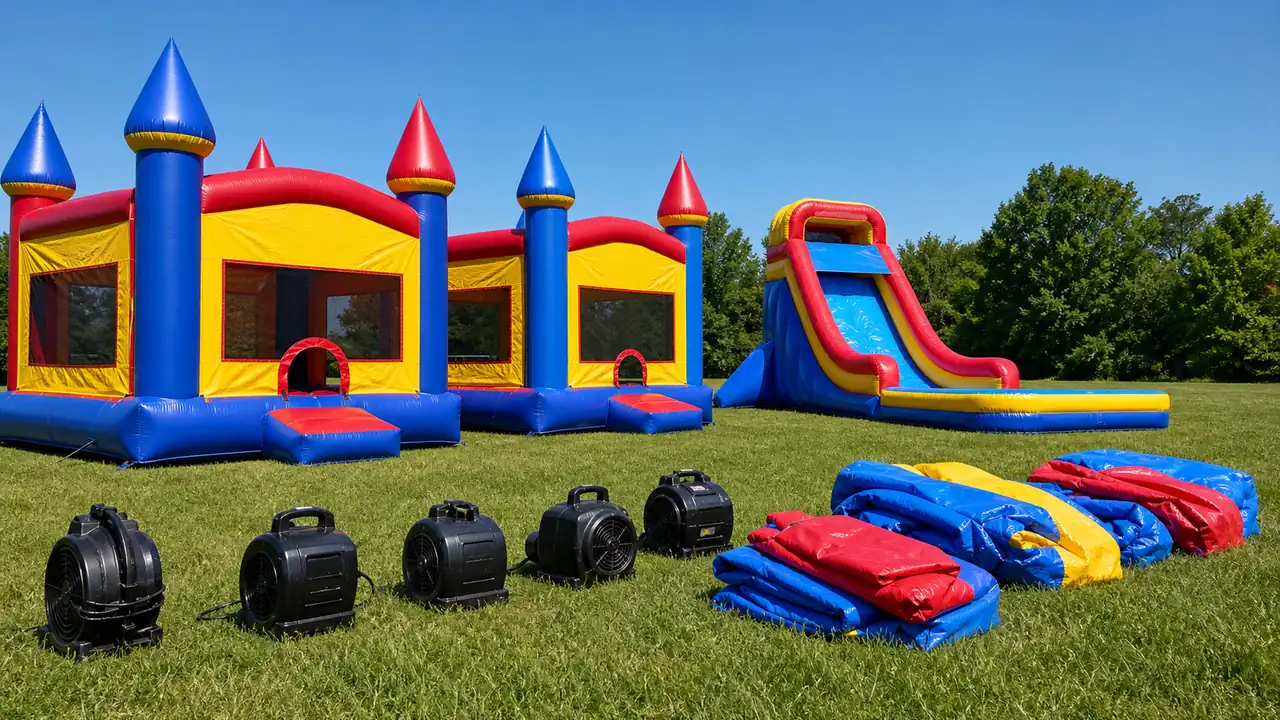
This is the single most common mistake first-time importers make. Latin America is split on mains voltage, and the blower — not the inflatable itself — is the part that has to match.
Always specify the blower voltage and frequency on your purchase order. A 220V unit plugged into a 110V outlet simply will not inflate the unit fully; a 110V blower on a 220V line will burn out. Order spare blowers in the correct voltage as part of every container — they are the most failure-prone component and the hardest to source locally. The inflatable bodies are voltage-agnostic; only the electrical hardware needs matching.
Unlike Europe with EN 14960 or the US with ASTM, Latin America has no unified, region-wide inflatable safety standard that all buyers can point to. Requirements vary by country and often by municipality, and many markets default to international references in practice.
Do not invent or accept claims of a "Latin American certification" — none exists region-wide. Treat EN 14960 / ASTM compliance as your quality floor and verify it in the order contract.
Inflatables ship by sea in the vast majority of B2B orders. The major gateways include Manzanillo and Veracruz (Mexico), Santos (Brazil), Buenaventura and Cartagena (Colombia), Callao (Peru), San Antonio and Valparaíso (Chile), and Buenos Aires (Argentina).
Key clearance points to plan for:
For a deeper walkthrough of the end-to-end sourcing process, see our complete factory-direct sourcing guide for international importers.
A common worry for first-time Latin America inflatable importers is hitting a supplier's MOQ without overstocking one product. The practical answer is mixed-container loading: rather than a full container of one model, combine castles, a couple of water slides, entry-level bouncers and spare blowers into a single shipment.
This spreads your fleet risk across categories, lets you test which units rent best locally, and still fills the container to maximize freight value. Inflatables compress well, so cube-out (running out of space) usually happens before weight-out — meaning you can pack a lot of rental capacity into one box. To run the numbers on how much fits, see our container loading guide comparing 20ft and 40ft HQ capacity. As a rule of thumb, a 40ft HQ gives the best cost-per-unit for a serious starter fleet, while a 20ft works for a cautious first test order.
The difference between a one-time buyer and a repeat distributor is after-sales support. When you source from China for resale in Latin America, build the support layer into the deal:
Distributors who can promise their own customers fast parts and clear instructions defend their margins and earn repeat fleet orders.
Whether you are a Mexico bounce house importer, a Brazil inflatable supplier, or a regional distributor sourcing castillos inflables wholesale, the playbook is the same: pick proven categories, match blower voltage to your destination grid, source to EN 14960 / ASTM as your quality floor, control your Incoterms and customs paperwork, and load mixed containers to spread risk. Get those fundamentals right and importar inflables china becomes a repeatable, high-ROI channel rather than a one-off gamble.
Beyond regional logistics, if you are building a complete product mix, our juegos inflables sourcing guide covers the whole category range that Spanish-speaking market buyers stock.
Castles are the highest-demand category across Latin America; our castillos inflables sourcing guide goes deeper on importing them for Spanish-speaking markets.