
"Inflables para niños" is not one product. It is a family of formats that share a buyer — the operator, retailer or rental company serving families — but differ sharply in footprint, age suitability, blower requirement and price band. Treating them as interchangeable is the most common and most expensive mistake in this category.
For commercial purposes the range splits into five working groups:
Bouncers and castles. The entry format. Single-chamber, wall-and-net construction, from roughly 3 × 3 m up to 6 × 6 m for commercial units. The inflatable bouncer range covers the smaller footprint end; the larger inflatable castles carry themed print, taller walls and higher throughput.
Combos. Bouncer plus slide in a single unit — roughly 30–40% more footprint than the equivalent bouncer, and the format that most often justifies being carried on its own trailer.
Slides. Dry and wet variants. Inflatable slides are the highest-throughput single unit in a children's fleet, and also the most sensitive to slope, anchor surface and wind exposure.
Funlands and multi-zone units. Several play zones in one footprint, specified far more often for fixed indoor sites than for rental fleets, because setup time scales with the number of chambers.
Soft play and toddler units. Low-wall, no-net formats for the 1–3 group, built low-pressure or foam-core rather than by scaling down an adult castle.
If you need the wider catalogue view before narrowing to the children's segment, our general inflatables product guide covers every category side by side.
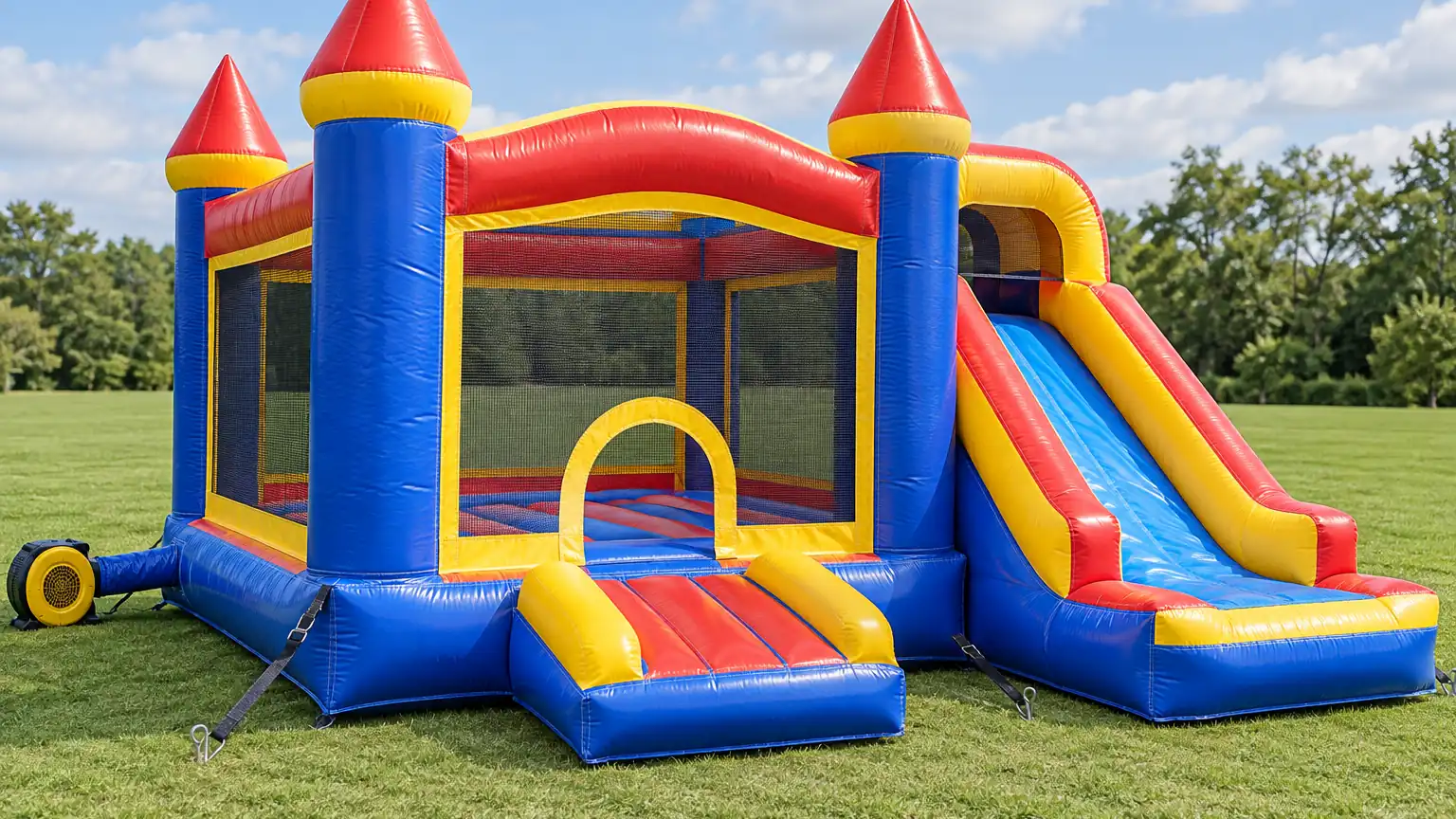
A 5 × 5 m castle rated for ages 4–12 is not a bigger version of a toddler unit. Wall height, entry step, netting mesh and internal fall height are engineered per band, and mixing bands inside one unit is what drives most incident reports — and most insurance disputes.
1–3 years. Wall height under 0.6 m, no enclosed netting, low-pressure or foam-core construction. Capacity is typically 4–6 children and the supervision ratio sits near 1:1. This is why these units are bought by indoor play centres rather than rental fleets — the supervision cost erases the rental margin.
4–7 years. The volume band. Standard commercial castles and small combos, wall height 0.8–1.0 m, capacity 6–10 children. This is where most rental fleets actually make their money.
8–12 years. Larger castles, obstacle courses and slides. Wall height 1.0–1.2 m, a higher anchor count, and a genuine requirement for impact-absorbing matting at slide runouts.
13+ and adults. A separate product class with its own load ratings. "Commercial" on a listing does not mean a teenage or adult user group.
Operators building a fixed children's zone rather than a rental fleet should map age bands to throughput before ordering; the maths is set out in our guide to sizing inflatable equipment for a kids' FEC.
These are the line items that separate a genuine commercial children's build from a scaled-down adult unit. Ask for each one explicitly in writing.
Netting mesh size. Tighter mesh prevents finger and footwear entrapment. Specify the mesh dimension rather than assuming it.
Anchor points. Units above 4 × 4 m should carry a minimum of 6–8 anchor points, with hardware rated well above the unit's operating load. Sandbag-only anchoring is not acceptable for outdoor commercial use, and in many markets it is not insurable either.
PVC grade and phthalate content. Children's inflatables sit under a stricter chemical regime than general commercial units. The EU REACH restriction on phthalates and the US CPSIA phthalate rule both apply to children's products specifically — a standard commercial unit is not automatically compliant, and a certificate for the adult version does not cover the children's version.
Blower guarding and tube routing. The blower intake must be guarded against small fingers, and the inflation tube routed so it cannot be tripped over at the entry step.
Fall height and matting. Elevated platforms and slide runouts need impact matting specified alongside the unit. Buying it after delivery almost always means buying the wrong thickness.
Format follows venue more than venue follows format, and the constraint is almost always supervision rather than floor area.
Party rental fleet. Castles and combos in the 4–7 band, one trailer, three or four units. Prioritise units that two people can set up in under 15 minutes; every extra chamber adds setup time that eats into a same-day double booking.
Indoor play centre. Funlands and toddler soft play, run continuously rather than per-session. Continuous duty changes the blower specification — a blower sized for a two-hour party will not survive eight hours a day, six days a week.
Mall or retail play zone. Smaller footprints, themed print, and a hard emphasis on sightlines: the parent must be able to see the child from outside the unit.
Event and festival hire. Slides and obstacle courses, chosen for throughput per square metre rather than per unit price, with matting budgeted from the start.
Ordering by price per unit instead of by age band. The cheapest castle in a quote is usually the one that cannot legally serve the age group you actually sell to.
Under-specifying anchors. Anchor count is the first thing cut in a cheap build and the first thing an inspector checks.
Assuming the blower is included and adequate. Confirm the blower is supplied, that it is rated for continuous duty if the venue needs it, and that it matches the destination market's voltage — 110V and 220V markets cannot share one stock keeping unit.
Ignoring setup and storage footprint. A packed unit is roughly 30–40% of its inflated footprint, but only if it is folded properly. Size the storage and vehicle before committing to the unit.
Skipping the spare parts list. Blowers, anchor stakes, repair patches and netting panels are the parts that fail. Confirm they are orderable separately, in the destination market's voltage and mesh specification.
What is the best-selling inflatable for children?
The 4–7 age band castle remains the highest-volume commercial format, followed by bouncer-and-slide combos. Sales volume, however, is not the right selection criterion — the correct unit is the one whose age rating matches the customers you actually serve.
Can one inflatable serve all ages?
No. Age band determines wall height, netting mesh and internal fall height. A unit rated for 4–12 is not suitable for toddlers, and a toddler unit will not survive teenage use. Mixing bands inside one unit is the leading cause of injury and of insurance claims being declined.
Are children's inflatables subject to different certification than commercial ones?
Yes, and this is frequently missed. EN 14960 covers inflatable play equipment, but children's products additionally fall under chemical restrictions such as the EU REACH phthalate limits and the US CPSIA phthalate rule. A compliance certificate issued for a general commercial unit does not automatically transfer to a children's unit.