"General inflatables" is not one product — it's a whole category of commercial equipment covering bouncers, water slides, sports games, advertising blimps, and event tents. When buyers search for general inflatables for sale, they're usually at the start of a sourcing decision: which products fit their business, what a realistic wholesale price looks like, and how to actually place a factory-direct order. This guide answers all three.
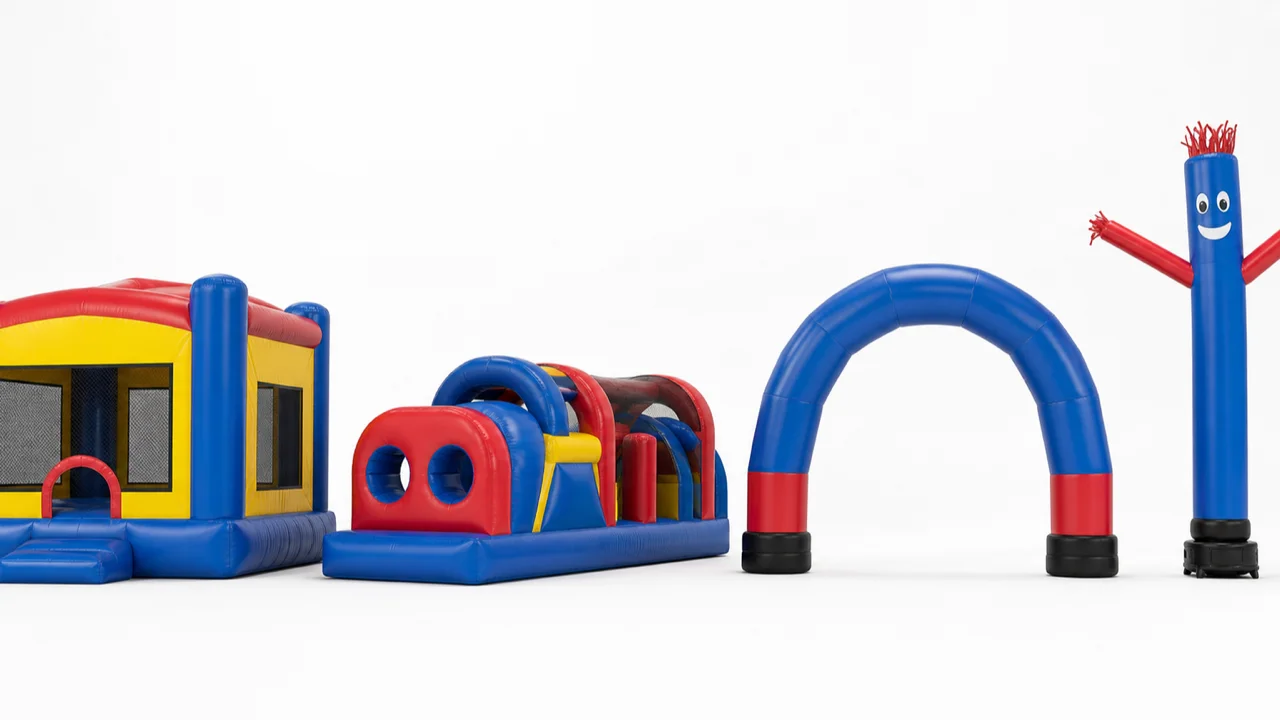
The term spans every constant-air and airtight product a commercial buyer might stock. In practice, it breaks into five working families:
For a category-by-category read on what's actually booking and selling in 2026 — water slides, obstacle courses, castles, combos, and promotional inflatables, broken out by region — see our 2026 trending products guide.
Match the product to your revenue model before you compare prices. A rental operator, a resort, and a marketing agency buy very different units.
| Product family | Typical use | Common size range | Typical MOQ |
|---|---|---|---|
| Bouncers & castles | Kids' parties, school events, rentals | 4×4 m to 6×6 m | 1–5 units |
| Water slides | Summer rentals, resorts | 6–10 m long | 1–3 units |
| Obstacle courses | Corporate, festivals | 15–35 m long | 1–2 units |
| Air dancers & arches | Retail, dealership promo | 3–8 m tall | 5–20 units |
| Aqua-park modules | Lakes, resorts | Modular, custom | Project-based |
As a quick decision rule: if your buyer base is mostly birthday and school-event bookings, prioritize bouncers and castles for the lowest MOQ and fastest cash-cycle turnaround. If you're serving summer rental demand or a fixed resort installation, water slides justify the higher per-unit cost through longer session times and premium pricing. Obstacle courses and aqua-park modules make sense once you have consistent access to corporate or municipal-scale bookings that can absorb their larger footprint and lead time — they're a poor first purchase for a new operator still building a client base.
There is no flat price list for general inflatables, because cost is built from the spec sheet up. The main levers:
Rather than chase a headline price, evaluate cost per season of use. A cheaper single-stitched unit that fails in year two costs more than a welded 1100D unit with a longer payback. For the numbers that actually matter on a quote, our factory-direct sourcing guide walks through reading a real spec sheet.
Wholesale pricing on general inflatables steps down at real volume thresholds rather than moving smoothly with quantity — useful to know before requesting quotes at an odd unit count that lands between tiers:
| Order Volume | Typical Shipping Mode | Relative Unit Price | Best For |
|---|---|---|---|
| 1-5 units | Parcel / LCL | Highest per-unit cost | Testing a new supplier or product line |
| 6-20 units | LCL / partial container | Moderate | Small fleet operators, first bulk order |
| Full 20ft container | FCL | Lower, meaningful step-down | Established operators reordering a proven mix |
| Full 40ft HQ container | FCL | Lowest per-unit | Distributors and multi-location fleets |
Request a quote at your target volume rather than a round number that happens to land mid-tier — moving a small order up to the next tier threshold often costs less per unit than it saves in freight efficiency.
Wholesale pricing improves when you fill a container rather than air-freight singles. Most factories set low per-SKU minimums — often a single unit for large items and 5–20 for small promotional pieces — but the real economy comes from container consolidation.
If you're combining several product types into one order, check realistic minimums first in our MOQ reality check by category before you finalize the packing list.
Much of what shows up under "inflatables for sale" online is residential-grade: thin material, sewn seams, and blowers sized for a backyard afternoon. Commercial units are a different class of product. They run on heavier 1000D+ PVC, use welded seams and reinforced anchor points, tolerate all-day operation, and carry the certifications that let you legally rent or operate them. Paying residential prices for commercial duty is the most common first-order mistake — the unit fails early and the "saving" evaporates. If a quote looks unusually cheap for the size, confirm the fabric weight, seam type, and blower rating before anything else.
The certification you need is set by where you sell, not where you buy:
Specify the target standard on your purchase order — retrofitting compliance after production is slow and expensive.
A clean first order follows a simple path: shortlist your product mix, request spec sheets and reference photos, confirm material grade and certification, agree Incoterms (FOB or CIF), place a deposit, approve artwork proofs, then inspect before shipment. Bundle your categories into one container to protect margin, and lock the target certification in writing.
General inflatables reward buyers who treat the purchase as a fleet decision rather than a single SKU. Start from your use case, build the spec, then let the price and container plan follow.
---Contact us for a factory-direct quote
Related guide: Inflatables from China: Manufacturing Standards, Testing & Export Certification — which welding method belongs on which seam, PVC batch testing, factory QC checkpoints, and the certification route per market.