
Most commercial inflatables sold anywhere in the world are built in China. That fact tells an importer nothing useful, because the quality spread between two factories in the same industrial park is wider than the spread between countries. What separates them is measurable: the welding method used on seams, whether incoming PVC is tested by batch, and how many QC checkpoints exist between the cutting table and the shipping carton.
Those three things are auditable before you place an order. Certification is a separate question, and it works backwards from your destination market rather than forwards from the factory.
Production is specialised by category, and few factories are genuinely strong across all of them. Knowing which cluster your supplier sits in tells you where their tooling and experience really are:
A supplier quoting aggressively across every one of these categories is usually trading, not manufacturing. That is not automatically disqualifying — a good trading company manages QC well — but you should know which one you are buying from, because it changes who is accountable when a seam fails.
This is the single most useful technical distinction in the industry, and it is easy to check on a sample.
High-frequency (HF) welding fuses PVC-coated fabric with radio-frequency energy under pressure. It produces a homogeneous, fully airtight joint with no needle penetration. It is the required method for airtight and drop-stitch products, which must hold pressure for hours without a blower. Failure mode: under-welded joints from wrong power or dwell settings, which look perfect and peel later — which is why peel testing on production samples matters.
Hot-air welding uses heated air and a pressure roller. Slower per metre than HF but handles long continuous seams and thicker material well. Common on large water park panels and heavy structures. Failure mode: inconsistent temperature along a long seam, giving a strong joint that has one weak metre in the middle.
Stitching with reinforcement — double or quadruple stitching, usually with glued or welded seam tape over the stitch line. Standard on constant-air dry play products, where a blower continuously replaces air and absolute airtightness is not required. Done well with quality thread and proper taping it lasts for years of rental use. Failure mode: needle holes enlarging under repeated stress, thread UV degradation, and tape lifting at high-abrasion points.
A useful acceptance question: which method is used on which seam of my product, and why? A factory that answers precisely is a factory that controls its process.
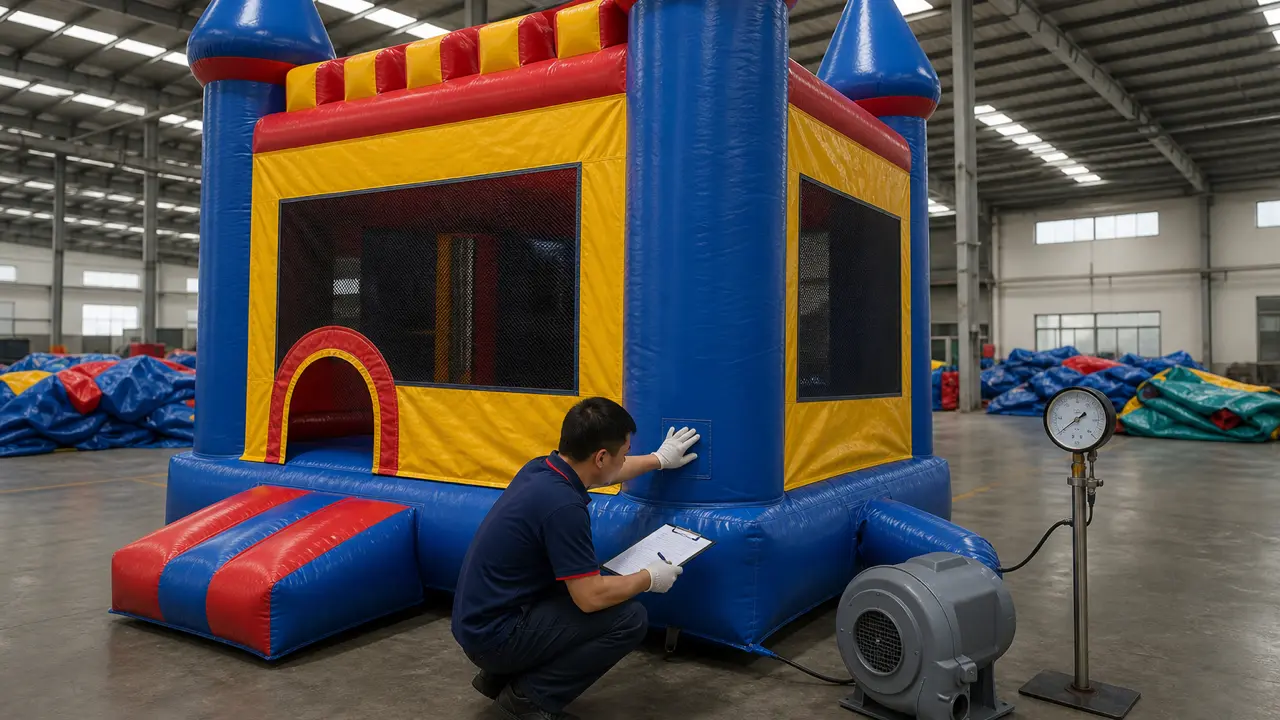
PVC tarpaulin is specified by base fabric denier and total coated weight — 1000D and 1100D base cloth at coating weights typically running from around 550 g/m² for lighter play products up to 900 g/m² and above for water park and structural use. The number on the quotation is a claim, not a measurement.
What a properly run factory can show you:
Colour matching deserves its own line in the contract. Specify Pantone references, state whether matching is contractual or best-effort, and agree tolerance in writing before production. Our guide to PVC tarpaulin grades for commercial inflatables covers how to read these specifications.
Ask which of these exist as recorded steps rather than as verbal assurances:
Put the pressure-hold duration and acceptance criterion in the purchase order as numbers. "Tested" is not a specification.
Not every supplier quoting you is the same kind of business, and the type determines how much technical control and pricing leverage you actually have:
| Factory Type | What They Do | Best For | Watch For |
|---|---|---|---|
| OEM manufacturer | Produces to your spec and branding on their own production line | Buyers who know their spec and want direct technical control | Usually carries a minimum order quantity tied to their production run size |
| ODM manufacturer | Offers an existing design you customize (color, print, minor dimensions) | Faster time-to-market, lower design risk for first-time buyers | Less flexibility on core construction changes |
| Contract/OEM-for-others | Produces for multiple brands off shared tooling and patterns | Competitive pricing on common product types | Confirm your order gets dedicated QC attention, not just shared-line output |
| Trading company | Sources from one or more factories, adds a margin, handles logistics | Buyers who want a single English-speaking point of contact and consolidated shipping | You lose direct visibility into which factory actually built your order |
Ask directly which category a quoting supplier falls into — a trading company that presents itself as "our factory" is a common source of confusion later when a quality issue needs tracing back to the actual production line. Beyond product-specific certification (covered below), also ask whether the factory holds a general ISO 9001 quality management certification and whether they've undergone a TÜV or equivalent third-party factory audit — these speak to process consistency across orders, which is a different signal from a single product's test report.
No single certificate makes a product globally saleable. Determine what your destination requires, then require it of the factory:
Two rules that save real money. First, a test report covers a tested configuration — a report for one model does not certify a modified version or a different size in the same family. Second, ask for the report itself rather than a logo on a brochure, and check the issuing laboratory, the date and the scope. The EU route, including CE marking and customs documentation, is covered in more depth in our guide to importing inflatables into the EU.
Production lead time for standard catalogue products typically runs several weeks; custom-printed and large water park orders run longer, and Q1 is the constrained window because the whole northern-hemisphere rental and resort trade orders for the same season. If your season opens in May, a February purchase order is already tight.
Inflatables are volume cargo, not weight cargo, so the container is the unit of economics. Consolidating multiple SKUs — dry play, water, promotional — into a single 40 ft HQ shipment is almost always cheaper per unit than staged part-loads, and it gives you one customs entry instead of several. Quote both FOB and CIF and compare the landed figure rather than the goods figure.
On risk control: order a paid sample before a first production run, tie payment milestones to inspection outcomes rather than to dates alone, and confirm spare-parts availability and warranty terms in writing before the deposit. Our 12-point manufacturer vetting checklist covers the audit process step by step.
Quality varies by factory, not by country. The measurable indicators are welding method appropriate to the product type, batch-level PVC testing with mill certificates, and recorded QC checkpoints including a documented pressure-hold test. Factories that can produce all three on request are the ones worth shortlisting.
It depends on the destination: EN 14960 plus CE marking for relevant components in the EU, ASTM references for the US, Japanese product safety and electrical documentation for Japan, and country-specific conformity schemes in the Gulf. Ask for the actual test report and check that its tested configuration matches what you ordered.
Plan for production in weeks rather than days — longer for custom printing or large water park systems — plus ocean transit to your port. Order in Q4 or early Q1 for a northern-hemisphere summer season, since factory capacity is the binding constraint at that time of year.