
This isn't a guide to FEC venue types or product mix — our Family Entertainment Centers guide for Latin America already covers venue formats and product categories for Spanish-speaking markets. This one is the buyer-decision framework that guide doesn't cover: how to size equipment to age groups, which safety certification actually applies depending on your country, and how to build a realistic ROI model before committing to an order.
A single mixed-age play zone undersells both ends of your visitor base — toddlers get lost in equipment sized for school-age kids, and school-age kids find toddler-scale equipment boring within one visit. A workable FEC equipment split is a dedicated toddler zone (soft play, low-height combo units, capacity for supervised free play), a school-age zone (obstacle courses, larger slides, higher-capacity bounce units), and optionally a shared zone for family/group activities that works across ages. Sizing each zone's square footage and unit capacity to your actual visitor age distribution — not a generic industry rule of thumb — is the single biggest factor in whether repeat visits happen. Our broader FEC buyer's guide and safety compliance overview covers the general product categories behind each age zone in more depth, if you need that layer too.
Spanish-speaking markets aren't a single regulatory zone. Spain and other EU Spanish-speaking territories fall under CE marking and EN 14960 — see our EU import compliance guide for the specifics. Mexico and parts of Central America, by contrast, often follow import and safety documentation practices closer to US conventions given trade proximity, covered in our USA import guide for buyers who need the equivalent reference point. South American countries vary further still. Confirm your specific country's requirement before ordering rather than assuming Spanish-language documentation alone satisfies the actual regulatory standard.
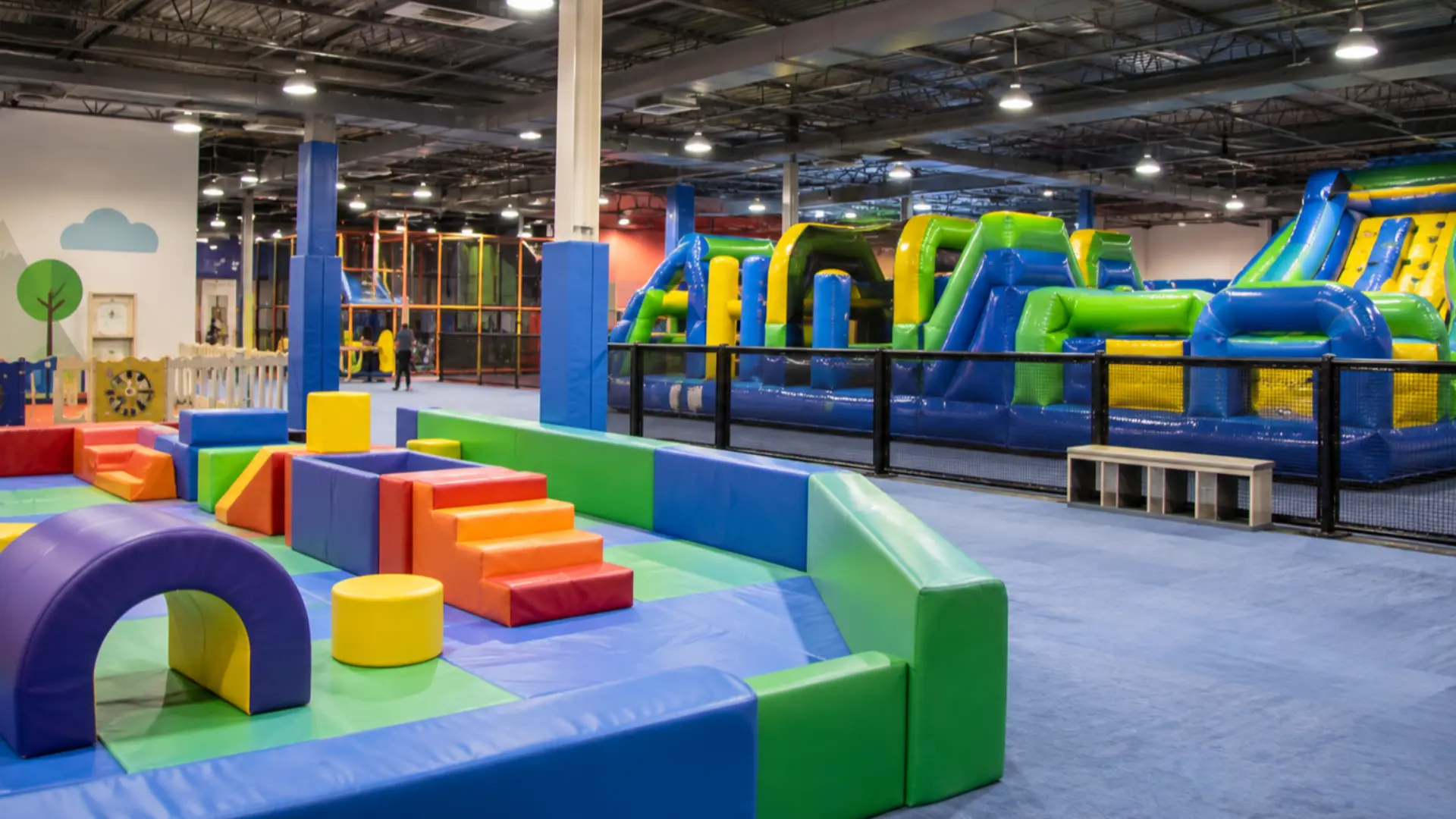
Estimate ROI from three inputs: expected daily visitor throughput per zone (bounded by both equipment capacity and physical floor space, not just capacity alone), average session length, and average per-visit spend including any add-ons like party packages or food and beverage. A zone that looks impressive but creates bottlenecks during peak hours caps your actual throughput below the equipment's rated capacity, which is the most common reason FEC ROI projections come in lower than planned. Payback periods for a mid-size indoor FEC installation typically run 12-24 months depending on local admission pricing and visitor density, and equipment durability matters directly here — a unit that needs early replacement resets your payback clock.
Staffing needs scale with age-zone complexity more than with raw square footage — a toddler zone needs closer supervision ratios than a school-age obstacle course zone where kids self-manage more independently. Build staffing cost into your ROI model from the start rather than treating it as a variable cost to figure out after opening, since understaffing an FEC creates both safety liability and a worse visitor experience that directly undercuts repeat-visit revenue.
Equipment footprint alone isn't the space you need — queuing area at each unit's entrance, circulation paths between zones, and parent/guardian seating and sightlines all take space away from what looks available on a floor plan. FEC operators who size purely to equipment dimensions consistently end up with a cramped, bottlenecked floor that undersells the equipment's actual capacity, regardless of how well the equipment itself was chosen.
Order timing matters as much as equipment selection for Spanish-speaking markets that see sharp seasonal visitor swings — Mexico's summer break (July-August) and Southern Cone countries' December-February peak (Southern Hemisphere summer) don't align with each other or with the Northern Hemisphere calendar most factory production schedules assume by default. Confirm lead time against your specific region's peak season, not a generic "summer" assumption, and factor currency exchange timing into your budget if your local currency has had recent volatility against the US dollar, since factory quotes are typically denominated in USD regardless of your local sales currency.
Should a small FEC start with a mixed-age zone or separate zones from day one?
If budget only supports one zone initially, a mixed-age combo with clearly marked age-appropriate sections is more practical than a single zone with no age differentiation, but separating zones as soon as visitor volume justifies it consistently improves both safety outcomes and repeat-visit rates.
Does equipment sourced for the EU market work in Latin American countries without modification?
Physically, often yes, but the compliance documentation and certification marking won't automatically satisfy a different country's import or safety review requirements — confirm certification needs per destination country before assuming EU-certified equipment transfers directly.
How much of the FEC budget should go to equipment versus space buildout?
There's no fixed ratio, but operators who underinvest in circulation space and overinvest in equipment density consistently see lower throughput and worse safety outcomes than the equipment budget alone would suggest — treat floor plan and equipment selection as one combined decision, not two separate budget lines.
Share your target visitor age mix and country with our team, and we'll help size a product list to your specific space and compliance requirements.