
A repeat order can look identical on a quotation while differing in material, construction, artwork or included hardware. Before deciding whether repeat inflatable orders need a new sample, establish what was approved last time and what will change this time. The useful question is not simply “Do we trust this factory?” It is “What evidence supports approval of this configuration?”
This checklist is for buyers working with an existing supplier and a previously approved model. It helps you choose a reapproval route. It does not replace supplier verification, product testing or production inspection. For the separate task of evaluating a physical sample, see our inflatable sample evaluation guide; apply appropriate model-specific procedures rather than assuming every test fits every type of inflatable.
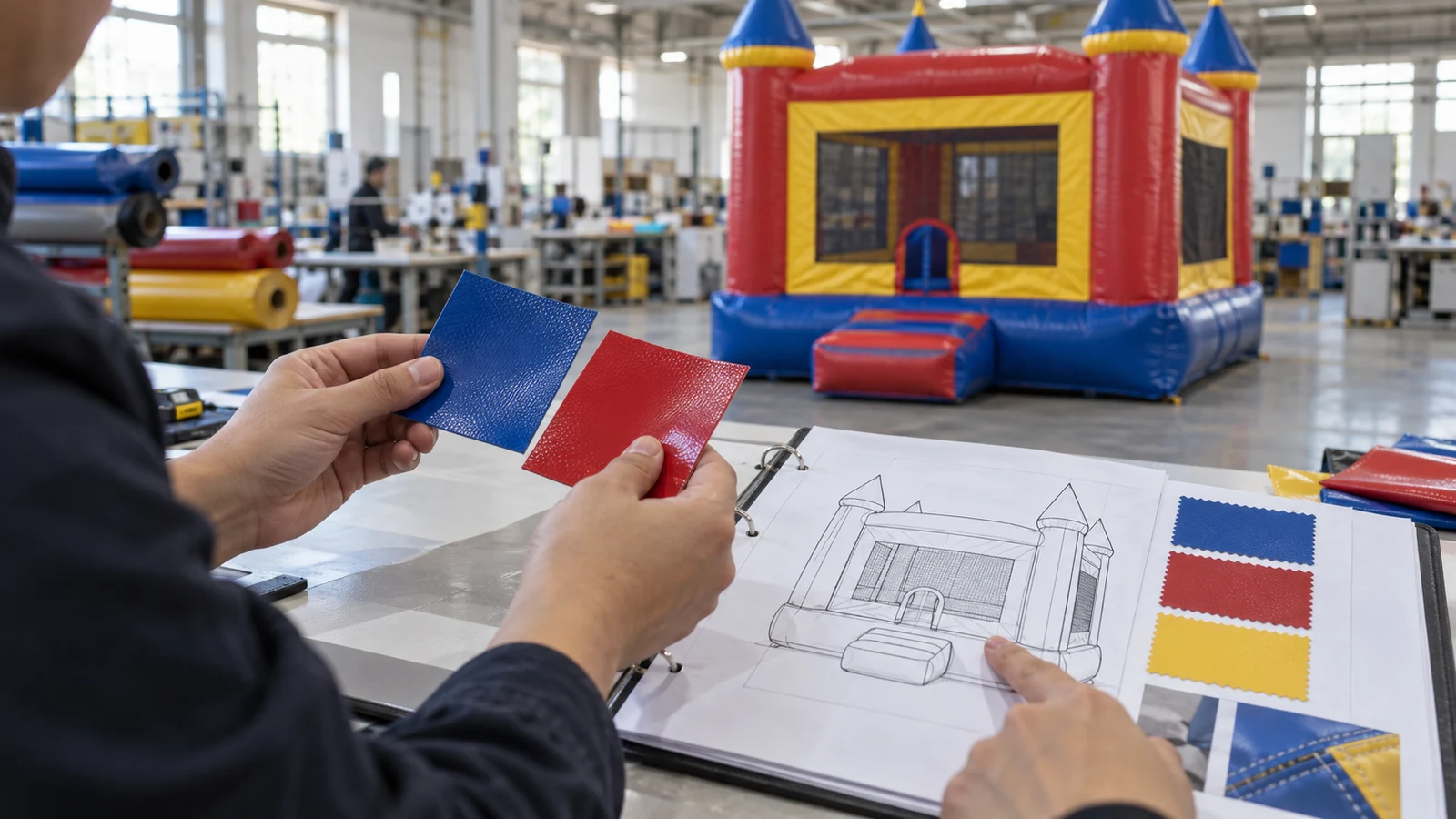
Collect the previous purchase specification, approved drawing revision, material references, artwork files and included-equipment list. Add the approval date, responsible person and records of any changes accepted during production. Where you retained a reference sample, identify it clearly and record whether storage or use has altered its condition.
Separate the supplier's model code from your approved configuration. Two orders can share a model name while specifying different dimensions, blowers or print layouts. For repeat purchases of commercial inflatable castles, for example, compare the actual dimensions and configuration on the documents, not just the themed product name.
If the previous specification is incomplete, mark the missing information as an approval question. A photograph of the finished unit cannot confirm every material or internal construction detail. Reconstruct the baseline with the supplier before treating the new order as unchanged.
Send the reference documents to the factory and ask it to identify differences in the proposed order. Include buyer-requested changes and supplier substitutions. Ask whether the material source, material specification, construction details, printing method, hardware or production location have changed. Request confirmation of no change for relevant items that remain the same.
Use a table with four columns: approved reference, proposed configuration, reason for change and evidence needed. “Same as last order” is a conclusion that needs a defined reference. It should not replace the comparison.
| Proposed change | Question to resolve | Possible evidence route |
|---|---|---|
| No declared change to a documented model | Does the production order still match the approved baseline? | Written revision comparison, configuration confirmation and agreed production inspection |
| Logo placement or print layout | Is the revised artwork correctly represented? | Annotated proof; physical print sample where the finish or colour needs confirmation |
| Fabric or coating substitution | Does the replacement meet the required specification and application? | Traceable material information and appropriate review; escalate to a representative build where necessary |
| Dimensions, structural layout or attachments | How does the revised design perform as a complete unit? | Revised technical documents and a representative full-unit evaluation before release |
| Blower, valve or other operating hardware | Is the proposed component suitable for the exact model and market? | Component identification and compatibility evidence; assembled evaluation where needed |
| Several linked changes or an unclear baseline | Can the combined configuration be approved confidently? | Re-establish the specification and agree a full sample or controlled pilot route |
These are starting points for the approval discussion, not a universal technical sign-off rule. The supplier's engineering review and applicable requirements determine what evidence is sufficient. A small sample may resolve one visible detail while leaving the complete unit's performance unconfirmed.
Document confirmation compares defined specifications and revisions. It can resolve whether the order instructions match the previous baseline. It does not demonstrate that every finished unit will conform to those instructions.
A material or print sample helps assess the particular material, colour or finish supplied for review. Record its identity and intended scope. Approval of a printed patch is not approval of the unit's structure, dimensions or operating hardware.
A complete pre-production sample lets the buyer review the assembled configuration. Agree which questions it must answer and how it relates to the intended production batch. Avoid assuming a sample alone establishes ongoing batch consistency.
A controlled pilot order may provide evidence about a small production run and the buyer's handling workflow. Define its quantity, evaluation conditions and decision point separately from the later bulk order. Do not treat delivery of the pilot as automatic approval to produce the remaining quantity.
A larger footprint, different slide arrangement and substituted blower might each look manageable on a quotation. Together, they describe a different configuration requiring review as a whole. For commercial water slide models, changes to dimensions or operating setup should not be approved solely through a colour swatch or a familiar model name.
Keep any questions about limits, instructions and market-specific documentation attached to the revised model. Do not carry forward a previous unit's paperwork without confirming its applicability. Where the supplier cannot explain the effect of a change, keep approval open and request the appropriate technical review.
Record the approved revision, supporting file names, sample identifier where relevant, approval scope and approving person. List unresolved items and define which production stage must wait for their resolution. Agree the release point with the supplier before cutting, printing or other work makes changes expensive.
Keep sample approval distinct from batch acceptance. Specify the production checks, records and inspection arrangements for the order even when no new physical sample is requested. The pre-order and post-delivery quality guide explains why checks at different stages address different problems.
An unchanged catalogue model: locate the approved specification, obtain the supplier's change declaration and confirm the production acceptance plan. Decide whether the available evidence supports repeating the configuration without another physical sample; do not skip this review merely because the invoice is familiar.
The same model with new branding: isolate the artwork changes and define the needed proof or print sample. Keep the previously approved construction reference explicit. If branding also changes panel layout or construction, extend the review beyond print appearance.
A larger model with different hardware: treat it as a configuration change. Request updated technical information and agree how the complete assembly will be evaluated before releasing bulk production.
A sound repeat-order decision ends with an approval record: what changed, what evidence was checked, what was approved and what still needs resolution. That record gives the factory a clear production instruction and gives the buyer a traceable reason for the chosen sample route.