
A delivery route can look efficient on a map and still fail before the second event. The first venue may open its loading gate late, the next booking may need the same crew, or the equipment for the first stop may be buried behind the final delivery. Inflatable rental delivery planning starts with those constraints, rather than with the shortest driving distance.
The useful question is whether each vehicle and crew can complete every assigned task before the customer’s agreed deadline. Build that answer from actual access windows, equipment requirements and recorded working times. Treat a route as a sequence of commitments, including collection stops, not simply a list of addresses.
For every booking, separate four times: when the crew may enter, when the installation must be ready, when the event ends, and when the venue requires collection to finish. An event start time alone cannot tell you when a truck should arrive. A venue may allow early setup, restrict access during other activities, or require a separate appointment for unloading.
Confirm the actual loading entrance, vehicle access restrictions, parking arrangements and the distance from the unloading point to the installation area. Record a contact who can resolve access problems on the day. Include collection access in the same conversation; a delivery route that works in the morning may leave no workable pickup window later.
Put these details beside the order reference in the bounce house delivery schedule. If an access window is unconfirmed, mark it as an open planning issue rather than replacing it with the event time.
Estimate the time needed at each stop from unloading, moving equipment, installation, required checks and handover. Use records for the actual equipment and crew, then allow for the venue’s access conditions. A short carry across level paving is a different job from a long carry through a narrow entrance.
A mixed route may include commercial bouncers, bouncer-and-slide combos and multi-section commercial obstacle courses. Do not assign all three the same handling or installation allowance. Request packed dimensions, handling weights and the manufacturer’s setup requirements before adding unfamiliar equipment to a route.
For each stop, calculate the expected arrival from the previous stop’s departure plus travel time. Start work no earlier than the venue’s access time. Add the on-site allowance to obtain the expected ready time. The difference between that result and the agreed ready deadline is the available slack. Negative slack means the current plan misses the commitment.
Include a deliberate allowance for travel uncertainty and waiting. Record what it covers so it is not silently counted twice. The on-site installation workflow is a separate reference; this schedule must preserve the time required for the applicable installation and checks.
Inflatable rental crew scheduling needs two linked timelines: one for vehicles and one for people. Two installation teams do not create two delivery vehicles. If a truck leaves a team at a venue and continues elsewhere, record how that team will travel to its next assignment and how its tools will move.
Check the load carried on every leg, including equipment collected after an event. A vehicle can leave the warehouse within its limits and become overloaded after a pickup. Verify actual load weights, available space, axle limits where applicable, and the handling equipment needed. Include blowers, accessories and carried supplies rather than counting only the inflatable bags.
Assign physical units that are released for use. The unit identity and release-status guide covers that control. A route assignment must not override an unresolved equipment hold. Also confirm that the assigned personnel have the skills required for the specific installation; an available person is not automatically an interchangeable crew member.
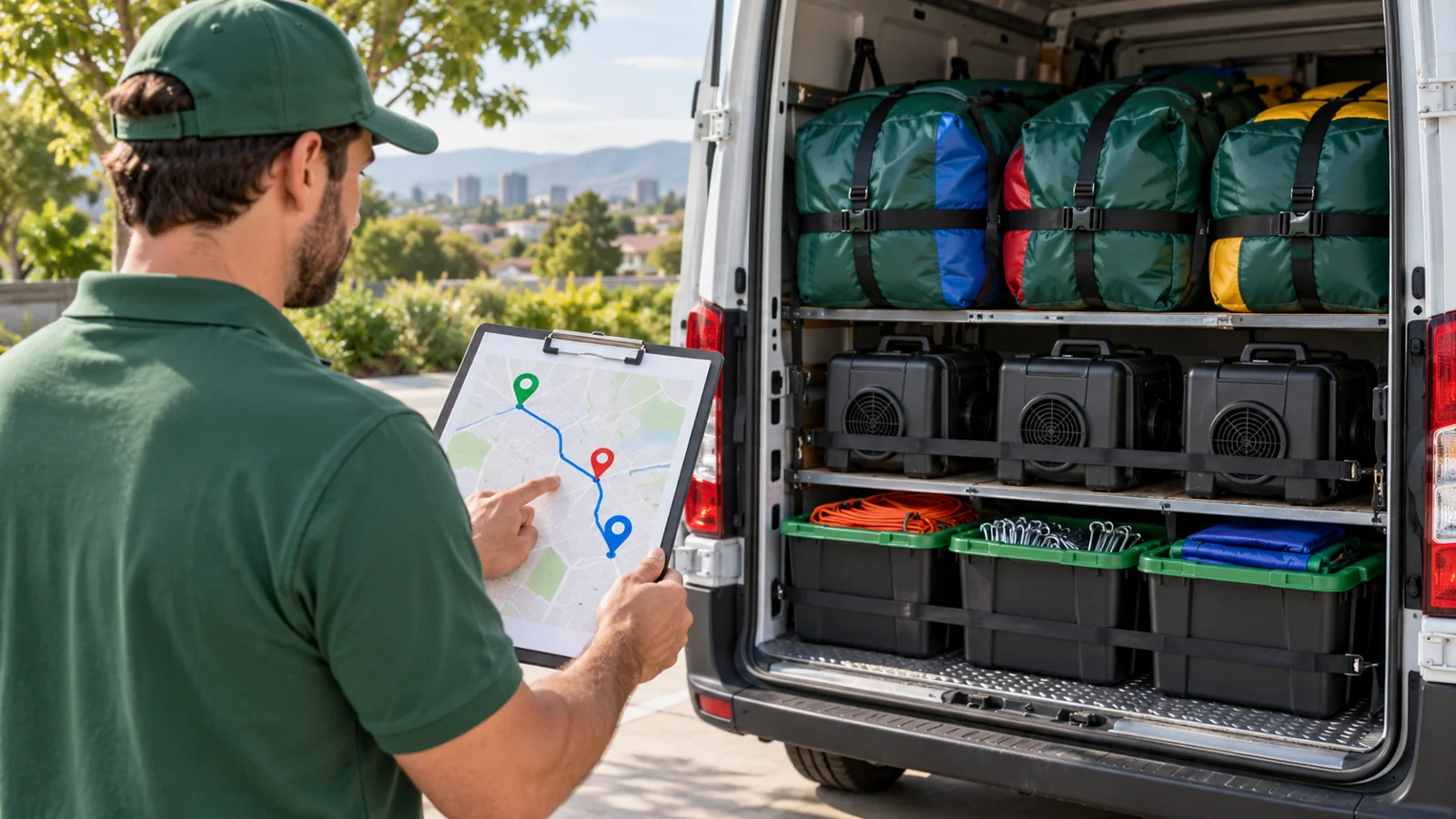
Plan inflatable rental loading order so each stop’s equipment can be identified and reached without unloading unrelated items. Group the appropriate blower and accessory kit with the corresponding job reference. For modular units, verify that all required sections and connection components are assigned before loading begins.
Accessibility is only one loading constraint. Weight distribution, suitable restraint and the vehicle’s loading instructions still govern the arrangement. Do not put a heavy item in an unsuitable position merely because it is needed first. Have the responsible loading person reconcile the route sequence with the vehicle’s requirements.
Reserve a workable location for return loads and account for wet or dirty equipment according to your handling procedures. Record any loading change that affects another stop. The driver and crew lead should leave with the same stop sequence and equipment list.
When an access problem or longer installation changes departure time, recalculate the remaining route immediately. Check which downstream commitment loses its slack first. “We will make up time” is not a revised plan unless the vehicle and crew timelines actually support it.
Possible responses include sending another suitably equipped vehicle, moving a qualified team, or agreeing a revised access or ready window with the customer. Each option needs a fresh capacity check. Moving one job to another route may solve the original delay while creating a new conflict there.
Do not recover time by skipping checks, rushing handling or compressing a manufacturer-required procedure. Give customers the revised expectation and name the person responsible for the next update. Keep planned and actual times so the next schedule uses better inputs.
Use one row for each delivery or collection stop and keep both in the same schedule. The following is a blank planning structure; its allowances must come from your fleet and venues.
| Field | What to enter |
|---|---|
| Stop and order | Address, entrance, contact, delivery or collection |
| Access and deadline | Earliest entry, required ready or collection-finish time |
| Assigned resources | Vehicle, crew, physical units and accessory kits |
| Time allowances | Travel, waiting, handling, installation or collection, buffer |
| Calculated times | Expected arrival, work start, completion and departure |
| Feasibility and owner | Deadline slack, load check, open issue and responsible person |
Before accepting another stop, test the complete route again. Before purchasing larger equipment, ask the supplier for the packing and handling information needed to run that test. A unit that fits your customer’s venue must also fit the delivery operation supporting it.