
A blower’s catalog noise figure cannot tell you how an event will sound beside a shop entrance, a guest seating area or a neighboring property. The installation may use several blowers, and walls or other sound sources can change the conditions at the place where people actually hear them.
Inflatable blower noise assessment should therefore evaluate the proposed equipment in its intended layout. Agree the venue’s criteria, record the measurement conditions, test the operating combination and check any changes again. The result is a documented site decision, rather than a claim that one product specification guarantees an acceptable event.
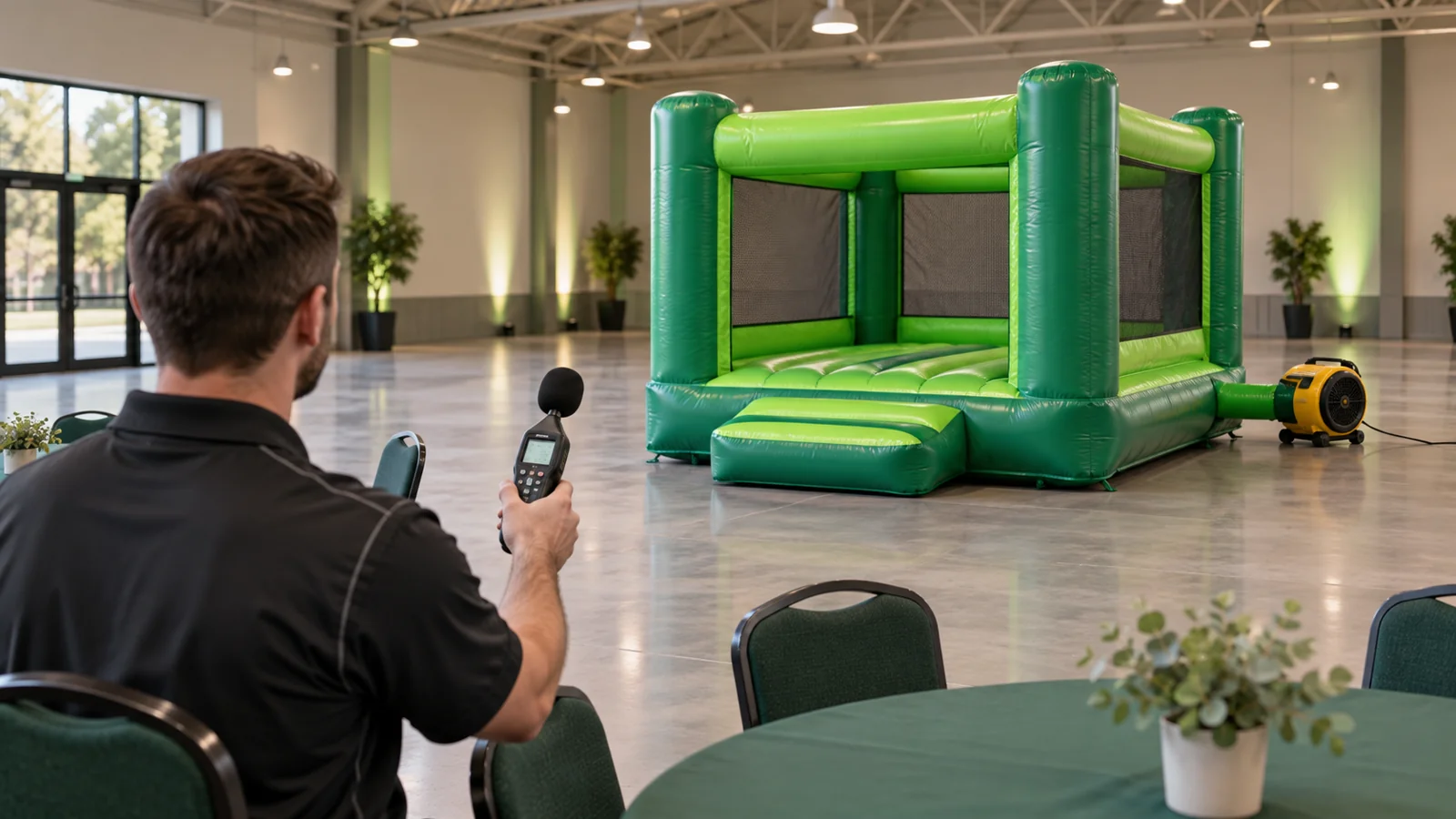
Start by asking the venue what it needs assessed and who can confirm the result. A guest-comfort request, a property-boundary condition and an employee exposure assessment are different questions. They may use different locations, measurement periods and criteria. Write down the applicable requirement and its source before taking readings.
Mark relevant positions on a simple site plan: the nearest staffed counter, a guest seating area, a neighboring entrance or another position specified by the venue. Record microphone location and height so another person can repeat the survey. Do not substitute a convenient point beside the blower for the location the requirement actually concerns.
For shopping mall play-zone planning, involve the venue representative responsible for adjacent retail spaces. Confirm the intended running hours and the other equipment expected to operate at the same time. There is no single decibel figure in this guide that makes every venue acceptable.
Keep a background reading with the event blowers off where that can be measured appropriately, then record the intended operating conditions at the same positions. Note any changes in nearby activity, traffic, announcements or music. A quieter background survey from another part of the day may not provide a meaningful comparison.
For inflatable blower noise measurement, identify the instrument, its settings, calibration checks and measurement duration. Record the metric being reported rather than writing only “dB.” An average level and a maximum reading answer different questions. Use the measurement method and equipment required for the purpose; obtain competent assistance when the decision requires more than a preliminary survey.
NIOSH distinguishes area sound-level measurements from personal exposure assessment. Its guidance recommends calibration checks before and after sound-level measurements and notes that phone-based measurements may not meet regulatory requirements. A phone app can support preliminary screening, but the device and method still need to suit the decision.
Do not subtract two decibel readings as ordinary numbers to calculate the blower’s contribution. If the requirement needs a source-specific result, use an appropriate acoustic method or ask a qualified person to establish it. Keep the original readings and conditions in the record.
A single-unit test can help identify a prominent source. The venue decision should also cover the combination that will actually run. List each blower, its assigned inflatable and its position, then measure the intended simultaneous operation. Do not add individual decibel values together as if they were weights.
Record the configuration for commercial bouncers separately from other event equipment. For inflatable event tents, confirm whether the selected construction requires continuous blower operation. A survey should reflect the supplied system, not an assumption based on its appearance.
Run equipment under the appropriate manufacturer-specified conditions. If a blower produces unusual noise or vibration, address its condition before treating the reading as normal. The blower sizing and compatibility guide covers selection; this survey does not authorize changing to a less suitable blower simply to obtain a quieter reading.
Also record whether generators, ventilation, music and other expected sources were operating. If some were absent, state that limitation when the venue reviews the result.
Consider whether a permitted layout can put the sound source farther from sensitive positions. Indoor surfaces can reflect sound, so assess the revised layout rather than assuming a distance change produces a fixed reduction. HSE identifies source positioning and room treatment among noise-control options; applying them to an event still requires a site-specific review.
Blower placement for event venues must preserve the manufacturer’s operating requirements, airflow, ventilation, connection arrangement and access. Do not cover a blower, obstruct its inlet or improvise an enclosure to quiet it. Changes to ducts or connecting tubes need supplier confirmation for the particular equipment.
Recheck cable routes and the available supply when moving equipment. The event power-planning guide addresses that separate constraint. A noise improvement is not useful if the new position creates an unsuitable electrical arrangement or obstructs the venue’s circulation routes.
If the approved equipment cannot meet the agreed venue requirement in a workable layout, discuss another suitable configuration or location. Do not promise that a makeshift barrier will resolve it.
After an adjustment, repeat the relevant measurements using comparable positions, settings and operating conditions. Identify what changed between the first survey and the retest. Preserve both records; a final number without the configuration makes the result difficult to use later.
The venue confirmation should identify the equipment combination, permitted layout, running hours and any restrictions. Name the person confirming it and attach the site plan. A change in equipment or placement may require another review rather than automatic reuse of the earlier approval.
Keep venue acceptance separate from regulatory duties and worker exposure assessment. A brief area reading does not describe every employee’s exposure over a shift. Where that assessment is required, use an appropriate professional process.
Use the following blank structure for inflatable event noise planning. It helps the supplier, operator and venue discuss the same configuration without presenting unmeasured values as specifications.
| Field | What to enter |
|---|---|
| Purpose and criterion | Venue requirement, source, assessment purpose and reviewer |
| Measurement point | Site-plan reference, location, height and conditions |
| Instrument and method | Instrument ID, settings, metric, duration and calibration checks |
| Operating configuration | Blowers, inflatables, other running sources and placement |
| Results and adjustment | Background, operating result, change and comparable retest |
| Decision | Accepted configuration, restrictions, date and responsible person |
Before buying equipment for a noise-sensitive venue, ask the supplier for its noise measurement conditions, blower configuration and operating documentation. Use that information to plan the site test, then base the venue decision on the layout you will actually operate.