
Every outdoor event operator has a story about it. The bouncer that started sagging at noon, the obstacle course that lost half its blowers when the sound system kicked in, the wedding reception where the photo-booth inflatable deflated halfway through cocktail hour. Power failures at outdoor inflatable events are almost never caused by mysterious electrical gremlins — they are caused by sizing the generator from rule-of-thumb single-blower experience and then plugging in four units, a lighting rig, a PA system, and a coffee cart.
The cost goes well beyond a rental refund. A deflated unit during a corporate family day or a school fair is the kind of moment guests photograph and parents remember, and the rental company carries the reputation hit long after the generator is back in the truck. Reliable outdoor power planning starts with treating wattage as a math problem, not a guess, and pairing the right factory-supplied blowers and power accessories with a generator sized for total connected load — not for the single biggest unit on site.
The first input to any honest power plan is real operating wattage for every device on site, plus its startup surge. Inflatable blowers are induction motors, which means they draw a brief inrush current several times higher than their running load. The headline horsepower on the blower tag is only useful when paired with measured electrical draw.
Typical numbers seen in field service: a small 1 HP blower draws about 750-900 W running with a startup surge near 1200 W. A medium 1.5 HP blower used on mid-size bouncers and combos sits at 1100-1300 W running and roughly 1800 W surge. Large 2 HP blowers feeding tall slides and obstacle courses run at 1500 W and can spike to 2400 W on cold-morning startup. Matching blower size to inflatable volume is critical — undersized motors run hotter and pull more current than the spec sheet suggests, as detailed in this commercial blower selection guide.
Auxiliary loads add up faster than operators expect. Event lighting ranges from 200 W for modest LED string setups to 1500 W when you add stage wash or perimeter floods. A small PA covers 300 W, a full band-capable sound system can pull 2000 W. POS terminals and cashboxes draw 50-200 W, phone-charging stations 100-400 W, and any inflatable tent with internal lighting or climate accessories adds its own line item — the kind of load profile covered in the commercial event tent power requirements breakdown.
Once every device has a running watt figure and a surge figure, generator sizing becomes arithmetic. Sum the running loads to get total connected load, then add 20-30% headroom. That margin absorbs simultaneous startups, voltage sag in long cable runs, cold-weather motor inrush, and the fact that real-world generators do not deliver nameplate output continuously at high ambient temperatures.
A typical five-unit event — four blowers (two medium, two large), event lighting, and a small PA — totals roughly 5.0-5.5 kW running. With surge margin, that event needs a 6-8 kW generator. A larger fleet day running a modular obstacle course installations setup of six to eight blowers, plus lighting and concessions, lands closer to 10-12 kW. The most expensive mistake is sizing only to running load: the generator handles steady state fine, but the moment a second large blower kicks on, the breaker trips and every unit on that circuit drops. Reviewing real multi-blower configurations like the large commercial slide configurations reference helps operators see how quickly surge totals climb when several big motors share a circuit.
Inverter-style generators are the practical default for inflatable work because they hold cleaner voltage under varying load, which protects blower motors and sensitive electronics on the same circuit.
A correctly sized generator can still fail the event if power is delivered through undersized cable. Voltage drop scales with current and run length, and a blower receiving low voltage spins slower, draws more current to compensate, runs hotter, and eventually trips on thermal overload — symptoms operators usually misread as "bad generator."
Working rule of thumb on 110 V circuits: for a 15 A blower load, use 12 AWG extension cable for runs under 30 m, 10 AWG for 30-60 m, and switch to a hardwired distribution panel beyond 60 m. Running that same 15 A load 30 m on a thin 14 AWG cord produces around 7% voltage drop, which is enough to push a marginal blower into overheat territory by mid-afternoon. On 220 V circuits the percentage drop for the same current is roughly a quarter, so longer runs are tolerable, but cable specification still matters — heat, UV exposure, and mechanical abuse all degrade outdoor cable faster than indoor wiring.
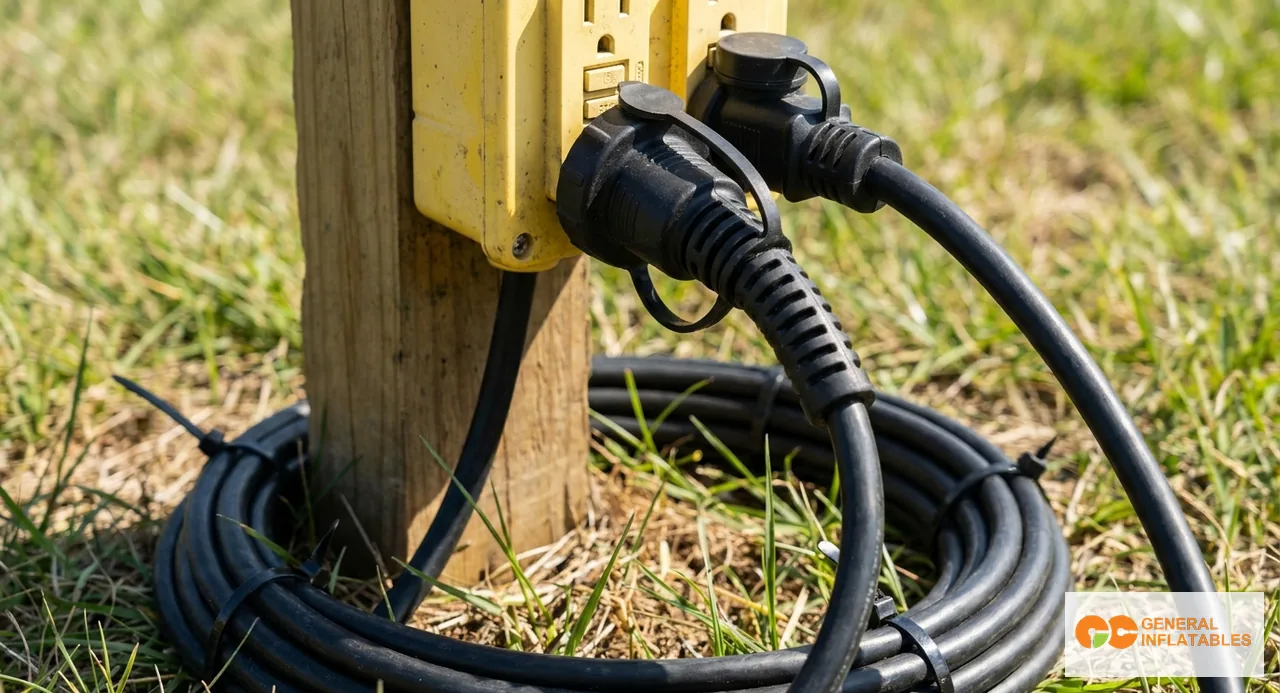
Daisy-chained extension cords are the other silent killer. Each connection adds resistance and a potential failure point, and a chain of three light-duty cords feeding a large blower is functionally a fire hazard. Single continuous runs of correctly sized cable from a distribution panel, with weatherproof connectors at every junction, eliminate most field power problems.
Plenty of high-value events happen at venues with no usable mains power: vineyard weddings, beach corporate days, remote festival sites, private estates. Portable battery inverter systems in the 5-10 kWh range now handle small two- or three-unit events for four to six hours quietly, which is a meaningful upgrade for noise-sensitive bookings like outdoor weddings and product launches.
Hybrid inverter generators — a battery bank topped up by a smaller, quieter engine that cycles on demand — cut fuel burn and noise compared with traditional open-frame gensets running continuously. For a daytime-only event, solar augmentation can carry the lighting and auxiliary loads and let the generator focus on blower duty, but solar is rarely a sole primary source for blowers because of the constant draw and intolerance for cloud-driven dips. Plan solar as supplement, never as the only line.
Power planning ends at the safety and compliance layer. Many local event permits require documented power-load calculations and licensed electrician sign-off above certain thresholds — commonly around 10 kW of generator capacity, though the trigger varies by jurisdiction. GFCI protection on every outdoor blower circuit is non-negotiable, and outdoor-rated GFCI breakers should be tested on arrival, not just trusted because they tripped last weekend.
When a single generator cannot cover the load, the answer is multiple generators on separate, clearly labeled circuits — never paralleling two units that are not designed and equipped to sync, because mismatched phase or frequency damages connected equipment and the generators themselves. Map the site so each generator feeds a defined zone, and post the assignment on the distribution panel so the on-site crew does not improvise reroutes mid-event.
Fuel handling, exhaust placement well downwind of guests and tent intakes, fire extinguisher availability, and local noise compliance round out the basics. Treat the generator area as part of the event footprint with its own perimeter, not as a piece of back-of-house equipment that takes care of itself.
Tell us your typical event size, inflatable mix, and venue power availability, and we will return a power planning proposal — per-unit wattage, generator sizing, cable specification, and off-grid options when needed — typically within three business days.