
Ask any rental operator which component fails first across a fleet, and the answer is almost always the same: the blower. It runs every operational minute, ingests dust and grass clippings, and gets dropped, dragged, and rained on. Across a typical commercial fleet, blowers account for more service tickets than seams, anchors, and zippers combined.
The two failure modes from incorrect sizing are mirror images of each other. An under-sized blower runs at maximum draw all day trying to keep the product taut, the bouncer walls sag at peak load, jumpers compress the chamber, and the motor overheats and shortens its operating life by half. An over-sized blower wastes electricity every minute it runs, generates noise that triggers complaints at residential events, and over-pressurizes seams in lighter products, accelerating wear. Right-sizing pays back across every maintenance cycle, every electricity bill, and every customer call avoided. For operators sourcing inventory, the smart move is to spec the blower against the product mix from day one, ideally with factory-supplied commercial blowers and spares matched to the inflatables they will run.
Two specs determine whether a blower will keep a product properly inflated: CFM (cubic feet per minute, the volume of air the unit moves) and static pressure (the resistance the unit can push against, measured in inches of water column). CFM alone is meaningless — a blower rated 1000 CFM at zero resistance might only deliver 400 CFM once it is pushing into a sealed inflatable through a 6-inch hose. Always read the rated CFM at the operating static pressure, typically 1.0 to 1.5 inches of water column for constant-air products.
Practical sizing rules by product class: small bouncers in the 3 to 5 meter footprint range need 350 to 500 CFM at 1.5 inches water column, comfortably handled by a 1 HP unit. Medium combos and obstacle modules in the 6 to 8 meter range need 700 to 1000 CFM, which is the sweet spot for the 1.5 HP commercial blower that dominates the rental market. Large slides 10 meters and above, multi-lane obstacle courses, and water park modules need 1500 to 2500 CFM, almost always split across two or three units rather than supplied by a single oversized motor. Match leak rate too — older units with worn seams and stitching lose air faster and need 15 to 20 percent more CFM headroom than fresh inventory.
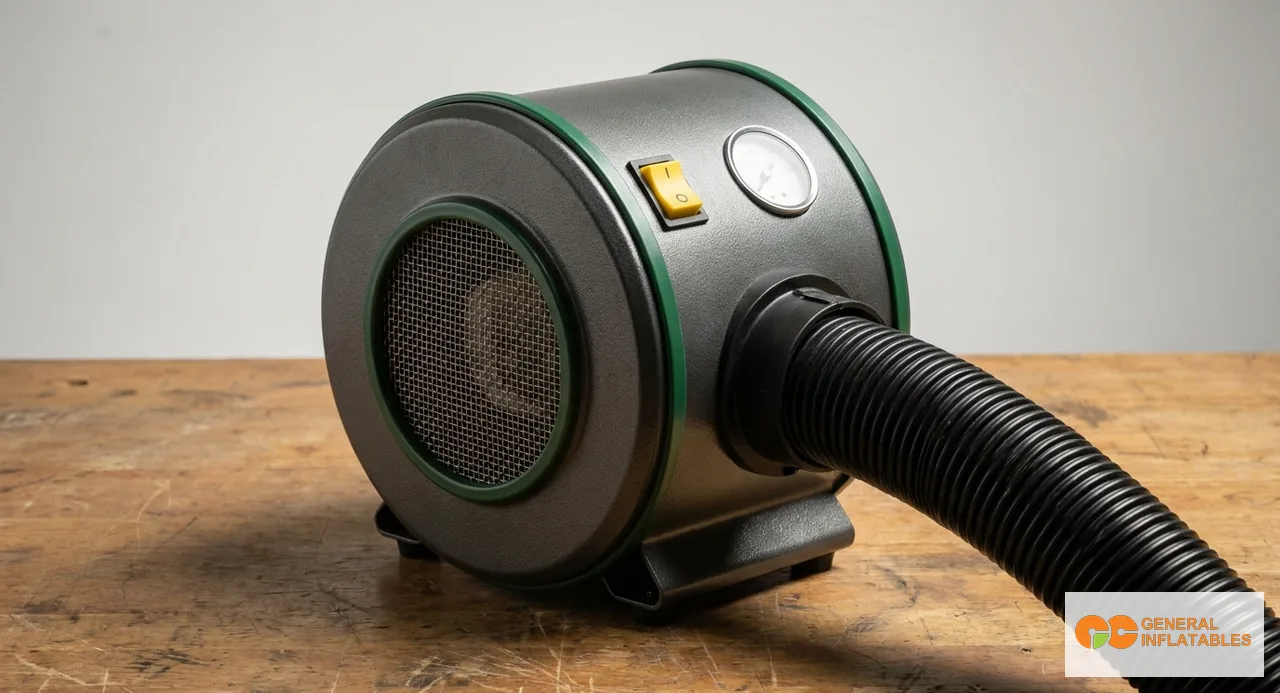
Voltage is determined by the destination market, not by the product. North American operators run 110V predominantly — a 1 HP motor draws roughly 750 watts, peaking around 12 to 13 amps at startup, which sits safely under the 15-amp limit of a standard residential or park outlet. A 1.5 HP unit on 110V pulls closer to 14 amps continuous and benefits from a dedicated 20-amp circuit; running two such blowers off one duplex outlet is the single most common cause of tripped breakers at backyard events.
Outside North America, 220V is standard, and the same motor sizes pull half the amperage at the same wattage, making circuit planning easier and cable runs longer without voltage drop. For fleets serving export markets or mixed-voltage venues, dual-voltage 110V/220V switchable blowers add modest cost but eliminate the need to maintain two parallel inventories. Three-phase power matters only for fixed installations — indoor family entertainment centers, resort water parks, or trade-show rental hubs running five or more blowers continuously. Single-phase covers virtually every portable rental scenario. For daily electricity cost math, assume a 1.5 HP blower at full duty draws roughly 1.1 kWh per operating hour; an 8-hour event day adds up quickly across a 20-unit fleet.
Not every inflatable needs a blower running during use. Constant-air products — bouncers, slides, combos, obstacle courses, the entire rental staple — leak air intentionally through seams and stitching and require a blower running every operational minute to maintain pressure. Airtight products built with drop-stitch fabric (sealed sports fields, floating docks, paddle decks, certain trade-show structures) inflate once with a high-pressure pump, then hold pressure for hours or days without continuous airflow. The difference in airtight vs constant-air construction determines whether you are buying a blower-heavy fleet or a pump-heavy fleet, and the two categories of equipment are not interchangeable.
Most rental operators are 90 percent constant-air and need one blower per deployed product, plus inventory spares. Resort and fixed-installation operators running mostly airtight gear need fewer blowers but a properly rated high-pressure electric pump (typically 8 to 15 psi capable) and the discipline to monitor pressure across the operating window. Mixing the two equipment classes — trying to inflate a drop-stitch product with a low-pressure constant-air blower, or running a constant-air bouncer off an airtight pump — damages product and equipment within hours.
Single-blower thinking breaks down past a certain product size. A 10-meter dual-lane slide cannot be inflated by one 1.5 HP unit because the airflow demand of the slide tower and the landing pool together exceeds what any reasonable single motor can deliver at adequate static pressure. Standard practice for large commercial slide configurations is two blowers: one feeding the slide structure, one dedicated to the landing pool and splash zone, with independent power circuits so a single trip does not collapse the whole product.
Modular water parks scale further. A 15-module aqua park typically runs one blower per three-to-four-module cluster, with a manifold control panel coordinating startup sequencing to avoid simultaneous inrush current. Inflated event tents present a different challenge — long sealed beams need higher pressure than wide open-volume products, and the rule of thumb for commercial event tent blower sizing is one blower per beam pair for span tents over 12 meters wide, on independent circuits.
Mobile rental crews running site events off truck-mounted generators face a sizing problem the residential outlet operator never encounters. Generator power behaves differently from grid power in three ways that push the spec upward. Voltage drop across 50 to 200 feet of distribution cable can shave 5 to 10 percent off delivered voltage, which a constant-load blower compensates for by drawing more current and running hotter. Generators rate output at continuous wattage, not peak — a "5000 watt" unit often holds only 4000 to 4500 watts under sustained load, while inductive blower motors can spike 250 percent of running wattage at startup. Parallel device load (lighting rigs, sound systems, payment terminals on the same generator) creates voltage dips that overheat blowers fastest of all. For event-day power planning, the upstream considerations covered in generator selection and event power planning drive every downstream blower decision.
Sizing a truck-power blower setup follows five steps. First, sum the rated CFM across every unit you intend to run simultaneously — a 5-unit rental fleet at a corporate field day might total 3500 to 4500 CFM. Second, add a 30 percent surge margin because generators do not deliver 100 percent rated CFM under real load. Third, match generator continuous wattage to total blower running wattage plus a 250 percent startup surge multiplier on the largest motor; for five 1.5 HP blowers in parallel, that lands at a 5000-watt inverter generator minimum. Fourth, calculate cable gauge by run length: 12 AWG for runs under 50 feet, 10 AWG for 50 to 100 feet, 8 AWG for 100 to 200 feet. Fifth, add inline GFCI protection on every blower circuit — mandatory for outdoor B2B compliance regardless of event duration.
Three mistakes recur across crews new to truck-power deployments. Running blowers off the vehicle's built-in inverter delivers insufficient wattage, voids the blower warranty, and stalls the truck electrical system. Sharing one generator across blowers, stage lighting, and a PA creates voltage dips at every speaker transient that cumulatively cook blower windings. Skipping GFCI for "quick" events fails the first wet-grass insurance audit. Recommended baseline for a 5-unit rental fleet on truck power: one 5000-watt inverter generator dedicated to inflatables only, a 12 AWG distribution panel, and four GFCI-protected outlets, deployed using a documented sequence like the field setup crew SOP including blower commissioning steps to stay consistent across crews and venues.
Commercial blowers have predictable wear curves and reward operators who plan replacement rather than wait for failure. Carbon brushes on brushed motors wear out at 800 to 1200 operating hours — once every two seasons for an active rental unit. Bearings come next at 3000 to 4000 hours. Whole-blower replacement for commercial use lands at five to seven years. Brushless commercial blowers shift this curve — no brush wear, longer bearing life, higher initial cost — and are increasingly the spec for high-utilization fleets.
Inventory math: keep one spare blower per five deployed units, scaled up to one per three for operators running daily through summer peak. The single biggest accelerant of blower failure is dust and debris ingestion through the intake — operating on dusty surfaces without an intake screen shortens motor life by roughly 40 percent. Cleaning intake filters weekly, storing blowers off the ground, and replacing brushes proactively at the wear-window rather than waiting for arcing are the three habits that separate fleets running blowers to seven years from fleets replacing them at three. Stocking brushes, bearings, and impellers alongside field repair kits and maintenance protocols for the inflatables themselves keeps a blower failure from becoming a missed booking.
Most blower failures narrow down to one of five causes. Work through this order before assuming a full replacement is needed:
If troubleshooting points to a genuine component failure rather than a fixable external cause, weigh the repair against the wear-curve figures above — a blower already near its five-to-seven-year lifecycle replacement window is often better replaced than repaired, while a failure well inside that window usually justifies a brush or bearing repair instead.
Tell us your product mix, operating voltage, and deployment frequency, and we will return a blower specification — sizing per product, spare strategy, multi-blower coordination if needed, and lifecycle replacement schedule — typically within three business days.