
Buying a commercial inflatable slide sounds simple until you realize "slide" covers everything from a 6-meter kids' rental piece to a 20-meter resort attraction with a concrete catch pool. The right configuration depends on operating environment, throughput targets, and how the unit fits your existing fleet. This guide walks through categories, height tiers, lane math, materials, and anchor requirements so you can move from "I want a slide" to a specific buildable spec before contacting a manufacturer.
Commercial slides fall into three product families, and confusing them is the most common procurement mistake. Dry slides are single-fabric units with no integrated pool, anchored on grass, turf, or rubber matting, and rated for weather but not for continuous water flow. The sliding surface is treated for low-friction dry use, and the seams are not designed to live under standing water. These are the workhorse units of the dry commercial inflatable slides category — birthday rentals, corporate field days, school carnivals.
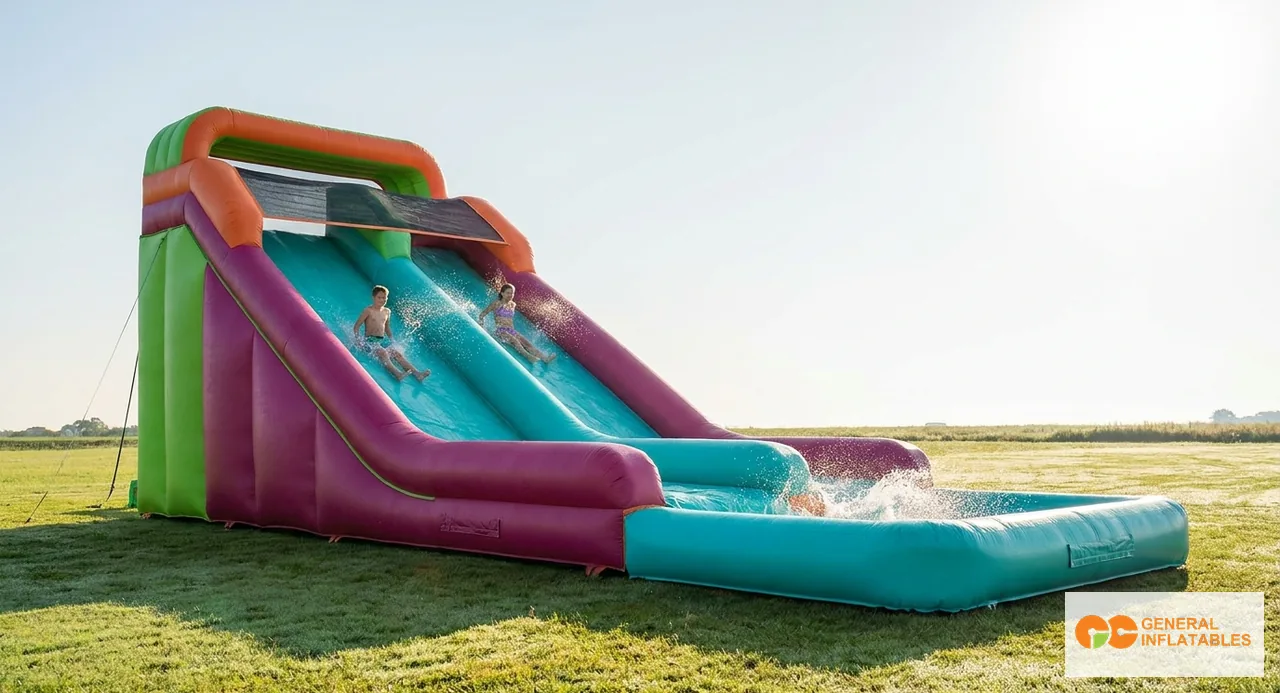
Water slides are a different animal. They are built with a pool basin at the landing, the sliding surface is shaped for a constant water sheet, and the fabric is marine-grade with reinforced seams that tolerate chlorinated or hard water exposure. Pumps, hose connections, and splash deflectors are designed in rather than bolted on. Pushing water down a dry slide voids the warranty within a season. Browse the commercial water slide product line for purpose-built units. Operators weighing wet-attraction add-ons often compare these basins against inflatable pool tracks, which fill the same splash zone at a lower per-unit cost.
Mixed-use convertible slides use a modular drop-in pool basin that detaches for dry operation. They cost roughly 25-35% more than a single-purpose unit at the same height, but for operators serving both summer water events and shoulder-season dry rentals, the flexibility usually pays back inside two seasons. Setup time is longer because the pool module has its own anchor points.
Commercial inflatable slide heights cluster into four tiers, each with its own anchor profile, shipping footprint, and operator-certification overhead.
5-7 meters is the rental-fleet baseline. These fit ASTM F2374 setup guidance comfortably, clear most indoor ceiling heights at 8m+, and ship in a single pallet. One blower, four to six anchors, two-person setup in under 30 minutes. 8-12 meters is the adult and mixed-age tier — festival anchors, larger corporate events, premium rental offerings. Two blowers, eight to twelve anchors, and you start needing a small crew for setup. 15-18 meters is the resort and water park installation range, often paired with permanent catch pools and requiring engineered tie-downs rated for the local wind class. 20 meters and above crosses into major theme park territory where independent structural engineering review, fire-rated egress planning, and permanent foundations become part of the procurement scope. Above 15m, most units exceed a single 40HC container and require split shipment with field assembly.
Lane count drives both your hourly capacity and your fabric cost, and getting the math right prevents both under-buying (queues that kill rebook rates) and over-buying (idle lanes that never pay for themselves).
Single-lane slides handle 60-80 runs per hour with a simple anchor pattern and the smallest fabric area. They are right for kids' parties, small venues, or any setting where queue management is informal. Dual-lane slides deliver 110-150 runs per hour, and — equally important — they create photographable parallel racing moments that drive social media engagement and rebook rates. Quad-lane slides are festival workhorses at 200-280 runs per hour, but the fabric area is roughly 3.5x a single-lane unit at the same height, so the per-run economics only work if you are actually running peak-throughput events.
Quick example: a dual-lane 10m slide at four peak hours and 130 runs/hour yields roughly 520 runs per event. At a typical per-ride or per-wristband recovery model, that's the throughput envelope to size your staffing and queue layout against. Single-lane at the same event would cap near 280 runs and leave guests in line; quad-lane would cap near 960 runs and likely sit idle outside peak windows.
Fabric grade is where lifespan is won or lost, and the right grade depends almost entirely on where the unit will live. The default for temperate-climate indoor and outdoor commercial use is 0.55 mm 1000-denier PVC tarpaulin — three to four seasons of weekly rental duty with normal care. For tropical outdoor deployment with daily UV exposure, step up to 1100-denier with UV stabilizer additives, which typically extends usable lifespan from three seasons to five. Coastal or saltwater-adjacent installations need marine-grade PVC with double-stitched and welded seam reinforcement — the salt aerosol degrades standard PVC at the seams long before the fabric body fails. Indoor, low-stress applications (trampoline park add-ons, shopping center activations) can drop to 0.4 mm 800-denier, which is cheaper, lighter, and faster to set up, but should never be sent outdoors. For a full breakdown of weights, coatings, and abrasion ratings, see this PVC tarpaulin grades reference before locking your spec.
Every commercial slide ships with a manufacturer-recommended anchor count keyed to height and the wind class of the operating environment. A 6m slide on protected turf might need four 18-inch stakes; a 12m slide on an exposed festival field can need twelve to sixteen, plus ballast bags. Above 15m, water bladder anchors or concrete pad attachment points become standard rather than optional — refer to this guidance on anchor systems for tall structures when you spec the install.
Water slides add a pool-pairing decision. Portable installations use a matched inflatable catch pool that ships with the slide and inflates from the same blower line. Permanent installations use a fixed concrete catch basin sized to the slide. The rule of thumb in both cases: pool diameter should equal at least 1.5 times the slide length measured along the sliding surface. Anything tighter risks slide-by overshoot, where riders skim across the water and hit the far pool wall. For dual or quad-lane water slides, the pool also needs separated landing zones to prevent rider collisions. For long downhill wet runs without a catch pool, look instead at purpose-built inflatable slip and slides, which spread the water sheet across a flat ground track.
Translate everything above into a buy list based on your business model.
(a) Rental fleet operator: Stock a 5-7m dry slide as your bookable workhorse — it covers 70% of inquiries — then add one 8-10m water slide as your premium summer offering. Two units, two anchor kits, one blower spec across both if possible to simplify field service. A rental fleet rounds out faster when you pair these slides with inflatable sports games, which book strongly for the same corporate and school events.
(b) Resort recreation manager: Invest in one 12-15m signature water slide with a matched pool, positioned as the headline amenity. Spend the budget on UV-stabilized fabric and engineered anchors rather than on a second smaller unit — the photo-driven marketing pull of one tall slide outperforms two medium ones.
(c) Water park operator: Build a multi-slide tower mix at staggered heights — an 8m for younger guests, a 12m mid-tier, and a 15m signature unit — so capacity scales across age groups and queue pressure spreads across the venue. This is also where modular water park installations beat single-unit purchases on per-guest economics. Where floor space is tight, many venues fold the slide into inflatable combo units that bundle a bouncer, slide, and climbing wall in one footprint.
(d) Event company owner: Prioritize a modular quad-lane unit in the 8-10m range. Throughput per event wins over headline height when you are billing on day rates, and quick teardown matters more than premium fabric grade because the unit is in transit half the year.
Height is the one specification that can block an import outright, so cross-check any slide you are considering against the inflatable slide height regulations that vary from market to market.
Tell us your operating model, venue type, target height, and lane count, and we will return a slide configuration proposal — model recommendations, anchor plan, pool pairing if needed, and container shipping breakdown — typically within five business days.
For related buying considerations, see our inflatable slide manufacturing OEM buyer's checklist.