Every hotel pool eventually faces the same capex decision: do we install a permanent slide, climbing rock, or fixed water feature — or do we invest in modular inflatable pool tracks that float in, deflate out, and reconfigure for whatever the calendar demands? For a 200-room resort with a single main pool, that choice shapes the next ten years of pool-deck programming, maintenance budget, and ancillary revenue. This is an operator-side comparison written for general managers, F&B and recreation directors, and pool management companies weighing the two paths.
A permanent solid pool feature — a fiberglass slide tower, a fixed climbing wall, an in-deck splash structure — carries hard infrastructure cost: engineering drawings, deck cuts, plumbing tie-ins, anchoring to the pool shell, electrical for pump-assisted features, and a permitting cycle that often runs four to six months. The amortization horizon is long, typically eight to twelve years, and the asset is essentially immovable. If the property repositions or the pool layout changes, the salvage value is close to zero.
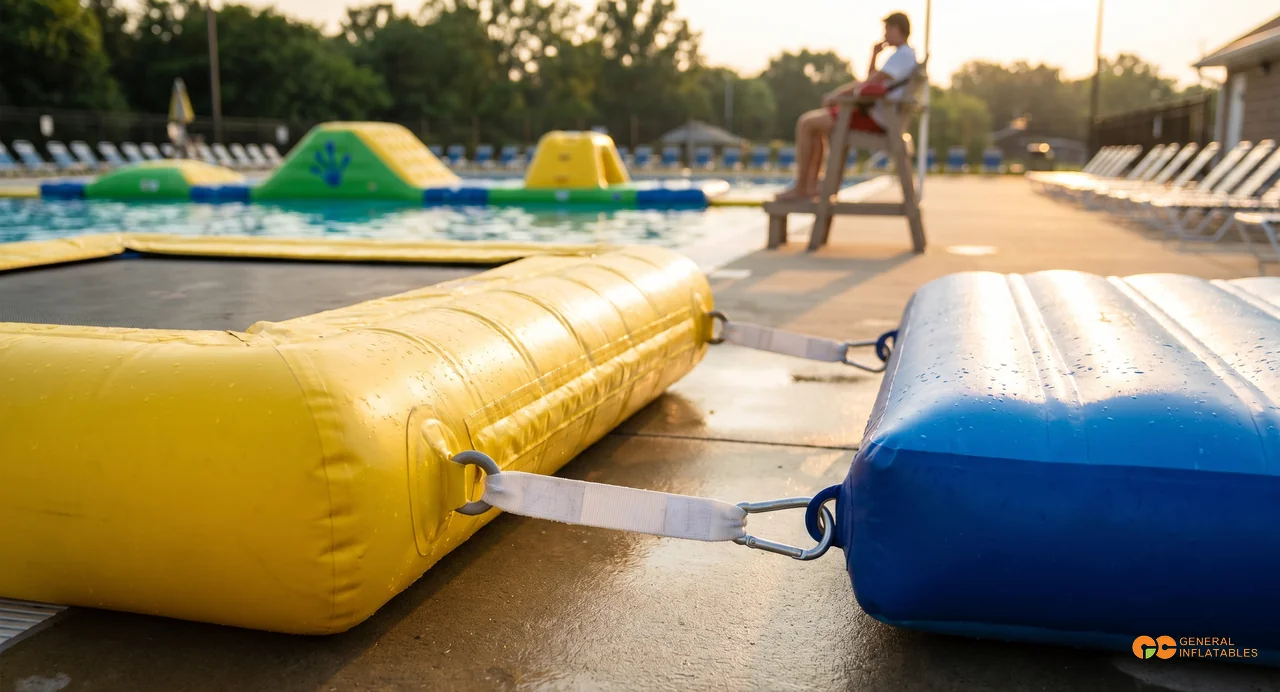
Modular inflatable pool tracks designed for hotel pool basins sit at the other end of the spectrum. Capex is a single equipment purchase, no deck work, no plumbing, no permit cycle. Anchoring is via existing pool-edge tie-points or weighted floor anchors. Most operators tell us the system pays for itself within one to two peak seasons through add-on revenue alone, with an effective amortization horizon of three to five years before the PVC needs major refurbishment. The capex ratio between the two paths is usually four-to-one or wider in favor of inflatables before you even count the deck construction.
This is where solid features lose the operator argument. A fixed slide occupies its footprint twenty-four hours a day, seven days a week, whether anyone is using it or not. It cannot be moved for the 7:00 a.m. lap-swim hour, the 10:00 a.m. aqua-fitness class, the 1:00 p.m. corporate group buyout, or the 6:00 p.m. cocktail-hour pool ambiance.
Inflatable tracks reconfigure in 20 to 40 minutes by two staff. A 25 m × 12 m pool can run lap lanes in the morning, a kids' obstacle course from 11 a.m. to 1 p.m., open swim in the afternoon, and a clean uncluttered surface for evening events. Airtight water play modules hold pressure for 8 to 12 hours of continuous use without a tethered blower, which is what makes mid-day reconfiguration realistic — staff are not dragging power cables across the pool deck.
For any property north of the 35th parallel, or any seasonal beach club, off-season storage is a real line item. A fixed slide tower occupies its 30 to 50 m² of deck footprint year-round, often shrink-wrapped or tarped, still visible to guests during shoulder season when the pool is closed. A full inflatable track system deflates to roughly 5% of its inflated volume — a 60 m² obstacle layout fits into three or four storage crates totaling under 4 m³. That matters for resorts with limited back-of-house storage and for management companies rotating equipment between properties.
Solid pool features need pool-chemistry-resistant materials, annual structural inspection of bolts and anchor points, regular re-sealing of fiberglass surfaces, and periodic pump and plumbing service if water-assisted. A realistic budget is 60 to 100 maintenance hours per year, plus a third-party engineering inspection every two to three years for liability documentation.
Inflatable maintenance is fundamentally different: pre-inflation visual inspection (5 minutes per module), seam check after each session, and a patch kit on the deck. Annual deep clean and pressure-test takes a single shift. Most operators report 15 to 25 maintenance hours per year across a full track system, roughly a quarter of the solid-feature burden. The trade-off is that inflatables carry a finite refurbishment cycle — expect to refresh high-wear modules every three to four seasons of heavy use. Material quality matters: read our notes on airtight construction quality and how it determines real-world lifespan before comparing vendor quotes.
This is the line item that changes the conversation. A solid pool feature is an amenity. It increases the perceived value of the room rate, but it does not appear as a separate revenue line. Operators cannot easily charge a guest extra for using the fixed slide that is part of the pool they already paid to access.
Inflatable pool tracks can be packaged as a bookable experience. The cleanest models we see in the field:
Properties with active water games programming for pool activations commonly recover their full equipment cost within the first peak season once two or three of these revenue streams are running in parallel.
Solid pool features skew toward two segments: families with younger children (4 to 9) who use the slide as a repeat-play amenity, and the lifestyle photography that drives bookings on travel platforms. They are durable, visually iconic, and good for brand identity.
Inflatable tracks reach a wider demographic spread: families with kids 6 to 14 (the obstacle-course sweet spot), teens who would otherwise leave the pool by age 13, corporate retreats, and the social-media-driven 20-something market where the photo-and-video output is the actual product. For mid-market resorts and family-focused properties, the demographic reach of inflatables is the stronger commercial argument.
Both options require lifeguard coverage during use, but the staffing math differs. Solid features are always present, so lifeguard staffing is constant whenever the pool is open. Inflatable sessions are scheduled, so an operator can run the obstacle track during defined hours with elevated lifeguard ratios (typically one guard per 8 to 10 active users) and revert to standard pool ratios outside those windows.
Insurance treatment varies by carrier but tends to favor scheduled, supervised inflatable sessions over permanent features that are accessible whenever the pool is open. Posted signage requirements — height, weight, swim-ability standards — are similar for both. Most carriers want a documented daily inspection log; inflatables make this easy because the deflate-inflate cycle is itself a daily inspection moment.
Solid features win for mature high-end resorts with a permanent brand identity built around a signature water feature, properties with a long amortization runway and stable repositioning horizon, and destinations where the fixed structure is itself the marketing image. If your pool is on the brochure, leave it on the brochure.
Inflatable tracks win for mid-market and family-focused properties, multi-use pools that need to serve five or six different programs per day, seasonal markets where storage flexibility is valuable, management companies that rotate equipment across portfolios, and any operator who wants the pool to generate a discrete ancillary revenue line rather than function only as an amenity.
A useful frame: solid features are a real-estate decision, inflatable tracks are a programming decision. If the question is "what should this pool look like for the next decade," solid may answer it. If the question is "how do we generate three new revenue lines from the pool this season," inflatables answer it faster and cheaper. Operators planning a modular build-out should also review our piece on how to select modular water park modules for mixed-use basins before finalizing a layout.
We help resort operators design modular inflatable pool track systems sized to their basin dimensions, with rotation schedules and revenue-model templates included. Explore our water slide catalog and request a pool layout consultation.