
Japan is one of the most demanding inflatable markets in the world — not because the rules are unusually strict on paper, but because buyers expect near-perfect execution. For any inflatable importer in Japan, success comes down to three things: matching equipment to Japan's 100V power grid, referencing recognized international safety standards, and getting customs documentation exactly right. Miss any one of them and your shipment stalls at the port or your units fail on the rental floor.
This guide breaks down what overseas buyers actually need to comply with when sourcing commercial inflatables for the Japanese market.
The short answer: no. There is no single mandatory japan inflatable standard that governs commercial bouncy castles, slides, and play structures the way EN 14960 does in Europe. JIS (Japanese Industrial Standards) covers materials, electrical safety, and many product categories, but it does not publish one unified inflatable amusement standard equivalent to EN 14960 or ASTM F2374.
In practice, this creates a documentation gap that experienced Japanese importers fill by requiring internationally recognized references. Most serious buyers ask suppliers to certify products against the EN 14960 and ASTM F963 safety standards so they have a defensible compliance trail for insurers, venue operators, and local authorities. When a JIS-specific requirement does apply — typically electrical components and flame behavior of materials — it sits on top of these international references rather than replacing them.
Buyers searching for JIS inflatable certification are usually looking for two assurances: that the blower's electrical components meet Japanese safety expectations, and that the PVC fabric meets fire-retardancy standards. There is no single stamp that covers a whole inflatable. Instead, a credible supplier provides EN 14960 / ASTM conformance for the structure, plus material fire-test data and electrically compliant blowers for the Japanese grid. Package these together and you satisfy what most Japanese buyers and venues actually demand.
This is where shipments most often go wrong. Japan runs on 100V — lower than the 110-120V of North America and far below Europe's 220-240V. A blower built for another market will underperform or overheat on Japanese mains. For a bouncy castle in Japan, an underpowered blower means a soft, unsafe structure and unhappy operators.
There's a second wrinkle unique to Japan: the country runs on two grid frequencies. Eastern Japan (Tokyo, Yokohama, Sendai) uses 50Hz, while western Japan (Osaka, Nagoya, Kyoto, Kobe) uses 60Hz. A blower must tolerate both, or you need to specify by region.
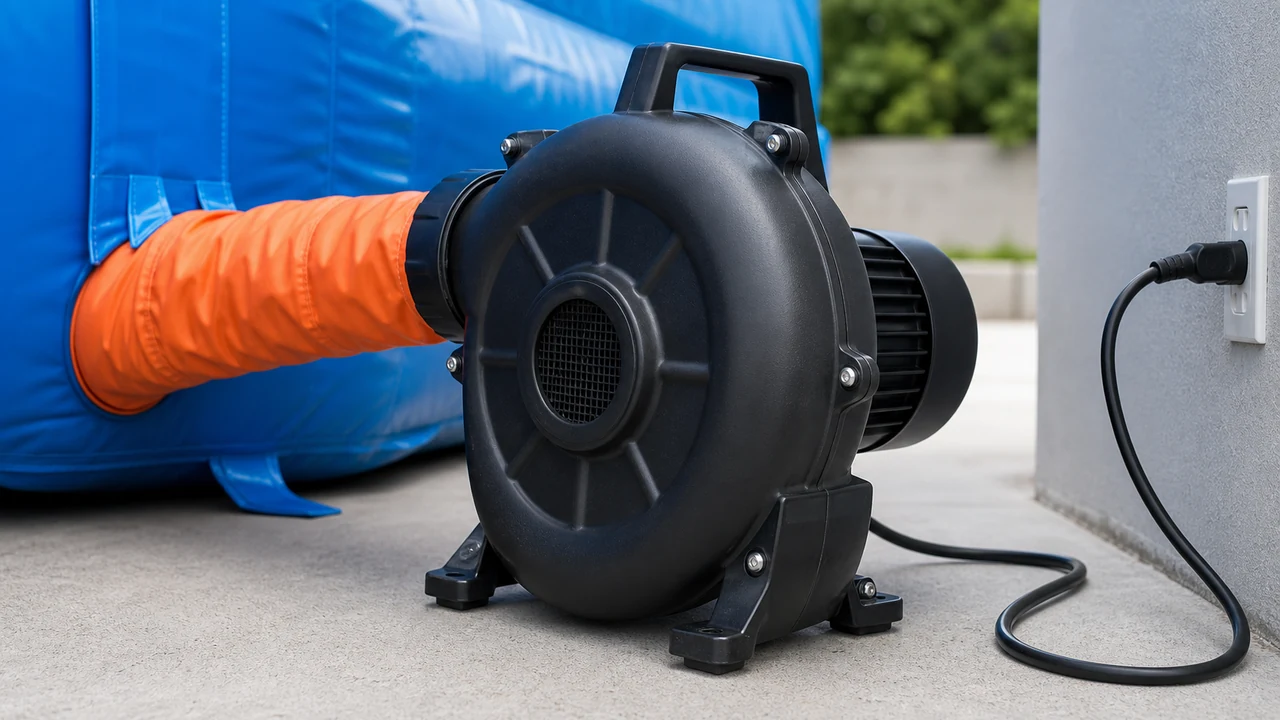
When sourcing for Japan, confirm three things with your factory before production:
Whether you're buying commercial inflatable castles or larger units, the blower spec should be locked down in writing. A reputable factory will test units on a 100V supply before they leave the line.
Almost all commercial inflatable volume into Japan moves by sea. The main gateways are Tokyo and nearby Yokohama for eastern Japan, and Osaka and Kobe for the western Kansai region. Transit times from southern Chinese ports are short — typically well under two weeks — which makes Japan one of the more forgiving markets for lead-time planning.
Inflatables compress well, so container utilization is usually strong. A 40ft HQ container holds a substantial mix of units, and consolidating an order to fill one is the most cost-effective way to land stock. Larger items such as commercial inflatable water slides take more volume, so plan your container mix around the bulkiest pieces first, then fill gaps with smaller bouncers and accessories.
Japanese customs is efficient but unforgiving of sloppy paperwork. For smooth inflatable Japan import clearance, your documentation set should include a commercial invoice and packing list with accurate HS classification, the bill of lading, and any material or fire-test certificates the importer requests in advance. Declared values and product descriptions must match across every document — discrepancies are the most common cause of delays.
Work backward from your importer of record. Most Japanese buyers have a customs broker they trust; align HS codes and declarations with that broker before goods ship rather than after they arrive. If FOB or CIF terms aren't crystal clear in the contract, sort that out early so responsibility for clearance and inland delivery is unambiguous.
Japanese venues — shopping malls, indoor play centers, event halls — take flame behavior seriously, and many will not host equipment without fire-test evidence. Specify flame-retardant PVC tarpaulin and ask your supplier for the corresponding material test reports. For indoor installations especially, having documented fire performance on hand is often the difference between getting approved for a venue and being turned away.
The cultural factor matters as much as any technical spec. Japanese importers and operators pay extraordinary attention to detail: stitching consistency, print registration, clean welds, accurate dimensions, and packaging that arrives undamaged. A blemish that another market might overlook can trigger a full rejection in Japan.
This raises the bar on supplier selection. You want a factory with disciplined quality control, pre-shipment inspection, and a willingness to send photos or video of finished units before dispatch. Building that relationship is the heart of a reliable factory-direct sourcing process — and it pays off in repeat orders, because Japanese buyers reward consistency with loyalty.
There may be no single japan inflatable standard, but the path to compliance is clear. Reference EN 14960 and ASTM for the structure, lock down 100V blowers that handle both 50Hz and 60Hz, fill 40ft HQ containers efficiently to Tokyo, Osaka, or Kobe, prepare clean customs documentation in advance, and back everything with fire-test data and tight QC. Get those right and Japan becomes one of the most rewarding, repeat-driven markets you can serve.