
Walk into any well-run holiday park and you will likely spot a huge white dome of air with a dozen kids launching off it at once. That is an inflatable jumping pillow — also sold as a jumping cloud, air pillow or bounce pillow — and for campground and park operators it is one of the highest-throughput, lowest-supervision attractions you can install. This guide covers what a jumping pillow is, how it is built and installed, and what international buyers need to specify when ordering factory-direct.
A jumping pillow is a large, low-profile inflated airbag with a tensioned top surface that buyers of all ages jump on, much like a trampoline but with no springs, no frame and no hard edges. The pillow inflates into a gentle dome; jumpers climb on directly from the surrounding ground or fall zone. There are no walls, no netting and no single entry point.
The core buyers are predictable: campgrounds and caravan parks, holiday parks and resorts, farm attractions, family entertainment centres (FECs), and municipal or seasonal play operators. What unites them is a need for a headline play feature that runs all day with minimal staff. A jumping pillow answers that better than almost any other single product in a commercial inflatable games range.
Operators often compare a jumping pillow against a walled inflatable bouncers unit, so the distinction matters. A walled bouncer is an enclosed play structure with inflated walls, a single doorway and a supervised entry — throughput is capped by the doorway and usually needs an attendant counting heads in and out. A jumping pillow is the opposite model: open on all sides, self-service, with a very large jumping surface that many children use simultaneously.
That open design is where the economics come from. No walls means no bottleneck, huge simultaneous capacity, and far less active supervision per rider. For a campground bundling play into the pitch fee, a jumping pillow generates value through volume and dwell time rather than per-ride ticketing — a set-and-run earner, not a staff-heavy ride. For operators weighing both, our commercial bouncer wholesale guide shows where enclosed units still make sense.
A commercial inflatable air pillow is not a garden bouncer scaled up. The jumping surface is the wear point, so it is built from heavy reinforced material — typically a 0.9mm reinforced PVC top skin — chosen for tear resistance and repeated impact under constant foot traffic. The dome is formed as a large sealed or double-skin airbag: single-skin construction gives a softer, more forgiving bounce, while double-skin (or baffled) construction holds a firmer, more consistent shape across a bigger footprint.
Unlike a walled bouncer that runs on a continuous-airflow blower, most jumping pillows behave as sealed-air or low-pressure airbags — inflated to a tensioned working pressure and topped up as needed, rather than fed by a constantly running fan. That tensioned jumping surface is what delivers the trampoline-like rebound while keeping the profile low to the ground. Footprints commonly run from compact units of a few metres per side for smaller sites up to large pillows of 10–15 m or more for flagship park installations; the right size is driven by your available fall-zone area, not just the dome itself.
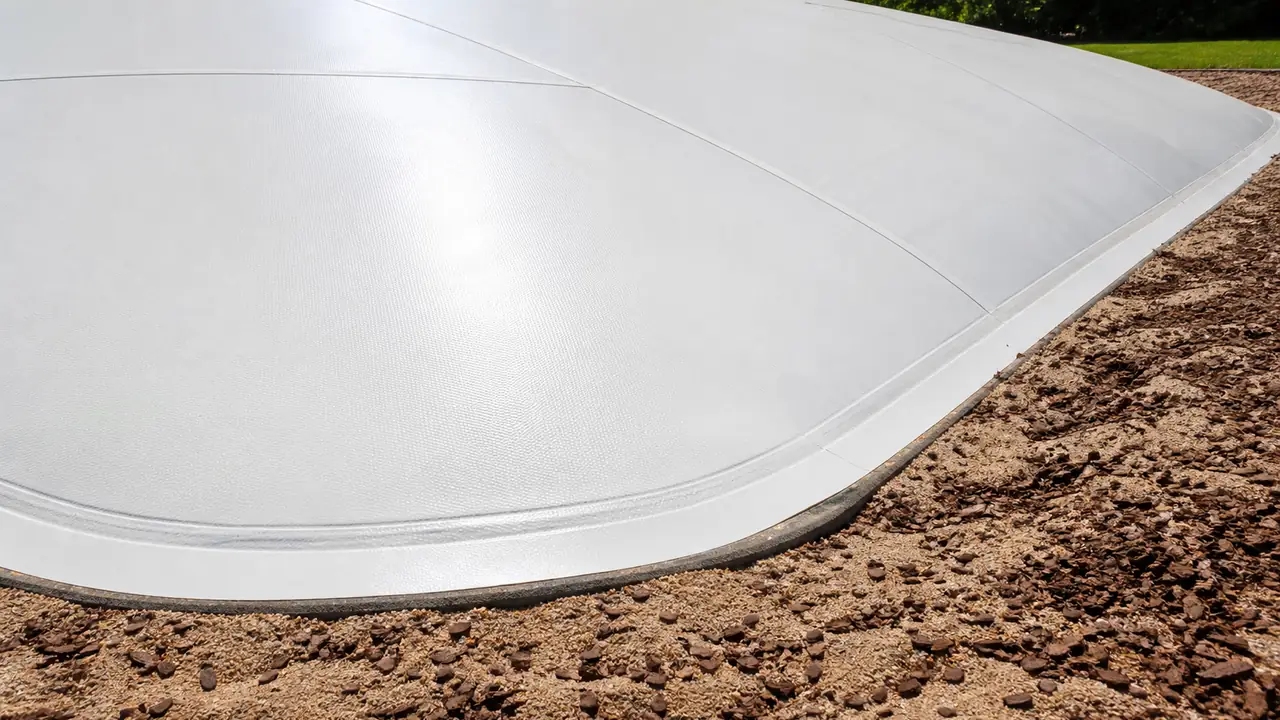
There are two mounting approaches. Inground (low-profile) install sets the pillow into a shallow shaped pit so the jumping surface sits nearly flush with the surrounding sand, bark or grass — the cleanest look, the easiest step-on access, and the most common choice for permanent holiday-park installs. Above-ground install places the pillow on prepared level ground with a built-up soft perimeter; it is faster to commission and better suited to seasonal or semi-permanent sites where excavation is not practical.
Either way, the ground works matter as much as the pillow. A properly graded base, good drainage and a defined soft fall zone of sand or bark around the entire perimeter are what keep the attraction safe and low-maintenance across a full season.
A jumping pillow must be positively secured — it carries dynamic load all day and cannot be allowed to shift. Depending on install type and ground conditions, that means ground anchors, buried tie-downs or ballast integrated into the pit edge. Get the anchoring specification right from the start; our overview of anchoring and ballast systems covers the trade-offs between staked and ballasted methods for different surfaces.
The soft fall zone surrounding the pillow is not optional — it is the primary safety feature of an open-sided product. It must extend around the full perimeter so that jumpers leaving the surface land on cushioning material, never on hard ground. Capacity and supervision should always follow the manufacturer's rated values supplied with your specific unit rather than any generic figure.
Two clarifications save buyers from ordering the wrong product. First, a jumping pillow is not a walled bouncer — it has no enclosure and a completely different supervision model, as covered above. Second, and more importantly, a jumping pillow is not a stunt or landing airbag. Freefall and stunt-landing airbags are engineered fall-arrest devices for controlled drops from height. A jumping pillow is a play product for people bouncing at ground level — it is not rated to arrest a fall and must never be used for jumps from height. If your use case involves drops or stunts, that is a separate category with its own engineering.
The whole value case rests on uptime. A pillow that needs patching every week is not an earner. Reinforced seams, a heavy-duty top skin, UV-stable material and reinforced anchor and inflation points are what let a commercial inflatable jumping cloud absorb heavy daily use across a season. When you compare quotes, look past the headline size to seam construction, skin weight and warranty on the jumping surface. The same durability logic applies across larger multi-play funland zones if you plan to build the pillow into a wider play area.
Jumping pillows ship well because they fold into dense bales. A single large pillow packs to a manageable cube, and multiple units consolidate efficiently into a 40 ft HQ container for FOB or CIF shipment — confirm exact carton dimensions with the factory so you can optimise container loading against your order. MOQ is flexible for commercial buyers; single trial units through to full-container mixed orders are all workable factory-direct.
OEM is where export buyers add margin. Custom pillow colours, printed logos and branded perimeter are standard OEM options — useful for park operators building a consistent site identity or distributors selling under their own brand. Specify colours, branding and certification requirements (EN 14960, ASTM) up front so they are built in rather than retrofitted.
A well-built jumping pillow is one of the most reliable revenue-per-square-metre attractions a campground or park can install: high capacity, low supervision, long service life. Get the size, install method, anchoring and OEM spec right at the order stage and it will run for seasons.