Paddle-sports hire has quietly become one of the highest-margin add-ons a waterfront operator can run. A resort beach, a lakeside campground, a marina dock, or a hotel water-sports desk can put a rack of inflatable kayaks and SUP boards on the water with almost no fixed staff, no fuel, and no engine maintenance — and rent each unit dozens of times per season. If you are sourcing a fleet rather than a single unit, the buying logic is completely different from buying for personal use, and this guide walks through what matters when you order at volume.
Human-powered paddle craft sit in a sweet spot for rental operators. Unlike motorized craft, a rental kayak or paddle board needs no licensing overhead, no fuel logistics, and minimal on-water supervision. Customers self-launch from a beach or dock, and one attendant can manage a rack of ten or twenty units. If you also run powered or rowing craft, treat those as a separate category — our commercial inflatable boats guide covers dinghies, rowing boats, and motorized tenders, which carry different safety, storage, and maintenance demands. This article is strictly about paddle-powered hire: kayaks, stand-up paddle boards, and canoes.
The case for inflatable over hard-shell is a rental economics case. Hard boards and rigid kayaks are heavy, awkward to stack, easy to gouge on concrete ramps, and expensive to store off-season. An inflatable SUP board or inflatable kayak rolls down to a duffel-sized package, survives being dragged up a beach, and stacks a full fleet into a fraction of the storage footprint. For a seasonal operation, that storage and transport advantage alone often decides the purchase.
Matching the fleet to your customers keeps utilization high:
A balanced starter fleet usually skews toward stable, beginner-friendly all-around SUPs and sit-on-top kayaks, with a handful of tandems and touring units to serve the confident end of the market.
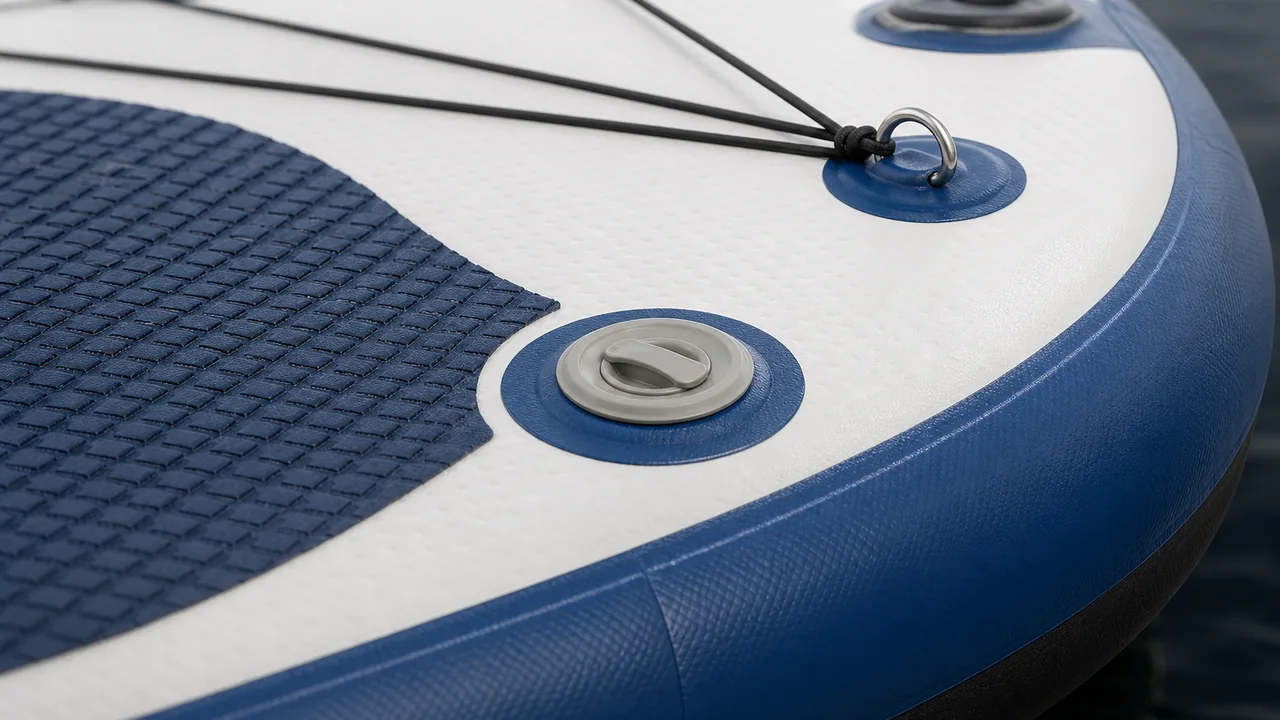
The single most important term in this category is drop-stitch. A drop-stitch core is built from thousands of fine threads connecting the top and bottom skins; when inflated to high pressure, those threads hold the panel flat and rigid, giving an inflatable board a stiffness that approaches a hard board. A quality drop-stitch SUP at full working PSI feels rock-solid underfoot rather than spongy — that rigidity is what makes an inflatable board a credible substitute for fiberglass on the rental rack.
For commercial fleets, look for these build details:
Because inflatable paddle craft are repairable in the field, a well-built fleet degrades gracefully — you keep units in service with patch kits rather than replacing them, which is the core of the rental ROI story.
Kayaks and SUPs rarely stand alone on a busy waterfront. Operators frequently pair them with other on-water products to build a full day-guest experience — an inflatable floating lounge platforms gives paddlers a mid-water rest and social hub, while a broader deck of commercial water attractions turns a single rental desk into a destination. For sheltered pools and calm shallows, our airtight water play range complements a paddle fleet, and operators scaling into powered craft can review the inflatable boats range alongside their kayaks and SUPs.
Rental safety is mostly about discipline, not equipment. Pair every paddler with a properly fitted PFD (personal flotation device) as a condition of hire, and keep spares in a range of sizes. Always inflate each unit to, and never above, the manufacturer's rated working pressure, and respect the rated paddler count and weight capacity printed on each hull or board — treat those figures as hard limits set by the maker, not numbers to estimate. Keep a hand or electric pump and a pressure gauge at the launch point, and pump up to spec before every session in cooler conditions where pressure can drop.
For marine and saltwater venues, rinse units with fresh water after use, store them out of prolonged direct UV, and inspect valves, seams, and D-rings on a regular schedule. A quick pre-hire visual check — pressure, valve seat, deck pad, rigging — catches most issues before they reach a customer.
The commercial advantage of inflatable paddle craft shows up sharply in freight. Because every unit rolls down compact, a shipping container holds far more inflatable kayaks and SUPs than the equivalent number of rigid boards — your cost per unit landed drops accordingly, and a full season's fleet can arrive in a single, efficiently packed container. When you request a quote, ask about:
Sourced well, a paddle-sports fleet is a low-labor, high-utilization asset that recovers its cost over a season or two and keeps earning long after. Build it around fleet-grade drop-stitch construction, match the mix to your venue, and order the accessories as part of the package.