Most of the inflatable boats you see online are built for a weekend angler who inflates them a dozen times a year. That is a completely different product from the inflatable boats a water park or resort needs to survive a full operating season of paying riders, UV exposure, and staff who are paid to move guests fast, not baby the equipment. If you are sourcing for a commercial operation, the buying logic flips: portability and price stop mattering, and material grade, load rating, and compliance become the only numbers worth arguing about. Spec a recreational hull into a commercial duty cycle and it will fail within a single season — usually at the seams, usually on a busy weekend.
This guide covers what commercial buyers actually need to evaluate: the product categories that belong in a water attraction, the construction that separates commercial from consumer, load and safety ratings, how boats pair with your wider water setup, and the logistics that decide your landed cost.
"Inflatable boats" in a commercial water-attraction context is a broad category, and it is worth being precise about which SKUs you are actually buying. The main types include:
These are commercial assets, not consumer toys. You can see the full commercial range on our commercial inflatable boats category, which sits within the broader airtight water play range for operators building a complete on-water attraction.
The single biggest difference between a recreational boat and a commercial one is the skin. Consumer inflatables use thin 0.4–0.6mm PVC that punctures easily and degrades fast under sun. Commercial inflatable boats are built from 0.9mm PVC tarpaulin — a heavy, reinforced fabric that takes abrasion from sand, concrete edges, and constant boarding without splitting. For floors and rigid sections, drop-stitch construction (thousands of internal threads holding two layers under high pressure) creates a board-stiff surface that behaves like a hard hull while still packing flat.
What to confirm with any supplier before ordering:
Commercial procurement lives and dies on the capacity plate. Every unit should be specified with a clear rider count and maximum load in kilograms, not a vague "fits the whole family." A 4-person towable rated for recreational use may carry a 320 kg load; the commercial equivalent should be tested and documented to that figure with margin, because your riders rotate hundreds of times a day.
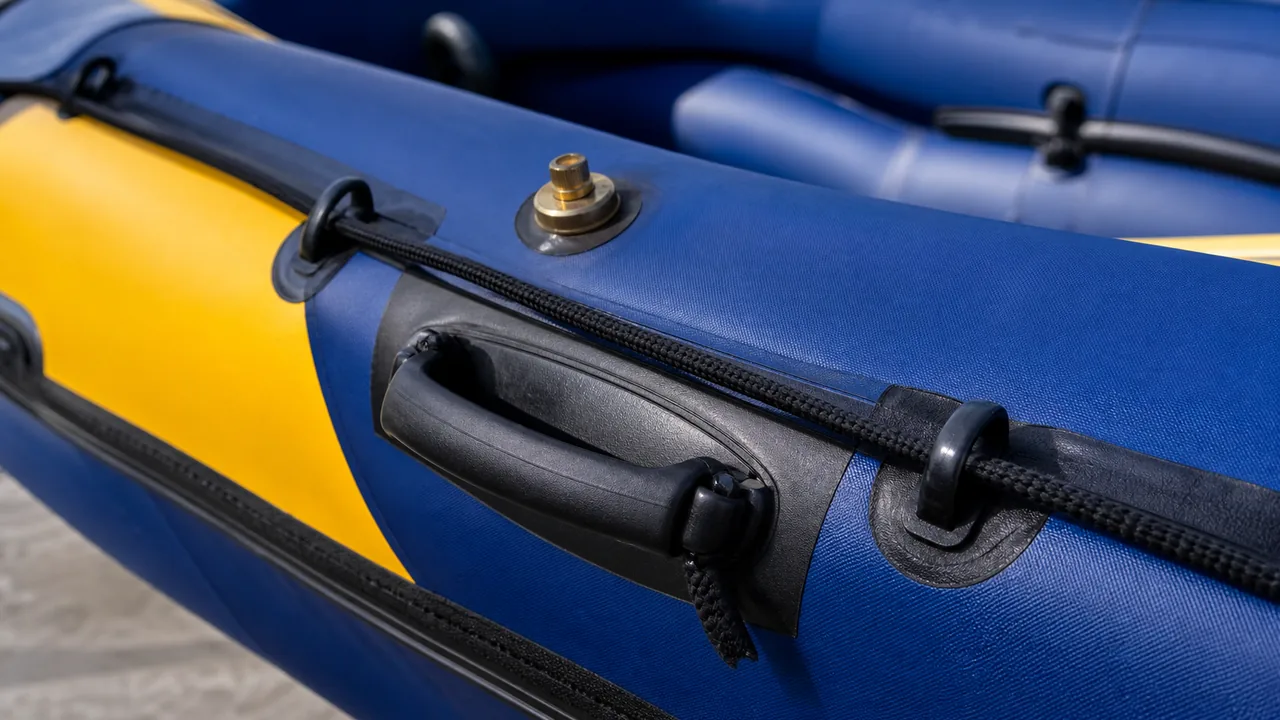
Build your safety spec around: independent air chambers, heavy-duty reinforced grab handles and tow points (the most common consumer failure point), non-slip boarding surfaces, and clearly molded or printed capacity markings. For units used inside a contained attraction, alignment with playground and inflatable safety norms such as EN14960 matters to European buyers and to your insurer. Ask the factory for test documentation, not just a verbal assurance.
Standalone towables are a rental line. The higher-margin play is integrating boats into a contained aqua park — a floating obstacle course where guests use paddle boats, platforms, and play craft as part of the circuit. This keeps guests inside your footprint, on your wristband, and spending longer. When you plan the layout, the boats need to match the anchoring system, water depth, and traffic flow of the wider park. Sourcing the boats and the park modules from one factory keeps the connection hardware, valves, and repair kits standardized — a real operational saving when you are patching units between sessions.
Inflatable boats deflate and roll, which makes them freight-efficient, but landed cost still turns on how well you pack a container. Tubes and towables roll tight; platforms and drop-stitch floors are bulkier and need careful nesting. For a mixed fleet order, the difference between a poorly and a well-planned load can be 20–30% more units in the same box. Before you finalize an order, work out whether your volume justifies a full 40ft HQ or whether a 20ft container fits the launch fleet — our comparison of 20ft vs 40ft HQ container loading walks through the math. Quote on both FOB and CIF terms so you can compare a freight-forwarder's rate against the factory's consolidated shipping.
For a factory-direct commercial order, expect a reasonable MOQ rather than single-unit pricing — boats are made to order, and tooling for a custom size or print only makes sense above a minimum run. OEM and ODM are standard: branded tube prints, custom colorways matched to your park theme, custom sizing for a specific lagoon, and your logo on every unit. Build in a realistic production lead time (typically several weeks for a custom commercial run, longer in peak season) and confirm certification and material test reports up front — TÜV, EN14960 alignment, and PVC material certificates are what your importer and insurer will ask to see.
Commercial inflatable boats are an investment in equipment that has to earn its keep season after season. The buying decision is not about the lowest unit price — it is about 0.9mm PVC over thin film, welded seams over glued, drop-stitch floors over flimsy decks, and documented load ratings over marketing claims. Get the material grade right and a commercial boat pays back across many seasons. Get it wrong and you replace the fleet next spring.
If you are speccing a fleet or building a full water attraction, talk to our team about commercial-grade construction, custom sizing, and consolidated container shipping. Send your target capacity, rider counts, and destination port, and we will quote on FOB and CIF terms.