The French-speaking market runs on inflatables. Fêtes de village, kermesses, comités d'entreprise events, parcs de loisirs, and summer beach programs in France, Belgium and French-speaking Switzerland all drive steady rental and resale demand for a structure gonflable catalogue that keeps operators busy from May through September. For importers, wholesalers and rental operators, the question is not whether the demand exists — it is where you buy your stock. This guide walks a French buyer through sourcing factory-direct from a Chinese fabricant structure gonflable, customizing for the local market, and importing cleanly into the EU.
Most French rental operators start by buying from a domestic revendeur or a regional distributor. That is convenient for one or two units, but it caps your margin and your range. A local reseller has already added their markup on top of the factory price, and their catalogue is limited to whatever they chose to stock. When you buy jeux gonflables directly from the manufacturer, you keep the intermediary margin, you access the full production range, and you can commission products that no reseller carries. For a business scaling a rental fleet or a wholesale operation, that difference compounds fast.
Not every Chinese supplier is a real factory. Many are trading companies that resell other people's production, which means no control over quality, no custom capability, and an extra margin layer you are paying for without knowing it. Buying from an actual fabricant structure gonflable gives you direct QC oversight, real custom production (theme, size, print), and one accountable party for the whole order. When you evaluate a supplier, confirm they own the workshop, sewing lines and welding equipment — a genuine fabricant will happily show you the production floor over video. Our factory-direct sourcing guide covers how to verify a real factory in depth.
A well-rounded French rental or wholesale catalogue usually spans three families. The core is dry play: châteaux gonflables, toboggans (slides), and combo units that pack a bouncer, slide and obstacle into one footprint — the highest-turnover items for kermesses and private hire. Next is water: aquatic structures, water slides and floating obstacle courses that carry the summer season at plages, campsites and municipal pools. The third is brand activation: advertising inflatables for retail openings, sports events and salons. Stocking across all three keeps your fleet earning year-round rather than only in peak weeks.
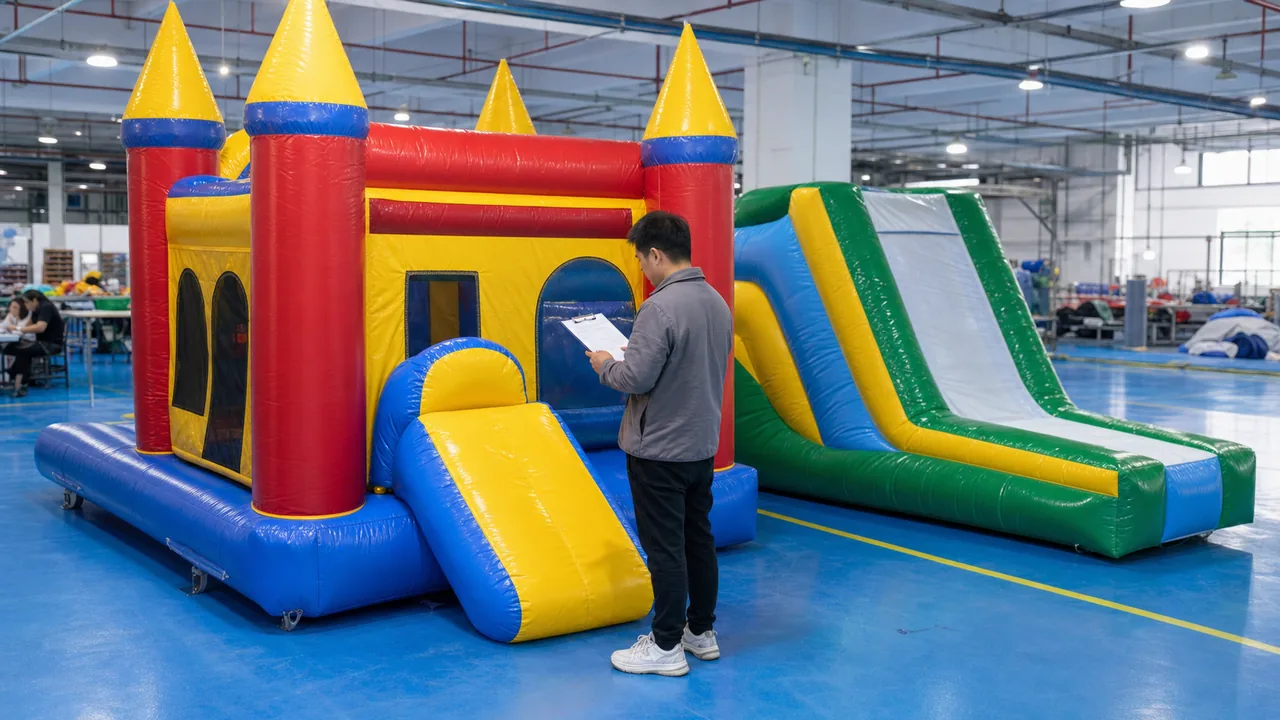
Explore the commercial inflatable games range for bouncers, slides and combos, the water attractions range for aquatic units, and the advertising inflatables range for brand activations.
Custom is where factory-direct sourcing pays off most. A fabricant can produce structures gonflables sur mesure to match the French market: themed designs (pirate, farm, medieval château gonflable), specific colourways, and printed branding for your own rental company or for a client's activation. OEM and ODM both work here — send a finished design and the factory builds to spec, or bring a concept and the factory's design team develops it into a production-ready unit. Custom print, custom dimensions to fit a specific venue, and your logo on the artwork all differentiate your fleet from the generic stock every other regional operator is renting out.
Sourcing at wholesale volume changes the economics. Inflatables are bulky but light, so a mixed 40ft HQ container is the standard shipping unit — you can combine a dozen or more units of different types into one load, spreading freight cost across the whole order. MOQ is flexible with a real factory; a single custom unit is possible, but container-level orders unlock the best per-unit value. Plan on roughly a 25-45 day production lead time depending on customization and season, then add ocean transit. Decide early between FOB (you control freight from the Chinese port) and CIF (the factory arranges shipping to your destination) — FOB gives you control if you have a freight forwarder, CIF is simpler if you do not.
For French buyers, containers typically route to Le Havre, Marseille or Fos-sur-Mer. Budget for EU customs clearance, VAT and import duty, and have your EORI number and compliance documents ready before the vessel arrives. Getting the paperwork right up front avoids demurrage charges at the port.
This is non-negotiable for anyone renting inflatables to the public in France. EN 14960 is the mandatory European standard for inflatable play equipment — anchorage points, wall heights, containment, and structural requirements are all defined by it, and insurers and event venues will ask for it. Specify material carefully: commercial-grade PVC in the 0.55mm to 0.9mm range, with reinforced, double-stitched or welded seams that survive daily commercial use rather than the thin single-layer fabric used for consumer toys. Ask your fabricant about fire-retardant fabric to B1 rating, which many French and EU venues require. Confirm CE-relevant documentation and full test records are supplied with the order. Our importing inflatables to the EU guide details the compliance and customs steps for European buyers.
A rental operator building general fleet stock can order on a flexible timeline, but an event organizer sourcing a structure gonflable for a specific trade show, festival, or corporate activation date works backward from a fixed deadline. Confirm production and shipping lead time against your actual event date with buffer for customs clearance, not just factory lead time alone — a structure that misses its event date has no value regardless of how well it was specified. If you're sourcing across both the French market and DACH (Germany, Austria, Switzerland) for a multi-country event circuit, confirm your supplier can produce to both markets' certification requirements in a single production run rather than running separate compliance passes, which adds cost and time without adding real safety value when the underlying structure is identical.
For a French-speaking-market buyer, the winning approach is straightforward: source from a genuine fabricant structure gonflable, not a reseller or trading company; build a mixed catalogue of jeux gonflables, water units and advertising inflatables; commission structures gonflables sur mesure to stand out; consolidate into 40ft HQ containers to Le Havre or Marseille; and lock EN 14960 compliance into every unit before it ships. Do that, and factory-direct sourcing turns a seasonal rental business into a scalable, higher-margin operation.