
An inflatable water iceberg is a tall, free-floating climbing attraction anchored in open water. Swimmers grip moulded hand and foot holds, scale the angled faces to a summit of 3–6 m, then jump or take an integrated slide back into the lake or sea. The inflatable climbing blob is its high-energy companion: a large air pillow where one participant jumps from a platform onto one end and launches a second participant off the other into deep water. Both are marquee open-water pieces for resorts, beach clubs and aqua-park operators who want a signature, high-throughput attraction.
It is worth being precise, because buyers often confuse three products. The water iceberg is the open-water counterpart to the dry land-based inflatable climbing walls and towers: same climbing concept, but engineered to float, drain and land climbers safely in water rather than onto a crash mat. It also differs from a bouncing platform — if you want a springy jump deck, look at the inflatable water trampoline instead. Icebergs and blobs are built for climbing, launching and gravity, and they sit within our wider commercial floating water attraction range.
A commercial iceberg is a multi-faced tower. One or two faces carry a dense grid of moulded climbing holds; the opposite side is usually a smooth, integrated slide so climbers can descend fast and cycle back to the queue.
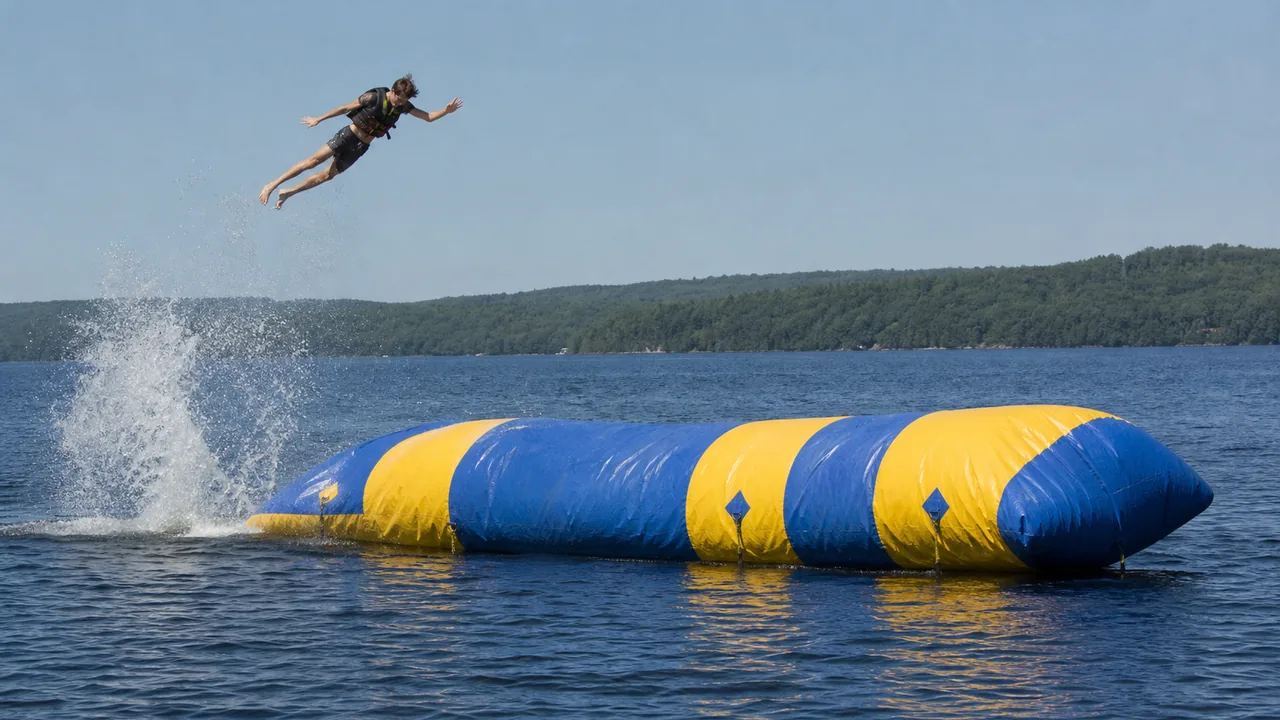
The blob — also called a water catapult or launch pillow — is a long, sealed airbag, typically 6–10 m depending on the launch power you want. A "jumper" drops from a raised platform onto one end and the displaced air fires the "flyer" from the other end high into the water. It is one of the most photographed attractions in any park, but it is also the one that most rewards disciplined operation.
Open-water use is punishing: UV, chlorine or salt, constant flexing and dozens of climbers per hour. That is why commercial icebergs and blobs are built from 0.9 mm reinforced PVC tarpaulin on the main envelope, with drop-stitch panels used for the rigid, high-pressure decks and platforms that must stay flat underfoot. Key build details buyers should confirm:
Getting the mooring right is the difference between a safe attraction and a liability. Icebergs and blobs are held on multiple anchor lines running to weights or screw anchors on the lake or sea bed, tensioned so the piece stays on station in wind and current while allowing gentle rise and fall.
For operators building a full open-water venue, the iceberg and blob are anchor pieces within a larger layout — see our complete floating water park systems and our planning guide on aqua park design for 200-guest capacity to balance throughput and lifeguard coverage.
Both products ship deflated and folded, so freight is efficient. A 20ft container suits a starter package of a single iceberg plus a blob and accessories; a 40ft HQ container consolidates multi-piece park orders and lowers per-unit shipping cost. MOQ is flexible for mixed trial orders, and we quote FOB or CIF to your nearest port.
Full OEM/ODM capability means we tailor colourways, print your logo and brand graphics, adjust iceberg height and slide configuration, and size the blob to your target launch power and water depth. The commercial value case is straightforward: durable reinforced PVC, high hourly throughput and repeat photo-driven visits deliver strong ROI across a multi-season service life, with in-house repairability protecting your investment.