
An inflatable water trampoline is one of the highest-turnover single units in open-water recreation: a floating bounce platform that anchors in a lake, a sheltered bay, a reservoir or a large resort pool and puts a queue of guests on it from the moment the season opens. For operators building a waterfront attraction, it is worth understanding exactly what you are buying, how it is built, and how it ships — because the difference between a two-season throwaway and a five-season revenue asset is entirely in the specification.
The product is a round floating ring — the buoyancy tube — with a tensioned jumping mat suspended across its centre. Guests climb aboard from the water or from an attached inflatable launch pad and bounce. That is the whole idea, and its simplicity is why the commercial water trampoline remains a staple of waterfront rental fleets, resort beaches and inland lake operations.
Placement drives almost every spec decision. In open water — lakes, calm coastal bays, reservoirs — the unit must ride wave action and hold a mooring, so buoyancy volume and anchor hardware matter most. In a resort pool or enclosed lagoon the water is flat, so the priority shifts to deck feel and guest flow. As a standalone aqua jump platform, the water trampoline is the anchor attraction people photograph, but it is not the same product as a modular play structure — more on that below.
Two things carry the load: the buoyancy tube and the jumping surface. The buoyancy tube is a large-diameter air chamber that keeps the unit afloat and defines its footprint. Larger tube diameter means more reserve buoyancy, more freeboard and a more stable ride in chop — a real consideration for open-water sites. Commercial units use heavy-gauge reinforced PVC, typically in the 0.9 mm class, because the tube takes constant UV, abrasion against the mat frame, and boarding loads at the waterline.
The jumping surface comes in two families. The classic build is a single-tube trampoline: a fabric mat tensioned across the ring with a webbing lacing system, giving the springy, forgiving bounce most guests expect. The newer build uses a drop-stitch deck — thousands of internal threads that let a panel inflate rock-hard and flat, so instead of a sprung mat you get a rigid inflated platform. Drop-stitch is stiffer, more like a stage than a trampoline, and is favoured where you want a walk-on/launch surface or a firmer rebound. Many operators run a sprung-mat trampoline as the centrepiece and add drop-stitch launch pads or decks around it. Whichever you choose, check the seam construction (welded, not merely glued), the D-rings, and the anchor rings moulded into the tube.
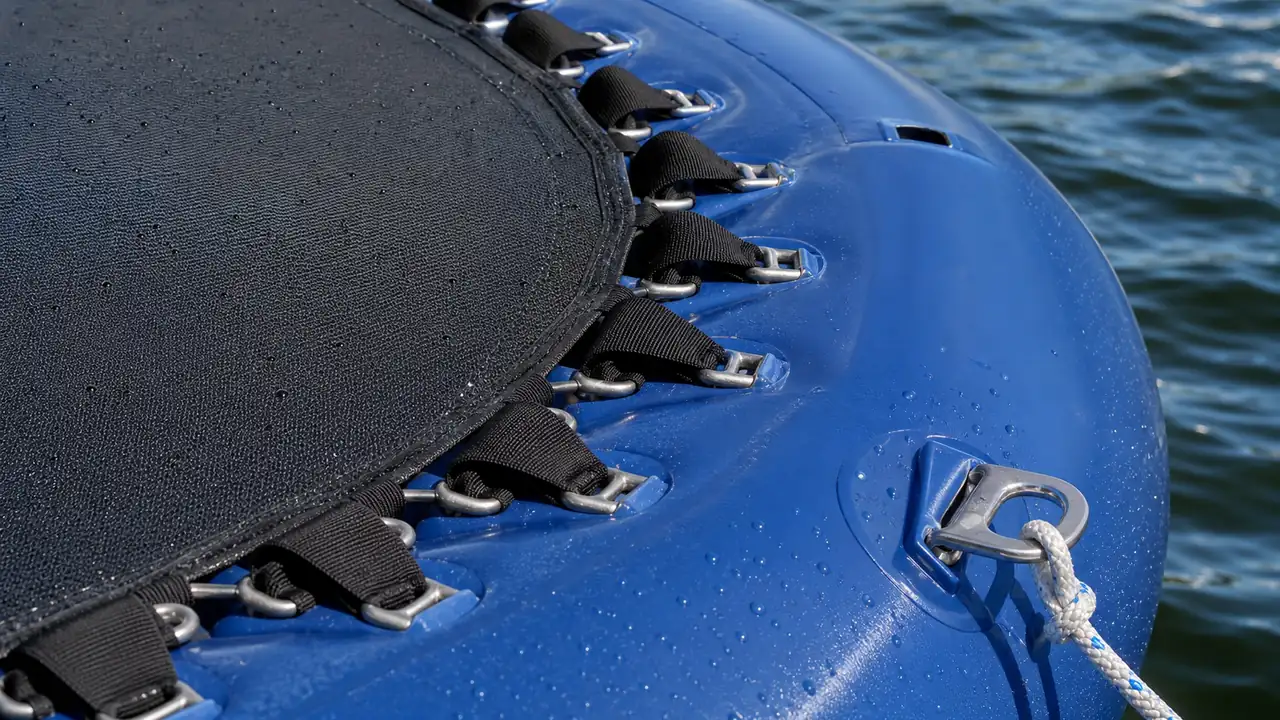
A floating trampoline is only as safe as its mooring. Open-water units carry multiple anchor rings around the buoyancy tube so the load can be spread to more than one anchor point, and reputable builds add reinforced D-rings for bridle lines. Your bottom conditions — sand, mud, rock — dictate the anchor type and rode length, and current plus expected wave height dictate the holding power you specify. The trampoline should sit on the mooring without snatching, with enough scope that a passing wake lifts it rather than jerking the rings. If you are laying out a multi-unit waterfront, plan the whole mooring field together; our overview of anchor and mooring systems walks through spacing, bridles and seasonal recovery.
Do not guess load limits. Every unit ships with a rated user count and weight capacity, and you should operate to the manufacturer's rated values — never above them, and never with more jumpers than the rating allows regardless of how much deck looks free. Freeboard (how high the tube rides above the waterline) affects both boarding and how the unit sheds wave water; a fuller buoyancy tube holds freeboard better as guest load increases. Keep the surface clear of hard edges, brief guests on one-at-a-time bounce zones where the rating requires it, and inspect anchor hardware and seams at the start of every operating day. Certification (EN 14960, ASTM) applies to the manufacturing side; the operating discipline is yours.
The water trampoline is a complete product on its own, and that is exactly why buyers get confused. It is not a slide — if you want riders sliding into the water, that is a different category entirely, covered by our commercial water slides. It is not a connected obstacle course either. The floating trampoline is the bounce/jump element. When operators want an entire connected play field — climbing walls, monkey bars, blast bags, slides and jump stations linked into one course — that is the aqua park modules range, and a trampoline typically drops in as one node within it. If you are scoping a full attraction, our breakdown of modular water park build-outs shows how a jump platform sits alongside the larger course. Many buyers start with a single trampoline to prove the site, then expand into a full airtight water play range once the footfall data is in.
From a sourcing standpoint the floating water trampoline is friendly to ship because it deflates to a dense roll. Diameter drives the packed cube, so a mixed fleet of small and large units loads efficiently into a 40 ft HQ; ask your factory for the packed dimensions and per-unit cube so you can plan the container properly rather than paying to ship air. MOQ is workable even for boutique resorts — a single trampoline plus a few launch pads is a viable first order, and volume opens better tooling and colour runs.
On branding: this is a natural OEM product. Buoyancy tubes take custom colourways and printed logos cleanly, so a resort or a rental brand can run its own livery across the fleet. Specify your Pantone colours, logo placement, mat colour and any launch-pad add-ons up front, and confirm FOB/CIF terms and lead time before the tooling starts. The value case is straightforward: a correctly specified commercial unit run to its rated capacity earns back its landed cost quickly across a busy season, and heavy-gauge PVC plus welded seams is what keeps it earning for several seasons rather than one.
For operators building out a full waterfront program, a floating trampoline pairs naturally with other wet attractions — see our guide to commercial inflatable water games for the interactive pieces that round out an aqua zone.
For powered and rowing craft rather than a bounce platform, our commercial inflatable boats guide covers dinghies and tenders for waterfront operations.