
Few attractions pull a crowd like a climbing challenge. An inflatable climbing wall gives event companies, FEC operators, and adventure providers a high-visibility, fully mobile draw that packs into a single container and deploys on almost any flat surface. Unlike a fixed climbing structure, it needs no concrete footings, no permanent footprint, and no crane to install—yet it delivers the same "can I reach the top?" energy that keeps queues moving all day.
This guide breaks down the category for commercial buyers: what types exist, why handhold and material durability drive lifetime value, how safety systems and landing design actually work, and what to check before you commit to an order. If you also run wet or obstacle attractions, it sits naturally alongside our commercial inflatable sports range.
"Climbing inflatable" covers several distinct product families, and matching the right one to your audience and site is the first sourcing decision.
The classic format: one broad climbing face with multiple parallel routes so several climbers race side by side. Rental operators favor these for throughput—more lanes means more turns per hour. Route difficulty is set by handhold spacing and size.
An inflatable climbing tower stacks routes vertically on a taller, often multi-sided structure. The inflatable climbing mountain variant offers several climbable faces around a central peak, letting a group climb from different sides at once—strong for team-building and camp settings where engagement matters more than raw lane count.
For a headline attraction, a climbing wall with auto belay pairs greater height with a self-retracting descent device that lowers each climber under control. This is the format that reads as a genuine "adventure" experience and commands premium pricing at fairs and festivals.
Shorter, gentler-angled walls sized for younger climbers—ideal for FECs and family events where the priority is accessibility and constant, low-supervision turnover rather than height.
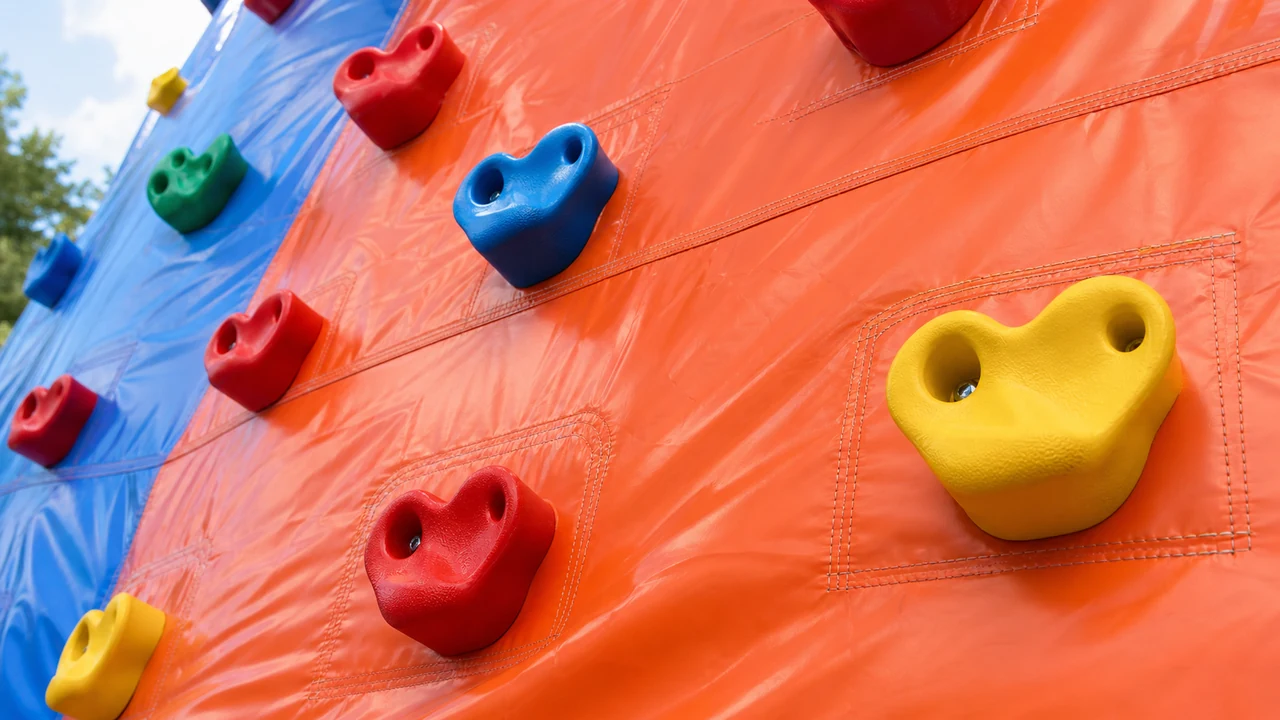
An inflatable rock climbing wall lives or dies on two things: the climbing surface and the handholds. The base should be built from 0.9mm PVC tarpaulin—abrasion-resistant, tear-tolerant, and able to survive thousands of climbers dragging shoes and hands across it. Thinner material may quote cheaper but wears through at stress points far faster; the trade-offs are worth understanding, and our guide to PVC tarpaulin grades covers them in detail.
Handholds are the highest-wear component of all. Look for firmly bonded, reinforced climbing points—stitched and welded rather than lightly glued—positioned to define clear routes. Ask suppliers how holds are anchored to the face and whether replacements are available, because holds take the most punishment and you want a wall you can maintain rather than retire.
Two systems carry the safety load on a climbing inflatable. The first is the auto belay on taller walls—a descent mechanism that catches a climber and lowers them smoothly if they let go or reach the top. The second, on all formats, is the landing: an integrated cushioned air mattress or thick buffer zone at the base that absorbs a fall or dismount.
Always operate to the manufacturer's rated values for maximum climber height, weight limits, and simultaneous user counts—these are set per structure and should never be exceeded or guessed at. Confirm the supplier tests to the standards your market requires and supplies the belay hardware and landing cushion as a matched system rather than as an afterthought. For securing the unit against wind and movement, the same principles as any tall inflatable apply; see our overview of anchor systems for inflatables.
Most commercial climbing walls run on continuous-airflow blowers—air moves through the structure constantly so a small puncture won't collapse it mid-use. Taller towers are often built in modules for stability and easier handling. On site, you need a flat area with clearance around the landing zone plus room for climbers to queue and staff to supervise.
Setup is a core selling point: a well-designed mobile climbing wall unrolls, inflates, and is climb-ready in well under an hour with a small crew, then packs down just as fast for the next booking. That turnaround is what makes it viable for weekend event circuits. If you're comparing it against other active attractions for your fleet, our inflatable obstacle course buyer's guide covers complementary high-throughput products.
Climbing walls ship deflated and folded, so freight planning matters. A single high tower can consume real cube, and mixing wall sizes affects how efficiently you fill a container—our breakdown of 20ft vs 40ft HQ container loading helps you plan FOB or CIF volumes. For most factories, MOQ is flexible on a single flagship unit, with better per-unit economics as quantities rise.
OEM and branding are standard: color matching, your logo on the climbing face, and custom heights or route layouts are typically available on production orders. Specify these up front so artwork and material are locked before manufacturing begins.
A durable climbing wall—0.9mm PVC face, well-anchored handholds, a proper auto belay and landing cushion—turns floor space into repeat revenue across events, FECs, and camps for years. Source it right the first time and it becomes one of the highest-utilization units in your fleet.