
A professional inflatable pool (piscina gonfiabile professionale) is a commercial-grade water structure engineered for continuous rental, hospitality and event use — not the thin backyard product sold in retail. The difference is not marketing; it is measurable in material thickness, wall construction, seam technology and certification. For European B2B buyers sourcing factory-direct, understanding these specifications is the difference between a unit that survives three seasons of daily use and one that fails within weeks. This guide breaks down exactly what separates professional grade from consumer grade, and what to demand on a spec sheet before you place an order.
This isn't a site-engineering guide — our commercial inflatable pools guide for resorts and hotels covers frame-vs-airtight construction, filtration and drainage integration, and ground load-bearing for a fixed installation. This one is the material-grade and certification verification guide: how to confirm a supplier's professional-grade claim is real before you order, and what European compliance documentation to require.
The fastest way to qualify a supplier is to compare the technical spec against a commercial benchmark. Consumer pools optimise for shelf price; professional units optimise for durability, safety and total cost of ownership. Here is how the two grades diverge on the points that actually matter:
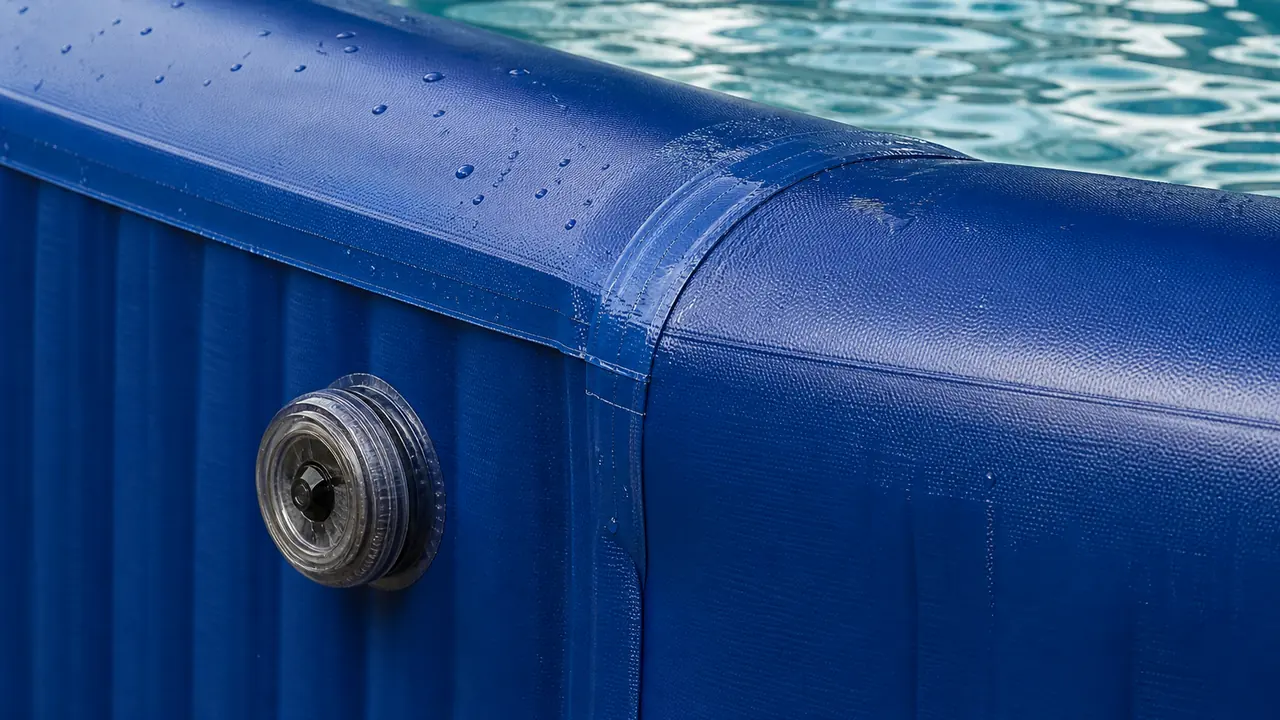
Material is where most sourcing mistakes happen. The professional baseline in Europe is 0.9mm reinforced PVC tarpaulin — a coated woven fabric that combines a polyester base cloth with PVC layers on both sides. That construction gives the fabric its tear strength, water-tightness and resistance to the UV, chlorine and mechanical abrasion that destroy lightweight film. Weight (measured in g/m²) is your quick proxy for quality: 900 g/m² and above signals commercial intent, while anything under 600 g/m² is a consumer product wearing a professional label. When you evaluate suppliers, ask for the exact fabric weight, the brand of the base cloth, and the full range in the commercial inflatable water product range so you can match material grade to your application. Fabric selection is deep enough that it deserves its own study — our breakdown of PVC tarpaulin grades for commercial inflatables covers weight, coating and scrim in detail.
The single biggest visual and structural difference between a professional and consumer pool is the wall. Consumer pools use ring chambers that sag and need constant topping up. Professional drop-stitch inflatable pools use high-pressure panels inflated to several hundred millibar, producing a wall that is rigid, self-supporting and dimensionally stable even when full of water and bathers. Drop-stitch also enables airtight (sealed-air) construction: once inflated, the pool holds pressure without a continuously running blower, cutting energy cost and noise — a real advantage for hotels, spas and event venues. If you are weighing sealed-air against constant-air blower systems, our guide to airtight versus constant-air and drop-stitch construction explains the trade-offs for each use case. For sourcing sealed-wall units specifically, review the dedicated airtight inflatable pools category and match wall height and footprint to your site.
Professional buyers size to their operation, not to a box on a retail shelf. Specify the footprint (length × width), wall height, water depth and stated bather capacity up front. A resort splash pool, a paddle pool for a kids' club, and a deep pool for a scuba or mermaid experience all demand different depths and reinforcement. Confirm the fill volume, the number and placement of drain valves, and the anchor or ballast points — these determine how quickly staff can turn the unit around between sessions and how safely it holds a full bather load. Reinforced handles and lifting points also matter for daily setup by rental crews.
For the European market, documentation is not optional. Where an inflatable pool includes play or amusement features, EN 14960 — the standard for inflatable play equipment — becomes the relevant reference for design, materials and safety testing. Even for pure water-containment units, professional buyers should require material fire-retardancy data, non-toxic coating declarations and load documentation. Ask any factory to state which standards their production line is tested against and whether they can supply the paperwork your local authorities or insurers will request. A supplier that cannot produce this is selling a consumer product with a commercial price tag.
EN 14960 applies EU-wide as the baseline standard, but local inspection culture and buyer expectations still differ meaningfully by country:
| Market | What Buyers Typically Expect | Installation Notes |
|---|---|---|
| Germany & Austria (DACH) | TÜV field verification is commonly requested for larger public installations, on top of factory EN 14960 documentation | Skilled labor cost runs higher; inflatable installations save meaningfully on setup labor versus traditional construction |
| France | Municipal and fairground event organizers often require proof of annual equipment inspection before granting a pitch for public installations | Coastal Mediterranean properties see strong seasonal demand; confirm contractor and inspection availability ahead of peak season |
| Italy | Professional pool buyers increasingly ask for spec sheets and certification upfront rather than after ordering, especially for resort and hospitality installations | Lower construction labor cost narrows the upfront gap with traditional pools, but inflatable installations still win on speed and off-season storage |
None of these are substitutes for EN 14960 documentation — they're additional local expectations layered on top of it. Confirm with your factory whether they have prior export experience into your specific target country, since customs and inspection expectations differ from general EU shipping.
The commercial advantage of buying factory-direct is control over specification and cost. A capable manufacturer offers OEM and ODM service — your branding, custom colours, printed logos, and dimensions built to your exact brief rather than a fixed catalogue size. Clarify the MOQ before you design your order; small custom runs and large volume runs carry very different lead times. On logistics, deflated professional pools pack tightly: plan container loading around 20ft and 40ft HQ units, and confirm whether pricing is quoted FOB (you arrange freight from the port) or CIF (the factory covers cost, insurance and freight to your destination). Getting the trade terms right protects your landed cost and your margin.
A professional inflatable pool earns its price through material grade, drop-stitch rigidity, welded seams, real capacity engineering and documented compliance. Consumer pools cannot deliver the service life or safety that continuous commercial use demands. Judge every supplier on the spec sheet — 0.9mm reinforced PVC, drop-stitch walls, welded seams, EN 14960 relevance where features apply, and clear OEM/MOQ and FOB/CIF terms. Meet those benchmarks and you buy an asset that returns its value season after season.
Request a professional inflatable pool quote and OEM options