
When a resort needs to add a swimmable water feature without pouring concrete, a commercial inflatable pool is often the fastest path from idea to opening day. But the value of these units has nothing to do with the toys floating inside them. It lives in the pool body itself: the wall structure that holds the water, the way the unit accepts filtration and drainage, and whether your site can carry the load. Get those three things right and a portable pool can be deployed in days, reconfigured between seasons, and moved to a new location entirely. Get them wrong and you have a leak-prone liability.
This guide is written for resort and hotel procurement teams, water park operators, and distributors evaluating the pool body as a piece of engineering, not as a consumer product. For material-grade verification and European certification requirements specifically, see our professional inflatable pools specification and compliance guide — this one focuses on the site-engineering side: construction method, filtration integration, and load-bearing for a fixed installation.
Commercial inflatable pools split into two structural families, and the difference drives almost every downstream decision.
Frame pools use rigid steel or aluminum poles to form a skeleton, with a PVC liner suspended inside. The frame carries the structural load; the fabric only holds water. These are stable and tolerant of uneven inflation, but they ship heavier, take longer to assemble, and the steel components are the part most likely to corrode or bend in transit.
Airtight pools hold their shape entirely through sealed, pressurized air chambers — no internal frame. A single inflation cycle stands the walls up, which means faster deployment and a lighter, more compact shipping footprint. The trade-off is that wall integrity depends completely on the fabric and the seam welds, so material quality and construction method matter enormously. For most resort and event applications where setup speed and portability win, the airtight inflatable pool range is the more practical starting point.
The single most important spec on a professional inflatable pool is how the walls are built. Standard single-skin inflatable walls balloon and bow outward when filled, because water pressure pushes hardest at the base. That bowing limits how deep you can safely fill the pool.
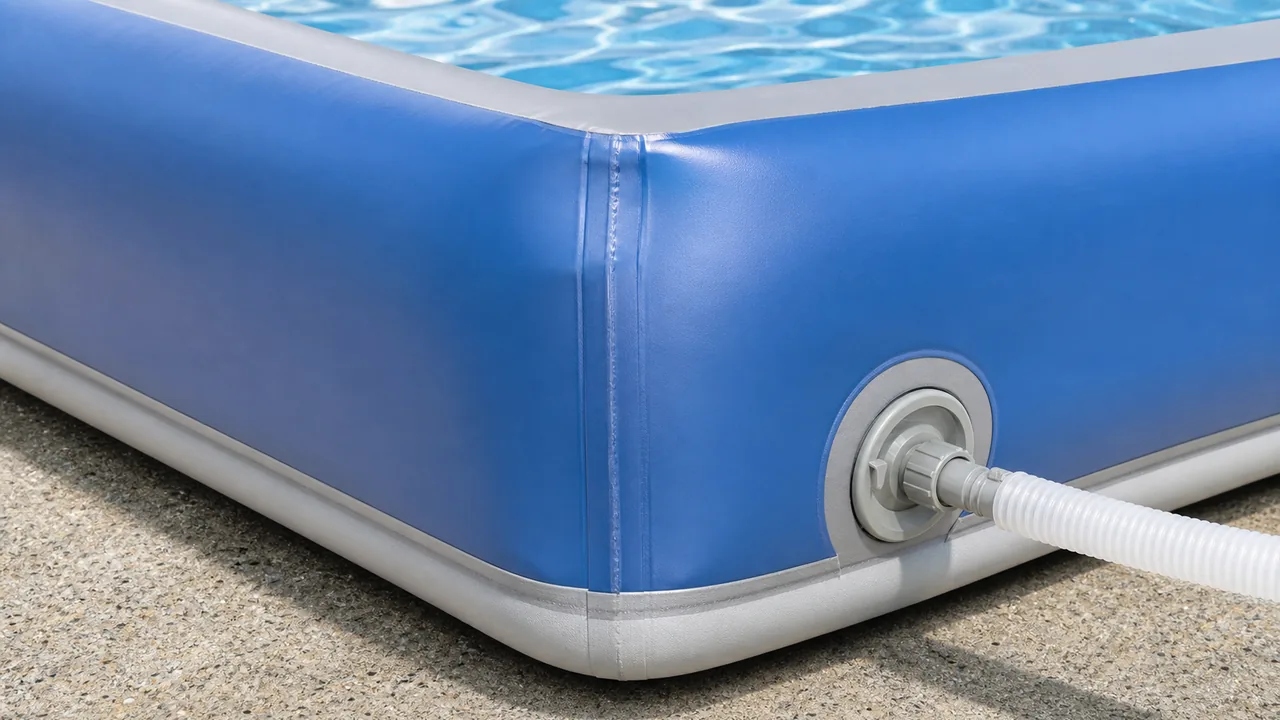
Drop-stitch construction solves this. Thousands of internal polyester threads connect the top and bottom layers of the wall, so when inflated to high pressure the wall becomes a rigid, flat panel rather than a rounded tube. A drop-stitch pool wall stays vertical under hydrostatic load, which lets you run deeper water with a thinner, more space-efficient wall profile. Typical commercial drop-stitch walls run in the 10–20 cm thickness range and hold pressures far above standard inflatables.
Water pressure rises with depth, so the deeper your intended fill line, the more the wall structure has to resist. This is exactly why the construction method — not the printed dimensions — should drive your selection. For a deeper technical comparison of the two methods, see our breakdown of drop-stitch versus traditional airtight inflatable construction.
Sizing should start from throughput and water volume, not floor area alone. A useful way to think about it:
Water depth matters as much as footprint. Every 10 cm of added depth across a large pool is a significant jump in total water volume — which affects fill time, chemical dosing, filtration sizing, and the load on your site. Define your target depth and guest density before locking dimensions. For operators planning a full attraction around the pool body, our guide to designing a 200-guest floating water park walks through capacity planning end to end.
A pool that holds water is only half the system. For any installation where guests swim repeatedly over days or weeks, the pool body has to integrate with circulation and treatment equipment, or the water turns within hours.
Check for these interface points before you commit:
If the pool is one element of a larger build, plan the hydraulics across the whole site. Operators assembling multi-element layouts should review the complete inflatable water park systems to see how pool bodies, filtration, and surrounding features are specified together.
A filled commercial pool is extraordinarily heavy — water alone weighs about one tonne per cubic metre, so even a modest mid-size pool can place tens of tonnes onto its footprint. That has two consequences buyers routinely underestimate.
First, the ground must be level. Any slope concentrates water and pressure on the low side, stressing those walls unevenly and risking failure. A flat, compacted base — or a properly engineered deck — is non-negotiable.
Second, the surface must carry the distributed load. Reinforced grass, compacted hardstanding, and rated decking are generally fine; soft soil, raised platforms, or rooftop areas need a structural assessment first. Always lay a protective groundsheet to shield the base fabric from punctures and abrasion. These constraints apply whether you deploy a single pool or combine it with modular water park add-ons across a shared site.
Buyers evaluating professional inflatable pools for a hotel inflatable pool installation often start by requesting quotes from European pool suppliers — regional distributors who hold stock or broker orders to a factory. This route trades a markup for convenience: faster initial response, local-language support, and no direct factory relationship to manage. Sourcing factory-direct instead removes that markup layer but puts the commercial pool specifications, documentation chase, and shipping coordination on the buyer's own team. For a first order, working through an established European pool supplier with a track record in your target country can de-risk the process; for repeat, higher-volume orders, moving to a direct factory relationship is where the cost advantage compounds. Confirm country-specific compliance documentation applies regardless of which sourcing route you choose.
For distributors and procurement teams, freight economics shape the order. Commercial inflatable pools fold down compactly, which is a real advantage versus rigid or framed alternatives — more sellable units fit into the same container.
A standard 40ft HQ container is the usual reference point for volume orders. Because folded pool bodies are dense rather than bulky, a 40ft HQ can hold a substantial quantity of mid-size units, though exact counts depend on wall thickness and whether frames are included. When you request a quote, ask for the packed dimensions and weight per unit so you can model container utilisation accurately. Confirm MOQ, packed volume, and whether pumps, filters, and repair kits ship inside the same load or separately — these details determine your true landed cost far more than the unit price alone.
The portability that makes a resort pool inflatable attractive also defines its off-season care. To protect your investment between seasons:
Handled this way, a quality commercial pool body serves many seasons and can be redeployed as your site layout evolves.
A commercial inflatable pool earns its place through mobility, fast deployment, and configurable capacity — but those benefits are only as good as the engineering underneath. Prioritise the wall structure (favour drop-stitch where depth matters), confirm filtration and drainage interfaces, and verify your site can level and bear the load. Specify the pool body as engineering first, and the rest of the attraction will be built on solid footing.
A resort pool earns far more when it is programmed rather than just filled — our guide to commercial inflatable water games covers the floating and interactive play pieces that turn a still pool into a paid attraction.
For open-water access beyond the pool, our commercial inflatable boats guide covers commercial dinghies and tenders for resorts and marinas.