
Two inflatables can look similar in a catalogue photograph and be built on entirely different engineering principles. One holds a rigid, square edge at high pressure with no power connected. The other is soft, forgiving, and deflates within minutes if the blower stops. Neither is better. They solve different problems, and buyers who specify the wrong one end up with a product that is either unnecessarily expensive or unfit for the way they operate.
This guide compares the two families across categories — pools, tracks, boats, castles, slides and obstacle courses — so that a buyer specifying a mixed fleet can tell which construction each item should be.
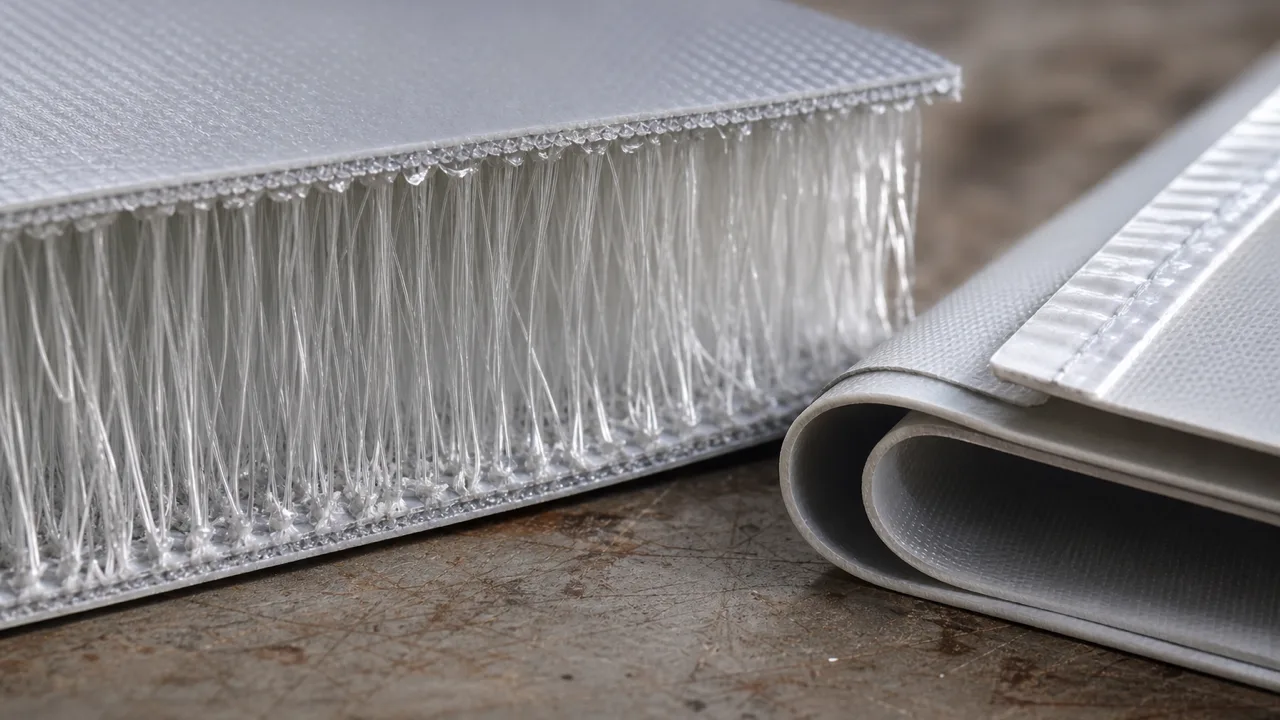
Drop-stitch. Two coated fabric skins are held a fixed distance apart by many thousands of fine polyester threads running between them. When inflated, the threads go into tension and stop the skins ballooning, so the panel stays flat and parallel-sided instead of becoming a sausage. Because the shape is held by the thread structure rather than by low-pressure fabric tension, a drop-stitch panel can be pumped to a pressure an order of magnitude above conventional inflatables — commonly in the region of 8–15 psi depending on the product — and it behaves like a rigid board. The unit is sealed: valves in, pump off, and it holds.
Welded single-wall. Panels of heavy coated PVC tarpaulin are joined by high-frequency welding, hot-air welding, or stitching with taped and welded seam covers, into a shaped envelope. There is no internal thread structure, so the shape comes from the pattern and from internal baffles and tie-tapes. These units divide into two sub-types that matter enormously in operation:
| Drop-stitch | Welded single-wall (continuous airflow) | Welded single-wall (sealed airtight) | |
|---|---|---|---|
| Working pressure | High — roughly 8–15 psi typical | Very low — a fraction of 1 psi | Low — typically around 1–3 psi |
| Power needed in use | None | Continuous blower, all operating hours | None once inflated |
| Shape held by | Internal thread structure | Pattern, baffles, airflow balance | Pattern, baffles, sealed pressure |
| Feel underfoot | Firm, rigid, low rebound | Soft, high rebound | Firm but yielding |
| Setup time | Longer — high-pressure pumping | Fast — minutes to full shape | Moderate |
| Packed volume | Compact and dense; heavy per m² | Bulky | Moderate |
| Relative unit cost | Highest per m² of the three | Lowest | Between the two |
On materials, the base fabric for commercial work is a polyester scrim coated both sides with PVC, quoted as denier plus total coated weight — commonly 1000D or 1100D scrim at roughly 550–900+ g/m² depending on the component and the market. Drop-stitch fabric is heavier for the same area because it is two skins plus the thread core.
This is where the two constructions diverge most in operation.
Continuous-airflow units fail gracefully. A tear is a leak the blower fights. The unit sags, the crew closes it, and a patch on the same day usually restores it. The chronic failure is different: seams that have opened slowly over seasons, so the blower runs harder for a softer unit, and the electricity bill quietly rises before anyone notices the equipment is deteriorating.
Sealed airtight units fail visibly and stop earning. There is no blower compensating. A pinhole becomes a soft module by the end of the session and a flat one overnight. Leak-finding on a sealed unit is a proper job — soapy water across every seam and valve, section by section — which is why fleet spares matter more for airtight water park modules than for dry play.
Drop-stitch fails in a category of its own. The common failures are valve seat leaks, which are repairable, and thread separation, which usually is not. If a group of internal threads pulls free, the skin balloons locally into a bubble that will grow. A drop-stitch panel with a developing bulge is at end of life, not in need of a patch — and it should be taken out of service immediately, because the failure escalates under pressure.
Deciding whether an ageing unit is worth restoring is a fleet-wide calculation rather than a per-repair one; our repair-versus-replace decision matrix for ageing inflatables sets out the thresholds.
Compare on operation, not on purchase price alone.
A continuous-airflow unit consumes power for every hour it is open. Blowers on commercial play equipment commonly draw somewhere between roughly 0.75 and 1.5 kW each depending on unit size, and a large obstacle course may need more than one. Across a long operating day, a full season and a multi-unit site, that is a real line in the budget — plus generator hire and fuel on sites without mains power, plus the noise, which venues increasingly care about.
Drop-stitch and sealed airtight units cost energy only at setup. Against that, they need pressure discipline: pressure rises with air temperature, so a unit inflated to spec in the cool of the morning can be over-pressure by mid-afternoon in direct sun, and over-pressure is what strains seams and threads. Daily pressure checks are the equivalent maintenance task, in the same way that blower output and PSI management is the discipline for air-blown units.
Two coated fabric skins held apart by thousands of fine polyester threads. Inflated, the threads carry the load in tension and keep the skins flat and parallel, allowing much higher working pressure than conventional inflatables and producing a rigid, board-like panel that holds shape without a blower.
Not better — different. Drop-stitch gives rigidity and needs no power in use, at a higher cost per square metre and with a non-repairable failure mode if threads separate. Continuous-airflow construction gives softness, fast setup and lower cost, at the price of running a blower whenever the unit is open. Match the construction to the product's job.
Because they are single-wall units that leak continuously by design, at very low pressure. The blower replaces the escaping air. That low pressure is also what makes the surfaces soft enough to be safe to land on, so it is a design choice rather than a shortcoming.
Surface punctures and valve seat leaks generally can be. Internal thread separation — visible as a localised bulge or blister in a surface that should be flat — generally cannot, and a panel showing one should be withdrawn from service rather than patched, because the failure spreads under pressure.