
Most commercial inflatables don't fail because they lose air — they fail because they run at the wrong air pressure. A constant-air unit is held up by a blower, not by a sealed PSI rating, and getting that operating firmness right is what keeps seams, welds, and your crew safe.
Air pressure is the single variable that decides how a commercial inflatable behaves under load. Too soft, and the structure sags, deck slopes shift, and walls fold inward when riders push on them — every bounce transfers stress straight into the seams. Too hard, and the welds sit under constant tension before anyone even climbs aboard, so a single hard landing or a hot afternoon can be enough to split a seam.
The goal is not "maximum air." The goal is the correct operating firmness for that specific unit: enough to hold geometry and absorb load, not so much that the fabric and welds are pre-stressed. Operators who treat pressure as a daily checkpoint get years more service life out of the same unit than those who plug in a blower and walk away.
There are two very different inflatable categories, and confusing them causes most pressure mistakes. For the full breakdown see our guide on airtight vs constant-air inflatables, but the short version matters here:
This article is about constant-air management. When someone asks "what PSI should my bounce house be?" the honest answer is: it isn't rated in PSI the way an airtight unit is. It's rated by the blower that feeds it and the firmness that blower produces. The number that matters is on the blower, not on a gauge stuck into the unit. If your unit does have inflation valves, our notes on commercial inflatable valve types explain which ones are constant-air feed points versus sealed pressure valves.
| Condition | What you see / feel | Common causes |
|---|---|---|
| Under-inflation | Soft walls, sagging roof or arches, sloped jumping surface, deep footprints, structure flexes when pushed | Blower too small (low CFM), blocked intake filter, kinked tube, torn seam or open vent, too many riders for the airflow, loose blower-to-unit cuff |
| Over-inflation | Drum-tight walls, no give underfoot, taut welds, faint creaking, the unit "rings" when tapped | Oversized blower (too much CFM/HP), blocked deflation vents, sealed-off relief points, cool-then-hot temperature swing |
Under-inflation is the more obvious problem and usually the one crews fix fast — a sagging slide is hard to ignore. Over-inflation is the quiet killer: the unit looks "great," tight and full, but every weld is loaded before the first rider. Oversizing the blower or taping over the small relief vents that the manufacturer built in is one of the most common ways operators shorten a unit's life without realizing it.
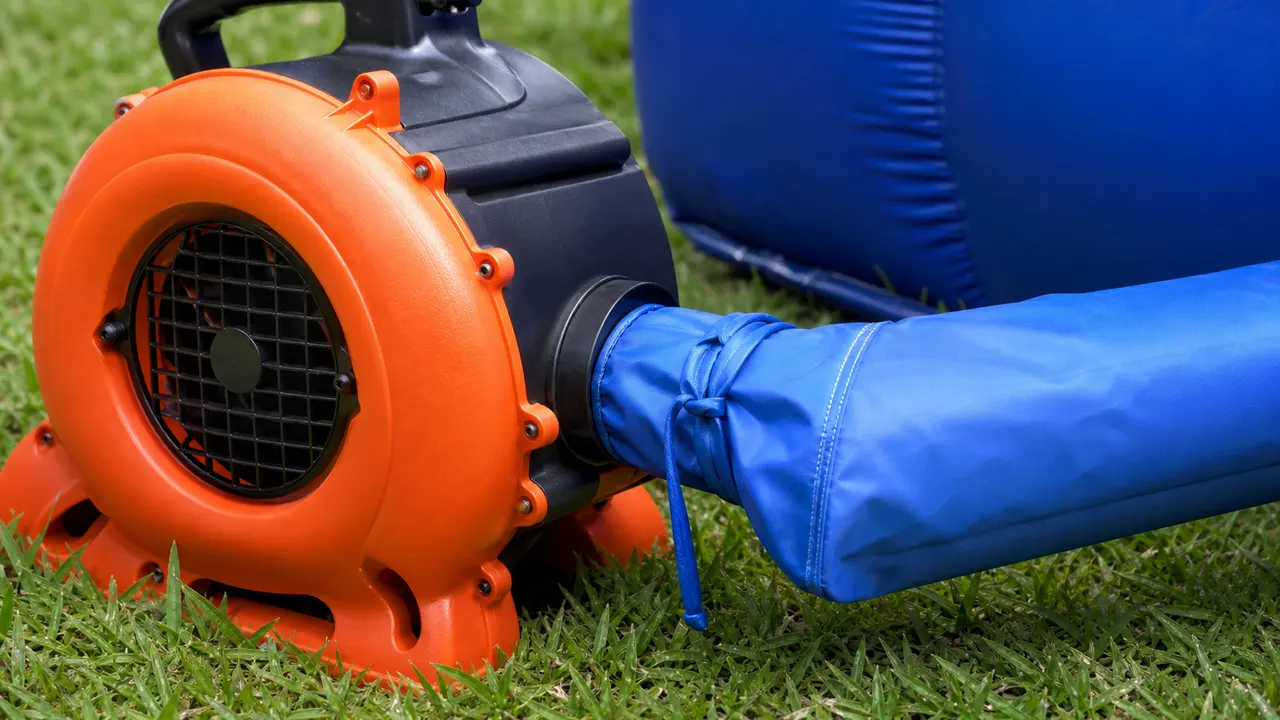
Because a constant-air unit's firmness is set by the blower, blower selection is pressure management. Two numbers drive the match:
The manufacturer specifies the blower a unit is designed for — match it. A 1.5 HP blower on a unit speced for it gives correct firmness; swapping in a 2 HP blower "to be safe" over-pressurizes it. Multi-chamber and large units often need two blowers, and each feed point must run the speced size. Don't mix and match by what's on the shelf. Our commercial blower selection guide walks through CFM, HP, and feed-point sizing in detail, and the unit's own spec sheet lists the exact blower model and count it was engineered around.
Constant-air units get a feel-based check, not a gauge reading. Build this into every setup, before the first rider:
Log the check. A two-line note per unit per day catches a failing blower or a slow seam leak long before it becomes a safety incident, and aligns with the operational inspection expectations behind standards like EN 14960.
Air is not constant, and neither is your firmness. Two field factors move it:
Get pressure management right at the purchase stage, not on the field. When sourcing, confirm with the supplier:
Stock the right blowers, cuffs, repair tape, and relief hardware up front. Browse our Accessories category for blowers and inflation hardware matched to commercial units.