
The valve is the smallest part on a commercial inflatable and the first one most buyers ignore on the spec sheet. Yet it is the single component that decides whether your unit holds air through an eight-hour rental day or sags by lunch — and how fast your crew can find a leak when one shows up.
Air retention is a sealing problem. Even a well-welded chamber loses pressure if the valve seat does not close cleanly, the gasket has hardened, or the cap is cross-threaded. On an airtight unit — a sealed chamber with no blower running — the valve is the only moving seal in the entire product, so it carries 100% of the retention burden. A 0.5 PSI overnight drop that buyers blame on "bad welding" is, more often than not, a tired valve gasket.
Valves also drive lifespan in a less obvious way: they govern how the unit is inflated and deflated. A cheap one-way valve that forces operators to wrestle the unit flat creates repeated stress at the valve weld, the highest-fatigue point on the whole envelope. Choosing the right valve type — and welding it to the right PVC base — protects the surrounding fabric over hundreds of inflation cycles. If you are weighing sealed vs blower-fed construction first, start with our breakdown of airtight vs constant-air inflatables.
Four valve families cover almost every commercial inflatable shipped today. Each is a different trade-off between fill speed, sealing quality, and how easy it is to service in the field.
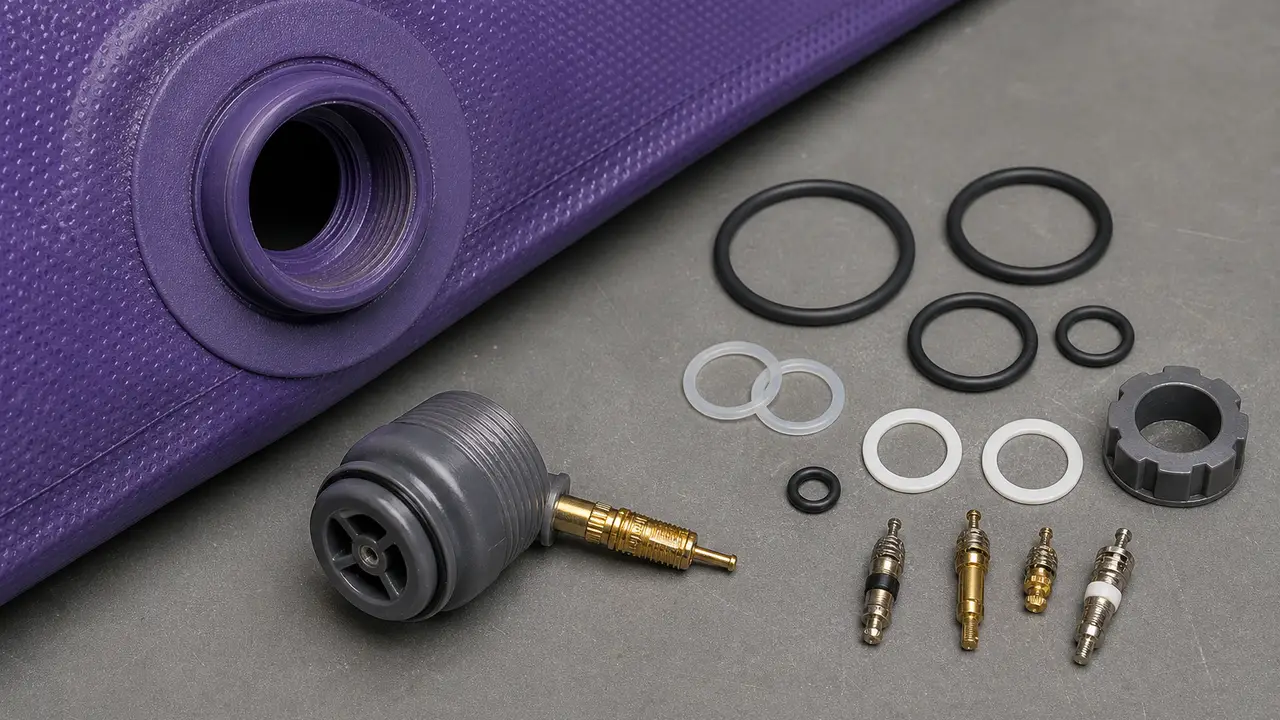
The Boston valve is a two-stage threaded valve with a one-way flap inside. You inflate through the spring-loaded check valve so air cannot escape while you pump; to deflate, you unscrew the larger base ring and the whole chamber dumps fast. It is the workhorse of mid-pressure airtight products — water games, sealed obstacle sections, paddle-style boards — because it fills cleanly and empties in seconds. Sealing is excellent when the internal flap and O-ring are intact, and replacement cores are cheap and stocked worldwide.
A threaded stem (screw) valve is a rigid barrel welded to the fabric with a screw-on cap sealing against a flat gasket. It handles higher pressure than a Boston flap and is common on drop-stitch floors, sealed walls, and rigid airtight panels. The downside: it is not one-way, so you must cap it quickly after filling. Sealing depends entirely on cap torque and gasket condition. For where this construction is used, see our notes on drop stitch vs traditional airtight construction.
This is not a pressure valve at all — it is a heavy nylon zipper behind a flap, often paired with a tie-off sleeve. It appears on constant-air products (bounce houses, slides, combos) where a blower runs continuously, so there is no sealing requirement; the opening exists for fast deflation, internal access, and repair. The "valve" of a constant-air unit is really the blower tube and its deflation flap. A torn zipper or a tie-off that won't cinch is the most common field complaint here, and both are cheap to replace.
The one-way quick-fill (military / spring-pin style) valve takes a high-volume pump nozzle and seals automatically the instant you remove it — no thread, no fumbling. It is the fastest valve to inflate and deflate and is increasingly standard on premium airtight gear that ships and sets up daily. Sealing is very good but depends on a small spring and pin that must be kept clean of grit; a single grain of sand on the seat causes a slow leak that is easy to misdiagnose as a seam fault.
| Valve type | How it works | Best for | Leak risk |
|---|---|---|---|
| Boston two-way | One-way flap to inflate; unscrew base ring to dump air fast | Mid-pressure airtight: water games, sealed sections, boards | Low — fails only if internal flap/O-ring degrades |
| Threaded stem | Rigid barrel, screw cap sealing on a flat gasket | High-pressure drop-stitch floors, rigid airtight panels | Medium — depends on cap torque and gasket condition |
| Zipper + tie-off | Not a seal; nylon zipper + tie sleeve for access/deflation | Constant-air units: bounce houses, slides, combos | N/A for air loss; failure = torn zipper or loose tie |
| One-way quick-fill | Spring-pin seals automatically when nozzle is removed | Premium airtight gear set up and packed daily | Low — but grit on the seat causes slow leaks |
The split is fundamental. A constant-air product never needs an airtight valve because a blower replaces leaked air continuously — its openings are about access and deflation speed, not pressure retention. Specifying an expensive sealing valve on a bounce house wastes money. The blower, not the valve, is the part that determines whether it stays inflated, which is why blower matching matters; see our commercial blower selection guide.
An airtight product is the opposite: there is no blower, so the valve must hold full pressure for the entire rental session. Here the valve choice (Boston, stem, or quick-fill) and the gasket grade are not optional details — they are the product. Buyers sourcing airtight units should treat valve spec with the same seriousness as weld quality.
When an airtight unit loses pressure, work from the cheapest fix outward. Order of investigation:
Keep a soapy-water spray bottle in every operator kit. Ninety percent of slow-leak callbacks resolve at the valve, and a two-minute test saves a unit being pulled from rental rotation unnecessarily.
Valves are consumables, not permanent fittings. Build a simple program:
Before you accept a container, inspect valves with the same rigour as stitching. Require your supplier to confirm:
Get the valve spec right at the PO stage and you remove the most common source of slow-leak disputes after delivery. Spare valve hardware, gaskets, and blowers are available in our Accessories category.