
Most retailers and event organizers can tell you what a promotional inflatable costs. Far fewer can tell you what it actually returned once the event or promotion window closed — because most promotional budgets never build in a way to measure it. This guide is a framework for allocating a promotional inflatable budget and actually tracking what it returns, rather than a catalog comparing formats. If you're deciding which product to buy, our outdoor advertising inflatables guide compares the five main formats; this guide covers what to do once you've bought one.
The single biggest reason promotional inflatable spend doesn't get measured is that the metric gets picked after the campaign, retroactively, when it's too late to instrument properly. Decide upfront which of these you're actually optimizing for, because the tracking method is different for each:
Trying to optimize for all three at once with a single deployment usually means measuring none of them well. Pick the one that matches your actual business goal — foot traffic for a retail location, direct conversion for a specific promotion, recall for a brand-awareness play — and instrument for that one.
A single one-off deployment is the hardest scenario to get ROI clarity on, because you have no comparison point. Operators who get the clearest read on ROI typically run the same format at the same location across multiple comparable windows — several weekends, or the same seasonal promotion repeated — which gives you a baseline to compare against rather than a single data point you can't contextualize.
This argues for owning rather than renting for any promotional format you plan to deploy more than a handful of times — the ROI math changes once you're not paying a rental fee on every use. For the ownership-vs-rental economics specifically, see our air dancer cost and ROI guide, and for a side-by-side comparison of two different attraction-grade formats when deciding where a limited budget goes furthest, see bumper boats vs air dancers: which attracts more revenue.
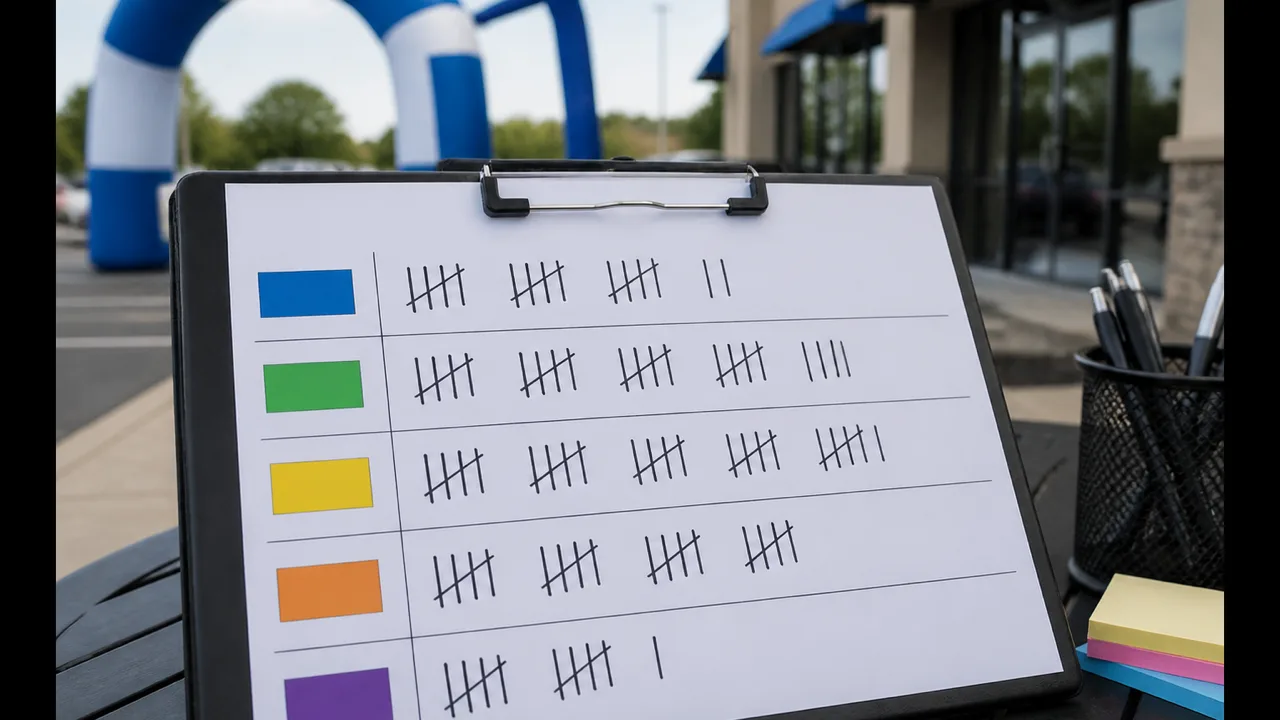
Placement matters more than most budgets account for — the same inflatable at a high-traffic corner versus a low-visibility back-lot position can produce meaningfully different results, and that placement decision usually costs nothing extra. Timing relative to the event or promotion (deployed only during peak hours versus running continuously) affects both the recall impact and the wear on the unit — running a unit only when it matters extends its usable life across more promotional cycles.
Coordinating multiple formats into a single visual funnel — an air dancer or advertising balloon pulling attention from the road, an inflatable arch framing the entrance — consistently outperforms a single isolated unit, because each format is doing the job it's actually good at rather than one unit trying to do everything.
After each deployment window, a short review against the metric you set at the start — even an informal one — is what turns a one-off purchase into a repeatable, improvable program. Compare against your baseline, note what placement and timing you used, and carry that forward into the next deployment rather than starting from scratch each time. Operators who skip this step tend to make the same placement and timing mistakes repeatedly, because nothing captured what worked the first time.
Running a new format at a new location for the first time and expecting a clean ROI read is the most common setup failure — two variables changed at once, so there's no way to know which one drove the result. Change one variable at a time: same location, new format; or same format, new location. Another frequent mistake is bundling the inflatable deployment with other simultaneous promotions (a sale, a mailer, a social campaign) without any way to separate their effects — if isolating the inflatable's contribution matters to your budget decision, run at least one deployment window without the other promotions overlapping.
ROI on promotional inflatables is measurable, but only if the metric is chosen before deployment and the campaign is instrumented to capture it. Pick one clear metric, favor ownership over repeated rental for anything used more than a few times, and build a short review habit after each deployment — that discipline is what separates a promotional line item from a repeatable growth channel.
Browse the full advertising inflatables category for current formats and specifications.