Event planners, church groups, schools, and community organizations booking inflatables for the first time all hit the same fork in the road: rent from a local operator for the event, or buy a unit outright. The math isn't obvious at low volume, and most of the advice online is written for rental operators building a fleet, not for the occasional buyer trying to figure out if ownership actually pencils out. This guide is a decision framework for that specific question.
A single-use rental for one event is almost always cheaper than buying — there's no argument there. The question that actually matters is: at how many events per year does owning become the better deal? Work it out with three inputs: the unit's purchase cost, a typical local rental rate for a comparable unit, and how many times per year you'd realistically use it.
Divide purchase cost by rental rate to get your break-even event count. Organizations running fewer than that many events per year are almost always better off renting — the capital sits idle between uses, and someone still has to store, maintain, and transport it. Organizations running significantly more than that number should be running the ownership math seriously, because every event past break-even is money that would otherwise go to a rental company.
A rough industry pattern: recreational buyers who use a unit fewer than 8-10 times a year rarely recoup the purchase price against local rental rates within a reasonable ownership window. Above roughly 15-20 uses a year, ownership economics usually win clearly — which is exactly the range where an organization starts looking less like an occasional renter and more like a small rental operator in its own right.
A rental quote is a single number that already includes delivery, setup, teardown, and the rental company's insurance. Buying moves all of that onto you: transport (a trailer or a van large enough for the deflated unit), a blower and generator if the site has no power, storage between events (dry, pest-free, out of direct sun), and your own liability insurance naming the inflatable specifically. See our commercial inflatable insurance guide for what coverage actually looks like — it's a real, recurring cost that belongs in the ownership side of the comparison, not an afterthought.
Maintenance is the other hidden cost. A rental company absorbs repair costs and swaps out aging units; an owner budgets for patch kits, blower servicing, and eventual replacement. None of this makes ownership a bad deal past the break-even point — it just means the true cost of ownership is higher than the sticker price alone suggests.
Pure frequency math isn't the whole picture. A few situations tip the decision toward buying even at moderate usage:
Buyers moving from renting to owning should specify commercial-grade construction from the start — reinforced 0.9mm PVC, double-stitched high-stress seams — even though it costs more than a lighter residential-grade unit, because it's what determines whether the unit survives the number of events needed to hit break-even in the first place. A unit that fails early erases the entire economic argument for buying. Our rental fleet ROI guide covers the same utilization and payback logic in more depth for buyers who cross into operating a small rental business themselves.
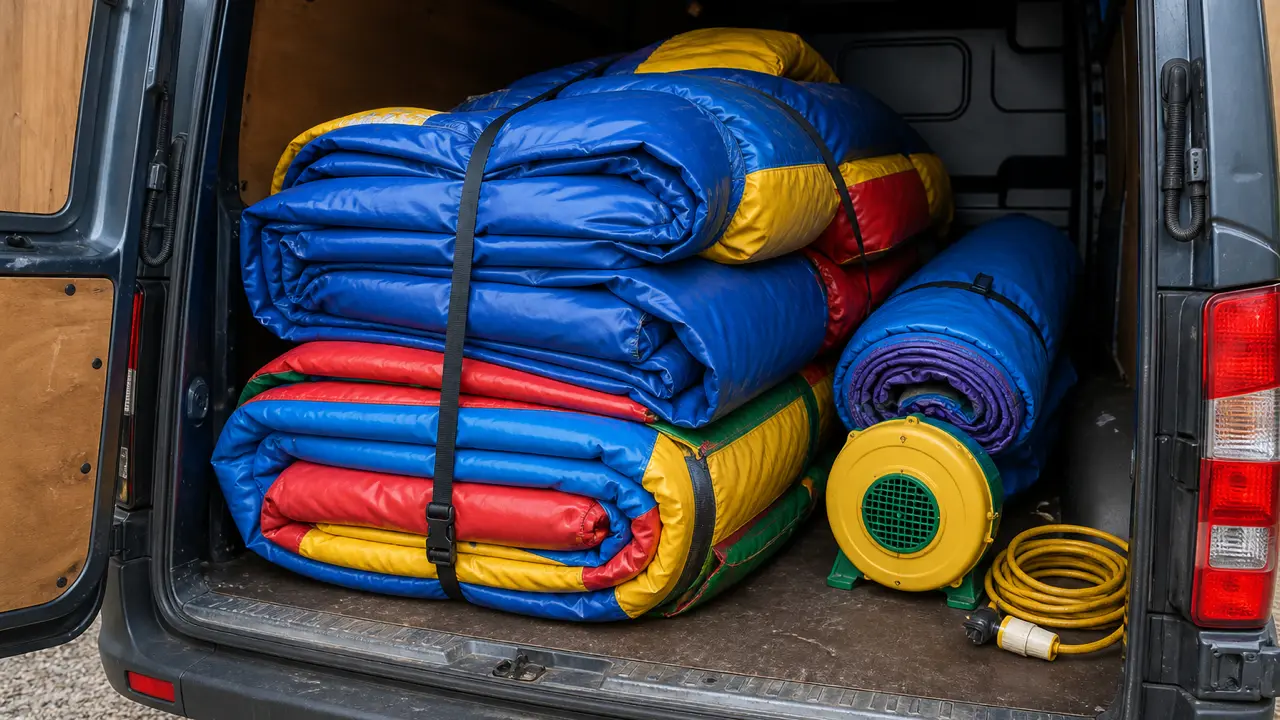
A deflated commercial bouncer still weighs 45-90 kg depending on size, and needs dry, climate-stable storage between events — a damp garage or an unheated shed that swings between freezing and hot in summer shortens the material's usable life meaningfully. Transport needs a vehicle with enough clear floor length for the folded unit, plus at least two people to load safely. Neither cost is large individually, but both are easy to leave out of a first-time buyer's mental math, and both apply regardless of how many events you run a year. Our off-season storage guide covers the specifics of storing a unit correctly between uses.
Run the break-even math with your real numbers before deciding — purchase cost divided by local rental rate gives you the event count where ownership starts winning. Below that count, rent and skip the storage and maintenance headache. At or above it, buy commercial-grade from the start, because a unit that doesn't last isn't actually cheaper than renting.
Browse the full inflatable bouncers category for current commercial-grade specifications.
For related buying considerations, see our bounce house rental cost guide.