
Japanese amusement park and leisure facility operators researching commercial inflatable water games face a narrower version of a familiar problem: most sourcing content assumes an open lakefront or a sprawling US-style water park footprint, neither of which matches the compact, often pool-based installations common at Japanese leisure facilities. This guide covers what changes for a Japanese operator specifically — compliance, site constraints, and the revenue model that fits the market's booking patterns.
Japanese leisure facilities — hotel pools, indoor water parks, and seasonal outdoor pool operations — typically work with a defined pool basin rather than open water, which shapes which product categories make sense. Standalone interactive games (floating totems, water see-saws, climbing modules) fit a pool footprint far more naturally than a sprawling multi-module floating course designed for lake installations. Our full Water Games range covers this standalone-unit format, and for facilities with a larger water surface, the Water Park Modules range covers configurable multi-unit layouts.
Commercial water play equipment operating at a Japanese amusement facility falls under general product safety oversight from METI, and facilities operating under an amusement park business license face additional local safety inspection requirements that vary by prefecture. For the equipment itself, EN 14960 or ASTM F2374 structural and safety testing documentation is the practical international baseline that Japanese insurers and facility operators generally accept — request this documentation from your supplier in writing before production, and confirm with your local authority whether any additional domestic inspection applies to your specific facility type before finalizing an installation date.
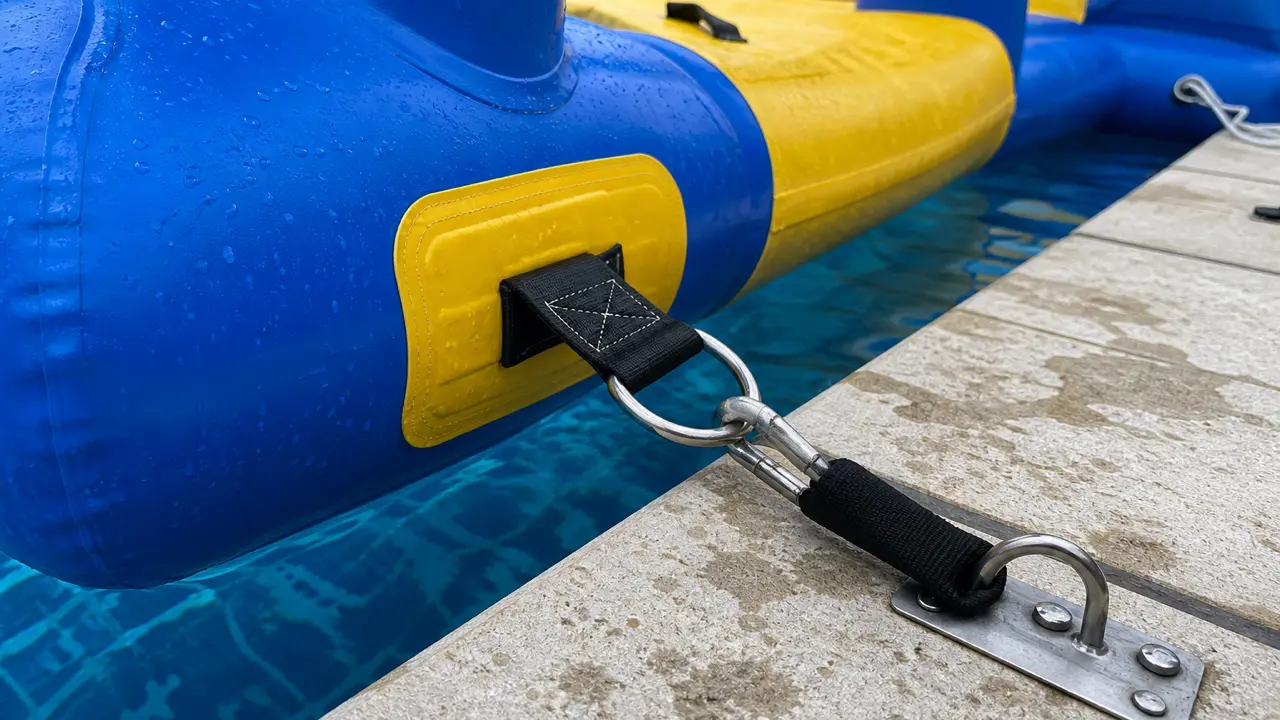
Japanese hotel and leisure facility pools tend to run smaller and more irregularly shaped than the rectangular pool basins common in US commercial installations, which affects module count and anchoring more than most general buyer's guides account for. Confirm your pool's exact depth profile and any structural features (steps, ledges, drainage points) with your supplier before finalizing a layout, since a module sized for a standard rectangular pool may not anchor cleanly in a pool with an irregular perimeter. Indoor facility installations also need to confirm ceiling clearance for taller modules like climbing towers, which outdoor open-air installations don't need to consider.
Japanese leisure facilities typically monetize water game installations through one of two models: a bundled day-pass or facility-admission model where the water games are included as part of a broader hotel or leisure facility ticket, or a timed-session add-on model where guests pay a separate fee for a defined session at the water games specifically. The bundled model suits hotel and resort operators where the installation functions as a guest amenity and booking driver rather than a standalone profit center; the timed-session model suits standalone leisure facilities where the water games are a primary attraction rather than a supporting amenity. Which model fits should determine module selection as much as site constraints do — a bundled-amenity installation can prioritize variety and photo appeal, while a session-ticketed installation needs to prioritize throughput per session.
Outdoor seasonal pool operations common at Japanese hotels and leisure facilities need a defined off-season storage and maintenance plan, while indoor water park facilities running year-round face different maintenance considerations — more consistent water treatment demands but no seasonal removal and reinstallation cycle. Confirm which operating model your facility runs before finalizing equipment specification, since the material and maintenance recommendations differ meaningfully between a unit stored six months a year and one in continuous year-round use.
Water game installations at Japanese facilities generally require the same attendant-supervision standard as any commercial water attraction, but staffing ratios and training expectations should be confirmed against your specific facility license rather than assumed from a general international guideline. Indoor facilities running continuous year-round operation typically justify dedicated trained staff for the water games area specifically, while seasonal outdoor operations often cross-train existing pool staff to cover the installation during its operating months. Either way, document a clear supervision zone and sightline plan before opening — Japanese facility inspectors and insurers commonly ask for this as part of the safety review, and having it prepared in advance shortens the pre-opening approval process considerably.
Japan-bound orders follow the same production lead-time planning as other markets, with ocean transit to a Japanese port typically running shorter than transpacific routes given regional shipping lanes from South China manufacturing hubs. For the broader compliance and import documentation process that applies across inflatable categories entering Japan, see our Japan market inflatable standards and import guide, and for commercial bouncy castle-specific sizing and ROI guidance if your facility is also considering dry play equipment, see our Japanese market bouncy castle buyer's guide.
Do inflatable water games need Japan-specific certification beyond EN 14960?
For most commercial B2B installations, EN 14960 or ASTM F2374 documentation is generally accepted by Japanese facility operators and insurers. Confirm with your local authority whether additional prefecture-level inspection applies to your specific facility license type.
Can standard water park modules be installed in a Japanese hotel pool?
Most can, but confirm your pool's exact depth profile and any irregular structural features with your supplier before finalizing a layout — Japanese hotel pools often run smaller and less uniformly shaped than the rectangular basins standard buyer's guides assume.
If you're planning a water game installation for a Japanese facility, our team can help match module selection to your pool's specific dimensions and your facility's revenue model.