
Every year, a predictable wave of first-time importers gets caught by Chinese New Year timing — not because the holiday is a secret, but because most buyers don't realize how far its effects extend beyond the factory's actual closed days. This guide covers the real shutdown window, what happens to production queues before and after it, and how to plan an order so CNY doesn't cost you your season opening.
Chinese New Year itself is typically a public holiday of about a week, but the effective factory disruption runs considerably longer. Many factories close production entirely for one to two weeks around the holiday date (which shifts each year based on the lunar calendar, generally falling between late January and mid-February), and full workforce return to normal capacity can take an additional one to two weeks beyond that as migrant workers travel back from home provinces and lines ramp back up to full staffing. Treat the effective disruption window as four to six weeks total, not the one-week public holiday alone.
The two to three weeks immediately before CNY are often the tightest production window of the entire year, not the shutdown itself. Every factory's customers are trying to get orders shipped before the closure, which means production queues back up, quality control can get rushed under deadline pressure, and factories with less disciplined scheduling may overcommit capacity trying to satisfy every customer's pre-holiday deadline. If your order timeline lands in this window by coincidence, build in extra buffer and confirm your position in the production queue explicitly rather than assuming a quoted date holds under this seasonal pressure.
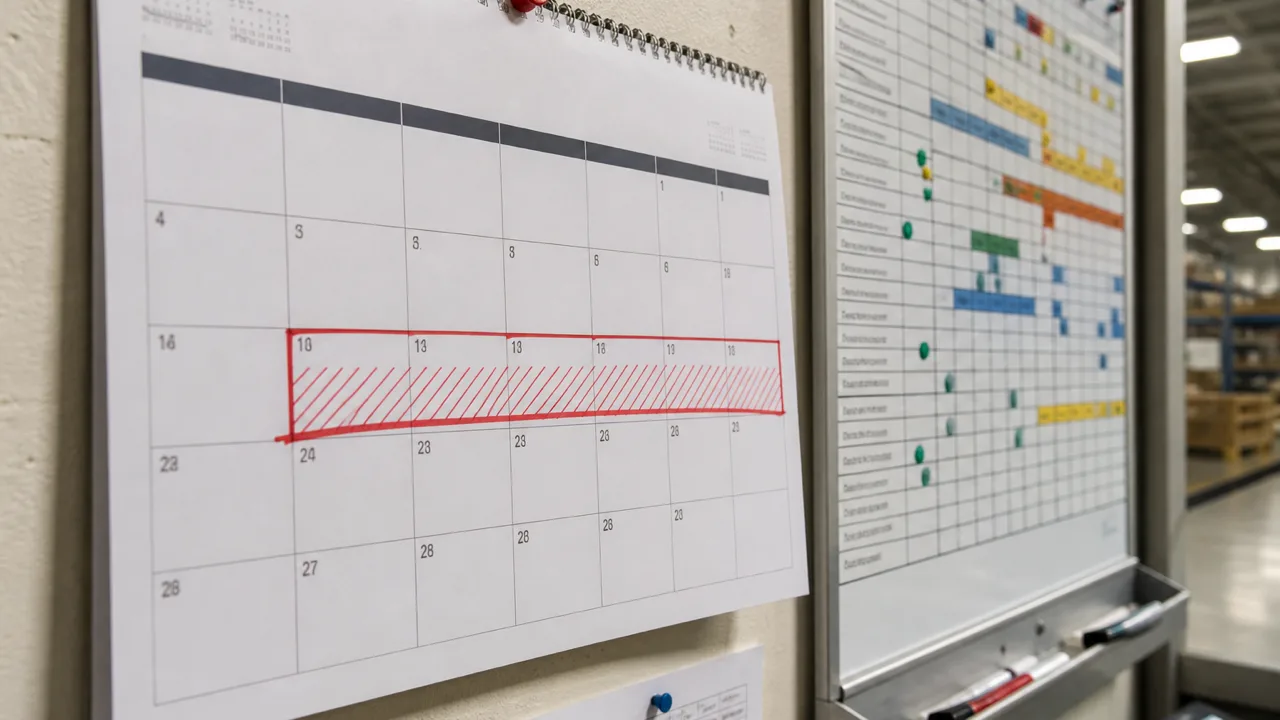
Production doesn't snap back to full capacity the day workers return. Expect a gradual ramp-up as staffing normalizes, particularly at factories with a high proportion of migrant workers who may return over a staggered period rather than all at once. Orders placed to start production immediately after the holiday often see slower initial progress than the same order would see during a stable mid-year period — factor this into your lead time expectations rather than assuming the factory's stated lead time applies uniformly across the calendar.
Buyers ordering for a spring or early-summer season opening face the most direct collision with CNY timing, since the natural ordering window for a spring launch often falls right into the pre-holiday squeeze or the immediate post-holiday ramp-up. Our production lead time breakdown guide covers baseline lead times to work backward from, and CNY should be treated as an additional seasonal factor layered on top of that baseline rather than a separate calculation entirely. For the broader supplier vetting and quality timeline this fits into, see our supplier vetting checklist and lead time guide.
CNY closure dates and duration vary by factory — some close for the statutory week only, others extend closure for the full workforce return period, and a few stagger operations to maintain partial capacity throughout. Ask your supplier directly for their specific closure dates and their internal order cutoff for pre-holiday shipment as early in your planning process as possible, since this information becomes harder to get useful answers on the closer you get to the holiday itself when everyone is asking the same question.
Ocean freight capacity and pricing also tighten around CNY, independent of factory production timing, since export volume spikes in the weeks before the holiday as everyone tries to ship before their factory closes. If your order is factory-ready but not yet booked on a vessel, confirm container availability explicitly rather than assuming standard transit times hold during this period — port congestion at major Chinese export hubs is a common secondary effect of the same seasonal rush that squeezes factory production. If you're planning a container order across multiple SKUs, our commercial inflatable range and our MOQ reality check by category are worth reviewing alongside your CNY timing plan, since consolidating orders ahead of the holiday often makes more sense than splitting shipments across the shutdown window.
How long is the Chinese New Year factory shutdown?
The public holiday itself typically runs about a week, but effective production disruption — including pre-holiday queue backup and post-holiday ramp-up — commonly extends to four to six weeks total. Confirm your specific factory's schedule rather than assuming a standard duration.
When should I place an order to avoid CNY delays?
Either early enough to complete production and shipment before the pre-holiday squeeze begins, or timed to start production only after the factory has fully ramped back up, generally three to four weeks post-holiday. Avoid the two-week windows immediately before and after the holiday itself.
If you're planning an order that falls near next year's Chinese New Year, our team can help confirm production timing and avoid the seasonal squeeze on both ends.