
Most water park operators in the DACH region (Germany, Austria, Switzerland) get the equipment purchase and the TÜV compliance sequencing right, then treat staffing and maintenance as something to figure out after opening day. That's backwards. Labor is usually the largest recurring line item on a DACH inflatable water park's operating budget — larger than the equipment amortization in most seasonal-operation models — and maintenance scheduling is what determines whether that labor budget holds or blows out mid-season.
This isn't a compliance guide — our DACH buyer's guide to compliance, installation & operating costs covers TÜV verification, EN 14960 documentation, and the regulatory sequencing. This one covers what happens after the complete water park installation passes inspection: how to staff it and keep it running through a full season.
DACH municipal authorities generally hold operators to more conservative lifeguard-to-guest ratios than several neighboring EU markets, and the specific ratio is set locally rather than nationally — confirm the number with your installation site's municipal authority before finalizing a staffing budget, not after signing your season's lease. As a planning baseline (subject to your local confirmation), a mid-size water park module running 100-150 guests at a time typically needs a minimum of one supervising lifeguard per major module (per slide tower, per jump zone) plus one perimeter marshal for general crowd flow — a larger 300-guest destination-scale layout scales this up rather than consolidating supervision into fewer stations.
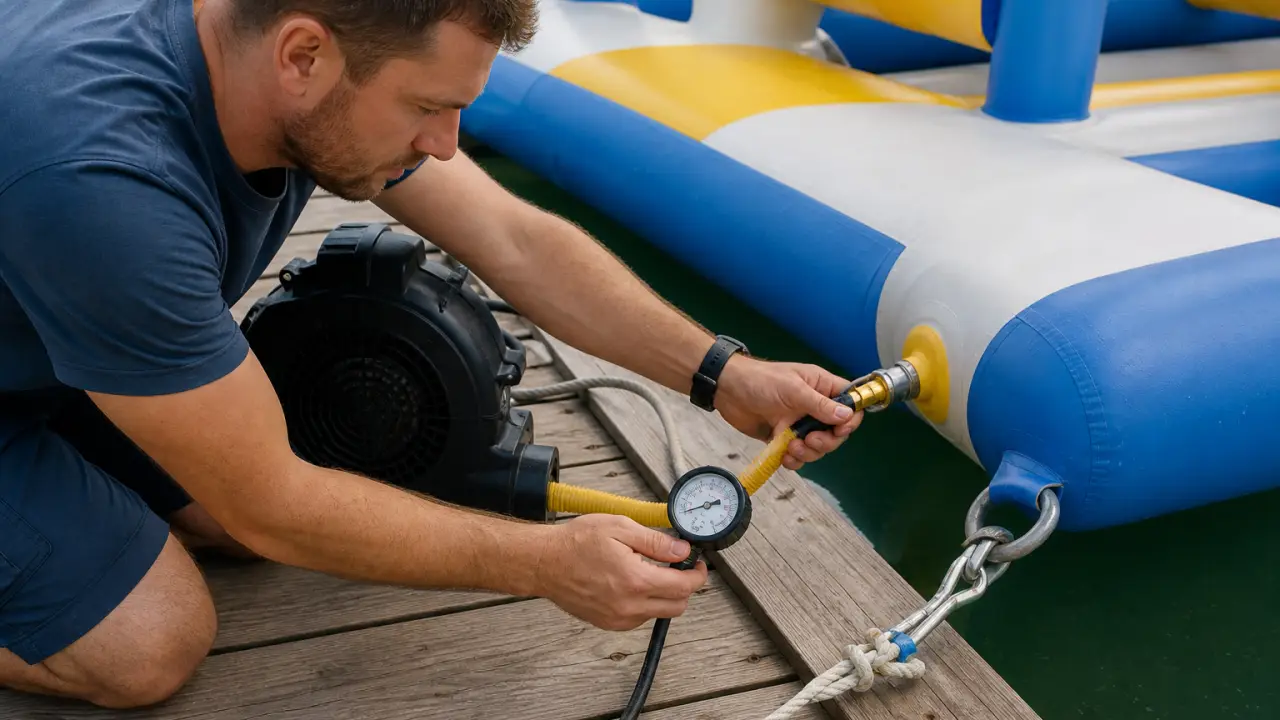
Beyond lifeguards, budget for a dedicated maintenance technician role separate from lifeguard duty, whether the installation is a full modular water park configuration or a smaller single-module setup. Combining the two in one understaffed shift is the most common way a DACH operator fails a surprise inspection — an inspector who finds the same person responsible for both guest supervision and pump-room checks reads it as a structural staffing gap, not a scheduling convenience.
Run this before gates open, every operating day, not just at season start:
DACH water park seasons run considerably shorter than warm-climate markets — typically late May through early September for outdoor installations, which changes the staffing model from a year-round payroll question into a seasonal ramp-up and wind-down problem. Three planning points matter most:
Pre-season training window. Budget 1-2 weeks before opening for lifeguard certification renewal (most DACH lifeguard certifications require annual re-verification, not a one-time credential) and site-specific orientation — a returning staff member from last season still needs to walk this year's layout and anchor plan, since module configuration often changes between seasons.
Shoulder-season staffing. Early and late season (cooler weather, lower guest volume) is where operators most often overstaff out of habit rather than actual demand — track actual guest counts against your peak-season ratio rather than running full peak staffing through the shoulder weeks, and reserve full ratios for the July-August peak.
End-of-season teardown and storage. Schedule teardown, drying, and storage prep as a staffed project with its own labor line, not an informal wind-down — a rushed teardown is the most common source of the mould and seam damage that shows up as an unpleasant surprise the following spring.
A realistic DACH operating budget separates maintenance into three lines rather than one general "upkeep" allowance: routine daily checks (staff time, already covered under normal staffing), scheduled component replacement (blower and pump wear parts, anchor hardware, patch kits — budget this as a fixed annual line based on module count, not as-needed spending), and the annual TÜV field inspection itself, which several operators mistakenly budget as a one-time setup cost rather than the recurring annual line it actually is. For the underlying water treatment and filtration calculations that feed into your water quality maintenance line, see our water management guide for inflatable pools and water parks.
Do DACH lifeguard staffing ratios differ between Germany, Austria, and Switzerland?
The underlying EN 14960 safety principles are shared across all three, but the specific staffing ratio and certification requirement is set at the regional or cantonal level rather than nationally — always confirm with your specific installation site's municipal authority rather than assuming a ratio that applied at a different DACH location.
Can one technician handle maintenance across multiple installation sites in the same region?
For smaller single-module sites within reasonable travel distance, a shared maintenance technician across 2-3 sites is common and cost-effective; for larger destination-scale installations, on-site dedicated maintenance staff is the standard expectation, since travel time between sites conflicts with the daily pre-opening checklist window.
How much does seasonal staffing typically add to total operating cost versus a year-round model?
The shorter DACH season concentrates the full staffing cost into roughly four months rather than spreading it across twelve, which raises the effective monthly staffing cost during operating months but eliminates payroll during the closed season — model your budget on the operating months only, not an annualized average, to avoid understating peak-season cash flow needs.
Get the staffing ratios confirmed locally, the daily maintenance checklist running from day one, and the seasonal ramp-up and wind-down staffed as real project phases rather than informal adjustments — that combination is what keeps a DACH water park installation compliant and profitable through a full season. Get in touch and we can help plan module count against your expected staffing model.