
An inflatable pool is bought as a structure and operated as a body of water. The structure is the easy part — it arrives, it inflates, it holds its shape. The water is what generates the complaints, the closures and, in hot climates, the real operating cost. Resorts that install a temporary pool and treat it like a paddling tub discover within a fortnight that thirty guests a day in warm water is a treatment problem, not a hosing-down problem.
This guide covers the water system only. For the fabric itself — cleaning, disinfecting and drying the PVC surfaces — see the separate cleaning and disinfection SOP for rental operators. The two disciplines run in parallel and are not interchangeable.
Calculate the operating volume before you specify any equipment. For a rectangular pool it is length × width × operating water depth; note that the operating depth is not the wall height, and on airtight pools with drop-stitch walls the usable depth is typically well below the top of the wall to keep freeboard for displacement and splash-out.
Work in cubic metres, then convert:
That single number sets your fill time, your circulation pump, your chemical dosing and your drainage plan. Get it wrong and every downstream decision is wrong with it.
Turnover is the time taken to circulate a volume equal to the whole pool through the filter. Public and semi-public pools are conventionally designed around turnover periods in the range of two to four hours depending on depth and bather load, with shallow, heavily used water at the faster end. Shallow water with high guest numbers — which describes almost every inflatable installation — belongs at the faster end.
The arithmetic is direct. Required flow = pool volume ÷ turnover period. A 30 m³ pool on a three-hour turnover needs 10 m³/h through the filter, or roughly 167 litres per minute.
Two things people get wrong:
Two options cover almost all temporary commercial installations:
Sand filters are the default for anything above roughly 20–30 m³. They handle organic load and suncream well, backwash rather than needing consumables, and tolerate the debris that an open-air pool collects. The trade-off is that backwashing dumps water — budget for the make-up volume and for where that water goes.
Cartridge filters suit smaller installations and sites where discharge is restricted, because they do not backwash. They filter finer than sand, but they clog faster under heavy bather load and each clean is manual labour. For a seasonal installation with a small team, cartridge maintenance often becomes the job nobody does.
Whichever you choose, fit a basket strainer ahead of the pump and clean it on a schedule. On an open-air site, grass, leaves and hair reach the strainer within the first hour of operation, and a blocked strainer starves and eventually burns out pumps.
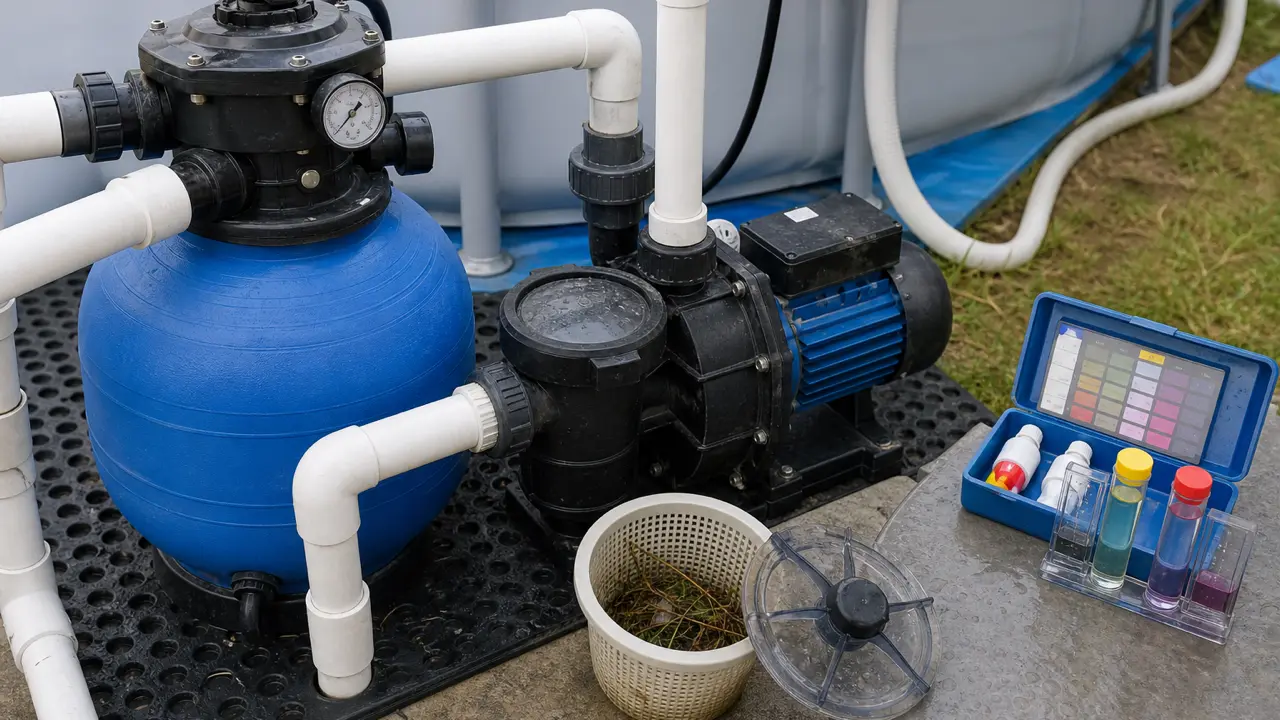
Disinfection targets for commercial pools are set by national and local health regulations, and those take precedence over any supplier's guidance. As broadly accepted operating ranges for chlorine-treated commercial pools:
Test frequency matters more than test precision. For a commercial installation, test free chlorine and pH before opening, at least once mid-session and again at close, and log every reading. The log is what an inspector or an insurer asks for after an incident. Bacteriological sampling on the schedule your local authority requires is separate from and additional to this.
Two inflatable-specific notes. First, dose into the circulation return, never directly into the pool where guests will be — concentrated chemical in contact with PVC bleaches and degrades the coating. Second, avoid letting undissolved tablets rest against the pool wall or floor for the same reason.
Resort installations in the Gulf, southern Europe and Southeast Asia carry a different burden. Water above roughly 28 °C accelerates chlorine consumption and bacterial growth simultaneously, evaporation runs high, and a shallow pool in full sun can reach temperatures where treatment becomes continuous rather than periodic.
Practical adjustments: shorten the turnover period, dose against measured demand rather than a fixed daily amount, plan make-up water for evaporation as a standing daily figure rather than an occasional top-up, and shade the pool where the site allows. Also watch the fabric — sustained high water temperature plus high UV is the combination that ages PVC fastest, which is why airtight pool specifications for hot markets should be quoted with UV-stabilised material.
Water weighs a tonne per cubic metre. A 30 m³ pool puts thirty tonnes on the ground, distributed across the footprint, and the ground has to hold it for the whole season without differential settlement. Before installation, confirm the substrate will bear the load when saturated, not when dry.
Larger installations combine pools with slides and modules on a shared water system, which changes the sizing exercise. Turnkey complete water park packages are specified with the plant load in view from the start; the guide to commercial inflatable pools for resorts and hotels covers the procurement side, and what drives the cost of an inflatable water park puts plant and water handling into the overall budget picture.
Before opening: test free chlorine and pH and log them; confirm visual clarity to the pool floor; empty the strainer basket; check the filter pressure gauge against its clean baseline; walk the perimeter for ponding and check anchor and wall condition.
During the session: re-test at least once mid-session; skim surface debris; top up to the operating level as splash-out and evaporation reduce it, since a falling level changes both chemistry and the safe operating depth.
At close: final test and log; run circulation on after the guests leave to clear the day's load; cover where practical to reduce overnight debris and evaporation.
Weekly: backwash or clean the filter on the pressure differential, not on the calendar; check pump seals and hose connections; inspect the fabric at the waterline, where wear concentrates; review the log for a drift in chlorine demand, which is the earliest signal of a developing problem.
The daily and weekly SOP above covers routine chemistry and filter maintenance. Layer these monthly and quarterly tasks on top for a complete inflatable pool maintenance checklist:
For the step-by-step cleaning procedure itself — what to scrub, what chemical ranges to target, and how to prevent mold specifically — see our inflatable pool cleaning and maintenance SOP, which pairs directly with the water chemistry and turnover guidance above.
With correct circulation, filtration and chemical control, water is maintained rather than routinely replaced — you replace what is lost to backwashing, splash-out and evaporation. Full replacement is driven by a treatment failure, an accidental contamination event, or the end of the season. If a pool needs frequent full changes, the turnover rate or the dosing regime is wrong.
Divide the pool volume by the target turnover period to get required flow, then size the pump at that flow against the actual total head of your pipe run. A 30 m³ pool on a three-hour turnover needs roughly 10 m³/h at the duty point, not 10 m³/h on the box.
Yes, with one discipline: dose into the circulation return rather than directly into the pool, and never let undissolved tablets or granules rest against the PVC. Concentrated chemical in contact with the coating bleaches and degrades it, and that damage is permanent.
Wherever local regulations permit — which is often not a storm drain and often not onto planting, because of the chlorine content. Establish the legal discharge route before the first fill and budget make-up water for the volume backwashing removes.