The first question every resort, water park operator, and distributor asks is simple: how much does an inflatable water park cost? The honest answer is that there is no single sticker price. An aqua park is not a finished product on a shelf, it is a configurable system, and two parks of the same surface area can differ by a wide margin once you account for material grade, structure type, anchoring, and certification.
That is good news for buyers who understand the cost structure. Once you know which variables move the inflatable water park price, you can build a precise budget, ask sharper questions, and compare quotes on a like-for-like basis instead of being misled by a low headline number that hides thin material or a missing anchoring system.
When you search for an "aqua park for sale," you will see prices ranging from entry-level packages to full commercial installations. The spread exists because the term covers everything from a handful of floating mats to a 600 m² modular course rated for hundreds of guests. The total investment is the sum of configurable choices, not a catalog figure. Below are the eight variables that actually drive a modular water park cost, and how each one moves your quote.
This is the biggest single lever. A park is built from individual elements: trampolines, slides, climbing walls, balance beams, blast bags, runways, and connectors. More modules and larger footprints mean more material, more labor, and a higher price. Decide your target guest capacity first, because that sets the surface area and module count, which in turn sets most of the budget. For how layouts are planned around guest throughput, see our guide to aqua park layout planning.
Material is where cheap quotes hide their cuts. Commercial aqua parks use reinforced PVC tarpaulin, typically 0.9mm thickness, in 1000D or 1100D weave density. Heavier 1100D fabric resists UV, abrasion from sand and concrete edges, and the constant flexing of wave action far better than lighter material. A quote built on 0.6mm consumer-grade film will always look cheaper, and it will fail within a season under commercial use. Always confirm the exact gram weight and denier rating, not just the word "commercial."
There are two construction philosophies. Constant-air (air-blown) modules stay inflated by a continuous blower and are lighter and cheaper per square meter. Sealed drop-stitch modules hold air like a paddleboard, feel rigid underfoot, need no running blower, and cost more to manufacture. Many parks mix both: drop-stitch for walkways and platforms that demand stability, constant-air for large bouncing surfaces. Your blend of the two directly shapes the price.
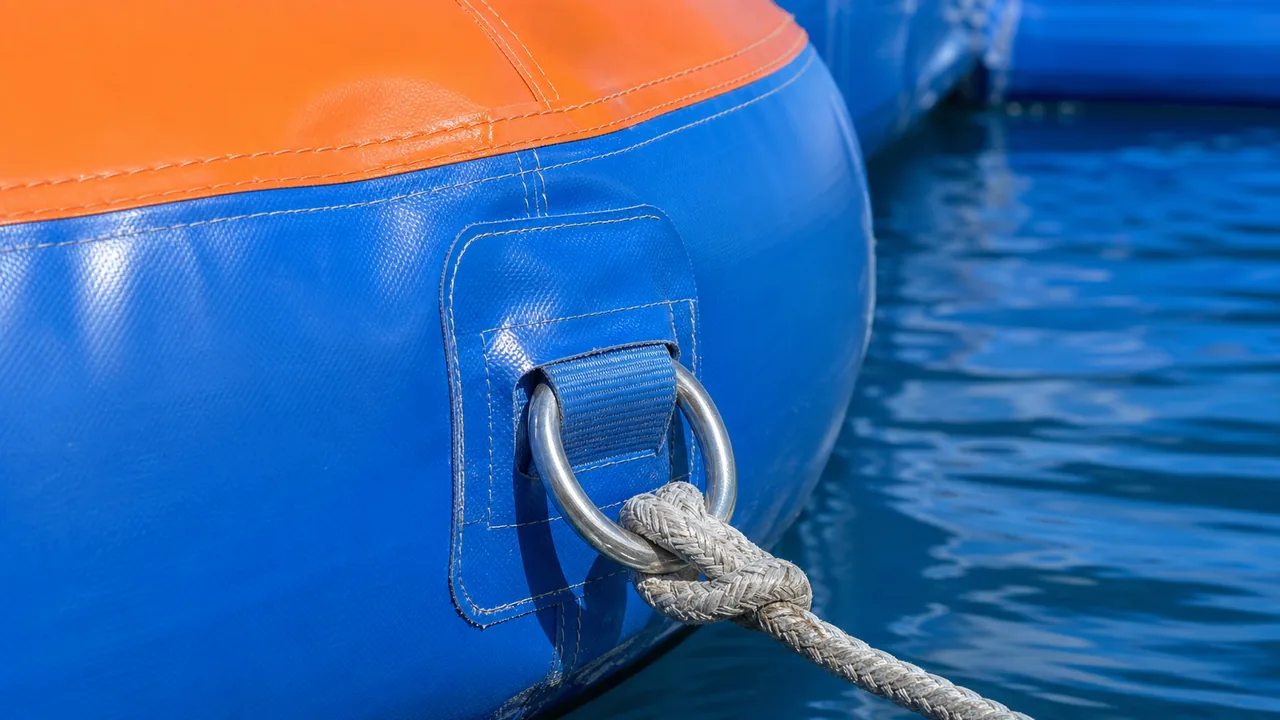
A floating park is only as safe as its anchoring. The mooring system, including anchor blocks or weights, ropes, shackles, and tension distribution, is a real line item that thin quotes often omit. Water depth, current, and wind exposure determine how heavy and how redundant the system must be. If a quote looks unusually low, check whether anchoring is included or quietly left for you to source locally.
Constant-air modules need reliable blowers sized to the volume they support, and many installations add water-fed features. The number, power rating, and quality of pumps and blowers add to both the upfront cost and your running energy budget. Cheaper blowers cost less now and more in replacements and downtime later.
Certification is not optional for a commercial operation, and it carries cost. EN14960 (the European standard for inflatable play equipment), TÜV inspection, and ASTM compliance require specific seam strength, anchorage ratings, and documented testing. A certified park costs more to build because the materials and construction must meet the standard, but it is what lets you insure the site, pass local inspection, and operate legally. Treat a missing certification as a hidden future cost, not a saving.
Inflatable parks deflate, but they are bulky and heavy. Freight is driven by how many cubic meters your park occupies and how efficiently it loads into a 40ft HQ container. A well-packed park lowers your per-unit landed cost; a poorly packed one wastes container space you still pay for. Whether you buy FOB or CIF, ask your supplier for the exact loaded volume and container count up front. Our breakdown of 20ft vs 40ft HQ container loading shows how the math changes your total cost to port.
The final driver is everything after the park arrives: installation support, operator training, repair kits, and spare blowers or modules. A supplier who includes a documented setup process, a repair kit, and remote installation guidance saves you costly downtime in season one. These are small line items relative to the park, but they protect the whole investment.
The modular nature of these parks is also a budgeting advantage. You do not have to buy your full vision in year one. A common approach is to launch with a core course sized to expected opening-season traffic, then expand with additional modular water park components as revenue and demand grow. Because elements connect to a common standard, phased expansion is straightforward and lets you reinvest earnings rather than over-capitalize at the start.
Two parks can list the same module count and still differ in price because of build quality. Double-stitched and welded seams, reinforced D-ring anchor points, quality valves, and UV-stabilized fabric all raise the unit price and all extend service life. The cheapest inflatable water park cost on paper is rarely the lowest cost of ownership. Measure price against expected seasons of service: a park that lasts five seasons at a higher upfront figure routinely beats a two-season bargain.
The factory quote is only part of your budget. Landed cost adds ocean freight, insurance, import duty, and inland transport to site. This is why container efficiency matters so much, and why FOB versus CIF terms change your comparison. When you collect quotes, normalize them all to the same delivery point before judging which supplier is actually cheaper.
Price is only half the equation. A commercial aqua park is a revenue asset, and the right way to evaluate it is payback period, not sticker price alone. Capacity, ticket or session pricing, operating season length, and utilization rate determine how fast the park pays for itself. A well-sized, well-built park with high summer utilization can recover its investment within a small number of seasons. For the math behind utilization and payback on rental and operated assets, see our analysis of inflatable rental fleet ROI.
To get quotes you can actually compare, give every supplier the same brief and ask each one to confirm:
With those ten answers in hand, you can line up quotes side by side and see exactly why one costs more than another, instead of guessing.
An inflatable water park has no fixed price because it is a system you configure to your site, your capacity, and your season. Understand the eight drivers above and you can build a budget that holds, ask the questions that expose thin quotes, and invest in a park that earns back its cost. Explore our range of complete inflatable water parks to scope a configuration and request a detailed, itemized quote built around your numbers.
Related guide: Adult Inflatable Water Parks: Load Ratings, Modules & Site Requirements — per-module load ratings, minimum water depth measured at low water, anchor loading and lifeguard ratios.