
A children's aqua park scaled up is not an adult aqua park. Adult guests arrive at 80 to 120 kg, climb higher, land harder and cluster on the same platform in groups of six. Three numbers decide whether a site works: per-module load rating, effective water depth, and anchor holding capacity. Get those right and the module mix is a commercial choice. Get them wrong and you have bought a park that fails its first busy Saturday.
This guide covers specification and site assessment. For what a park costs to build at each size, see our breakdown of what drives inflatable water park cost.
Four specification lines separate adult-rated modules from children's units:
Ask any supplier for these four figures in writing per module. If a quotation lists only dimensions and colour, it is not an adult specification.
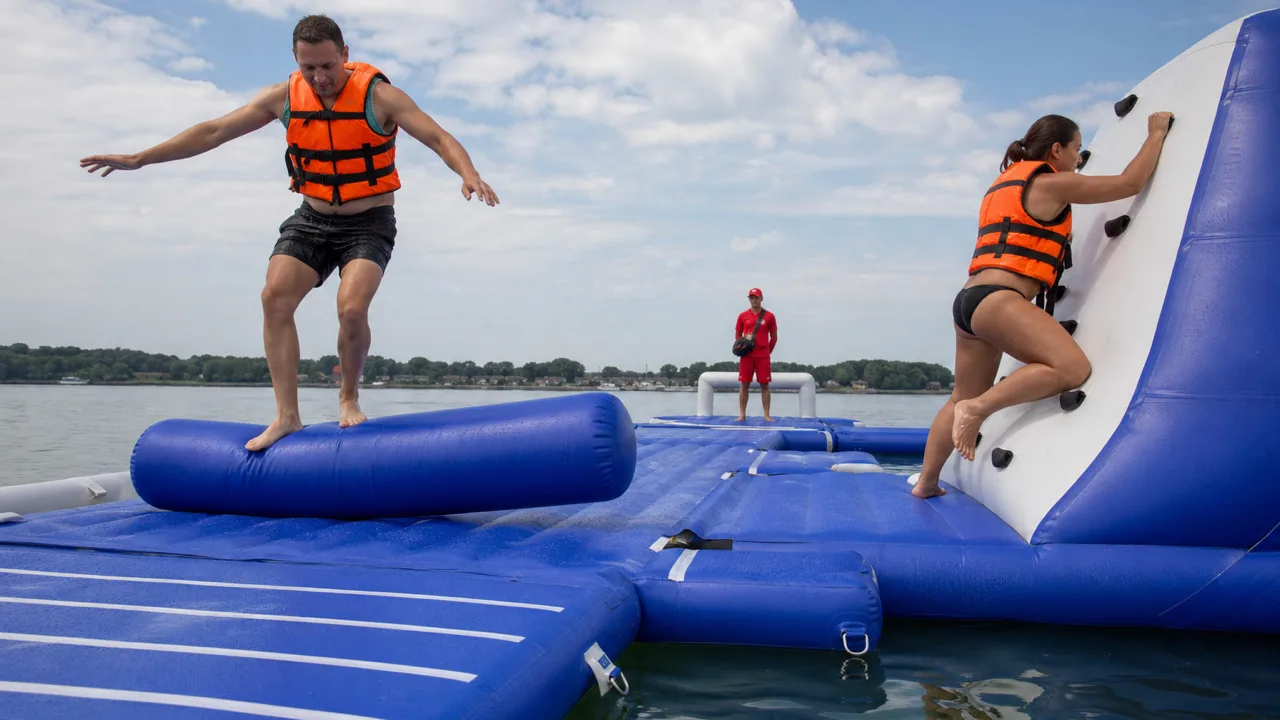
Not every module in a catalogue works for an adult audience:
A workable adult mix for a first installation is roughly 60% traverse and climb modules, 20% jump features, 20% rest deck. You can browse configurable options in the individual water park module range or specify a turnkey layout from the complete inflatable water park systems.
Site assessment comes before module selection, not after. Four checks:
Effective depth under every fall zone. Depth requirements are set per module by fall height, and they are measured at low water, not at average water. On tidal or reservoir sites, calculate at the lowest level the site reaches during the operating season. Traverse modules need the least; high jump platforms need the most.
Bed type and obstructions. Sand and soft silt are straightforward. Rock shelves, submerged stumps and shifting gravel are not — they dictate anchor type and sometimes rule out a jump zone entirely. Survey the footprint, don't assume it.
Current, wave height and wind exposure. Sheltered bays, lakes and hotel lagoons suit floating parks. Open coastline with running swell does not, whatever the brochure photograph shows. Set an operating limit for wave height and wind, and a defined close-down procedure.
Anchor loading. A floating park is a large sail. Anchor weight and holding capacity are calculated from park area, exposure and bed type, with a safety factor, then distributed across multiple anchor points so no single failure releases the park. Ask your supplier for the anchor plan as a drawing keyed to your survey — a generic weight-per-module figure is not an anchor plan.
Total capacity is the sum of your per-module simultaneous-user limits, not the number of people the park can physically hold. Adults occupy modules longer than children, so a park sized purely by area will feel full at 60% of its theoretical count.
Build the operating model around sessions: a fixed session length of 45 to 60 minutes, a full changeover, and a briefing before entry. Sessions give you predictable throughput, a natural point to check wristbands and buoyancy aids, and a rest window for staff.
Divide the park into supervision zones with clear sightlines, and staff each zone rather than the park as a whole. Jump features need dedicated eyes. Confirm the required lifeguard ratio and qualification with your local authority or insurer before you finalise the layout — requirements differ by country and by whether the water is a pool, a lake or open sea, and your insurer's figure may be stricter than the legal minimum. For guidance on laying out a larger footprint, see our walkthrough of planning a 200-guest floating park.
Adult parks live or die on material specification. Commercial floating parks use heavy-gauge reinforced PVC for the outer skin, with drop-stitch panels where rigidity is needed and reinforcement patches at every connector and high-traffic edge. Specific points to confirm:
Floating parks ship as modules, and packed volume is the cost driver. A modest adult park consolidates into a 40 ft HQ container; larger installations run to multiple containers, in which case ask the factory to split shipment so you can commission the core layout while the balance is in transit.
Practical procurement notes:
If your project is a hotel pool rather than open water, the specification changes substantially — pool-based installations trade anchoring for edge protection and are covered in the airtight water play range.
Buyers researching an aufblasbarer Wasserpark für Erwachsene in the German, Austrian and Swiss markets typically ask two questions before module selection even starts: what does an adult-rated installation actually cost, and what certification will a local authority or insurer ask to see. Neither has a single number, but both follow a predictable pattern.
Pricing scales with module count and adult-spec hardware, not surface area. A compact adult layout (8–12 modules, the traverse-and-climb-heavy mix described above) sits at the entry end of the range; a larger installation with multiple jump platforms and reinforced connector hardware moves toward the higher end, since adult-rated D-rings, heavier webbing and thicker drop-stitch panels all carry a real cost premium over the children's-spec equivalent. Request pricing broken out by module category rather than a single lump sum, so you can see exactly where the adult-spec premium is being applied.
TÜV certification is the DACH-market reference point. German, Austrian and Swiss operators and their insurers generally expect TÜV field verification or an equivalent EN 14960 test report on file for the specific module configuration installed — not a generic factory certificate for the product line. Confirm with your supplier whether TÜV documentation is available for your exact module mix before finalising an order, since retrofitting certification after installation is slower and more expensive than requesting it upfront.
Adult-rated modules are typically specified around 100–120 kg per user, each with its own simultaneous-user limit. Total park capacity is the sum of those per-module limits — ask for both figures in writing for every module before ordering.
Depth is set per module by fall height and must be measured at the lowest water level of your operating season, not the average. Traverse and climb modules need the least; high jump platforms need the most. Have your supplier confirm depth per module against your site survey.
Yes, in sheltered bays and lagoons with a suitable bed and a proper anchor plan. Open coastline with running swell is not a suitable site. Sea installations also require a freshwater rinse routine and corrosion-resistant hardware.