
Most "inflatable castles for sale" searches from Latin American buyers land on either a generic factory catalog (specs and photos, no pricing logic) or a pure import-process guide that assumes you've already picked a supplier. What's missing is the step in between: how to actually evaluate a wholesale quote and vet a supplier before committing to a container order.
This isn't an import-logistics guide — our direct-from-China import guide for Latin American buyers covers customs and shipping. This one covers what happens before that: reading a wholesale price quote correctly and separating a real factory-direct supplier from a reseller marking up someone else's production.
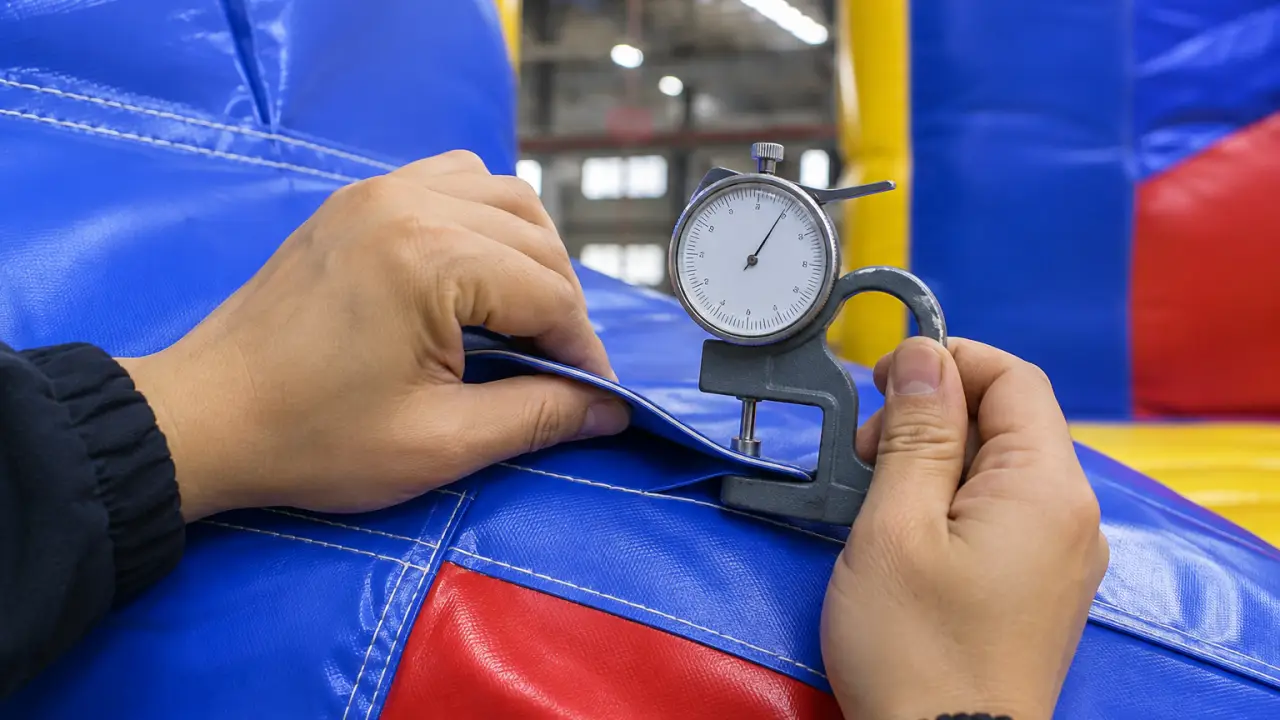
Three factors explain most of the price spread you'll see between quotes for what looks like "the same" castle: PVC thickness (0.40mm is common on budget units, 0.55mm is the standard commercial-grade spec, and the difference shows up in seam durability within the first season of heavy rental use, not on day one); panel construction (single-layer vs double-layer walls on load-bearing sections changes both weight and expected service life); and order quantity (per-unit price on a single castle vs a container-consolidated order of 8-12 units can differ by a meaningful margin, since tooling and setup costs spread across more units). A quote that looks unusually low relative to others is almost always cutting one of these three, not offering a genuine discount.
A complete quote should break out, at minimum: unit price at your target quantity, PVC thickness and GSM (grams per square meter, the actual material weight spec), included accessories (blower, repair kit, storage bag), and FOB port versus delivered pricing. A quote that bundles everything into a single number without these line items makes it impossible to compare against a competing supplier fairly, and is worth pushing back on before you commit.
Bulk discounts typically step down at recognizable order thresholds — a single unit, a half-container mixed order, and a full-container single-model order each sit at different price tiers. If you're ordering for a rental fleet rather than a single unit, ask specifically about the full-container threshold even if your current order is smaller, since it tells you where your pricing could go as you scale.
Two quotes for what looks like the same commercial bounce castle can differ by a wide margin, and the gap is almost never the factory's margin. It is the build specification. Understanding where the cost sits lets you compare quotes honestly instead of comparing headline figures.
Roughly half of a commercial castle's unit cost sits in the vinyl itself. The difference between a 15 oz (~0.45 mm) and an 18 oz (~0.55 mm) laminated PVC body is not cosmetic: the heavier grade resists abrasion at the entry step, holds stitch tension longer under repeated inflation, and is what commercial duty actually requires. A quote that does not state the vinyl weight is not a comparable quote.
The next largest block is labour, which scales with stitch count and baffle construction rather than with footprint. Double-stitched seams with binding tape, internal baffles at regular intervals, and reinforced anchor patches each add machine time. On a rental-grade castle that will see weekend use for years, these are the differences that decide whether the unit is repairable at year three or replaced at year two.
Smaller but frequently under-scoped items together account for the rest: the blower (a CE-marked unit with a declaration of conformity, not a generic import), the print method, and the anchoring kit. Full-surface digital print costs more per unit than a stitched-on banner panel but does not delaminate at the panel edge. Ground stakes, sandbags or ballast plates are often quoted separately, and a quote that omits them is not the delivered cost.
One structural point worth separating out: a commercial castle is specified for continuous rental duty, not for the domestic market. The commercial designation is about vinyl weight, seam construction, anchor count and blower duty cycle together. A supplier who markets a domestic unit as commercial on the strength of size alone is the most common source of an apparently cheap quote that does not survive its first season. For buyers assembling a rental fleet, our commercial inflatable castle range is built to rental duty rather than domestic use, and the specification differences are documented per model.
Once the unit specification is settled, the next cost lever for Latin American buyers is not the unit price — it is how the order is loaded. Bounce castles are bulky but light, so a container of castles cubes out long before it weighs out. That single fact drives most of the logistics economics.
Mix the load. A container filled with one large castle leaves significant dead space in the voids around the folded unit. Filling those voids with two or three smaller castles, or with slides and interactive units at complementary dimensions, raises the value shipped per container without raising the freight cost. For a fleet order, planning the mix so the units nest is worth more than an extra discount tier on a single-SKU load.
Size against the right container. A 40 ft high-cube is usually the better choice than a 20 ft for castle orders, because the constraint is volume rather than weight and the per-cubic-metre freight cost falls. Confirm the folded dimensions of each unit with the factory before you plan the mix — folded size varies more between models than buyers expect, particularly where a slide tower or an inflated roof is involved.
Route to the right port. West-coast South America (Chile, Peru, Ecuador) is normally served via Callao or Valparaíso; Brazil via Santos or Itapoá; Mexico and Central America via Manzanillo or Veracruz; the Caribbean and northern Colombia via Cartagena or Kingston. Inland transit from port varies enormously across the region and is often the least predictable line in the whole landed-cost calculation, so build the buffer there rather than in production.
On the pricing structure itself, our bounce house wholesale pricing structure guide covers how tiers, MOQ and FCL versus LCL are set. This section is about what to do with that structure once you are planning an order for this region.
Two things to fix before requesting wholesale pricing: the vinyl grade and the intended rental duty cycle. Those answers determine the build, and the build determines the price. Asked the other way round — price first, specification second — the quote that comes back is for a lighter unit than the one described in your brief, and the difference only surfaces in the second season.
This checklist covers castle-specific red flags; for the fuller 12-point factory vetting process that applies across any inflatable product category, see our manufacturer vetting checklist.
A genuine factory-direct wholesale price and a reseller's marked-up price can look similar on a single-unit quote, but the gap widens sharply at volume — a reseller's per-unit price barely moves between a 1-unit and 8-unit order because they're paying the same markup either way, while a real factory's per-unit price should step down meaningfully at higher quantities. Ask for pricing at three different quantities in the same request; a flat price across all three is the clearest sign you're quoting a reseller, not a factory.
Browse the full inflatable bounce castle range for current model specifications, our standard bouncer catalog for simpler no-slide units, or see our combo unit catalog if you're building a mixed rental fleet rather than a single product line.
Is a lower price per unit always a red flag?
Not always, but it should prompt a direct question about PVC thickness and panel construction before you assume it's a genuine deal — a legitimate factory running a promotional batch or clearing older stock will tell you plainly; a supplier cutting material specs usually won't volunteer that detail.
Should I order a sample unit before a full container order?
For a first-time relationship with a new supplier, yes — a single sample unit costs more per-piece than your eventual bulk order, but it lets you verify seam quality and material spec in hand before committing to a container-size order you can't easily return.
Do wholesale prices typically include shipping?
Most quotes are FOB (free on board, meaning the price covers the unit to the port only) unless you specifically request a delivered price — confirm which basis you're comparing before treating two suppliers' numbers as apples-to-apples.
Get the pricing structure and supplier vetting right before you commit to a container order, and the actual import process is straightforward from there. Get in touch with your target dimensions and quantity for a direct factory quote.