
Getting custom-branded advertising inflatables designed and printed is only half the sourcing decision for a European importer — the other half is the import logistics chain that determines whether artwork approved in week one actually clears customs and reaches your warehouse on the timeline your campaign needs.
This isn't a printing methods guide — our advertising balloons guide already covers screen printing vs digital printing vs heat-transfer in depth, including file specs and Pantone color matching. This one picks up after artwork is approved: the realistic timeline from proof sign-off to European delivery, customs documentation, country-specific compliance marking, and container consolidation options for importers bringing in mixed advertising-inflatable orders.
Once artwork is approved, budget 2-3 weeks for production of custom-printed advertising inflatables, then freight: sea freight to major European ports (Rotterdam, Hamburg, Antwerp) followed by inland transport typically runs 5-7 weeks total, while air freight compresses this to 1-2 weeks at a significantly higher cost per shipment. For a campaign tied to a fixed launch date, work backward from that date and treat the proofing cycle as a separate line item before production even starts — buyers who only budget production-plus-freight and forget the proofing stage are the ones who end up paying for air freight at the last minute.
A commercial invoice with accurate declared value and correct HS classification, a certificate of origin, and CE conformity documentation should accompany the shipment — confirm the correct tariff classification with your customs broker before the shipment leaves China rather than after arrival, since misclassification is one of the most common causes of clearance delay at European ports. Different EU member states can vary slightly in documentation scrutiny at the border, so a broker experienced with your specific port of entry is worth more than a generalist.
The logistics timeline above only starts once artwork is genuinely finalized — if file specs, color matching, and proofing rounds aren't locked yet, revisiting artwork mid-production is the single most common cause of a European import missing its intended launch window. Confirm your MOQ tier against your air dancer cost and ROI planning before finalizing artwork, since a lower MOQ at a higher per-unit cost can still beat a larger order sized for a discount tier you don't actually need.
CE marking is the baseline requirement across the EU, but some member states layer additional national requirements on top (specific language requirements for safety labeling, or country-specific registration for outdoor advertising structures above a certain size) that a generic EU-wide compliance checklist doesn't capture. Confirm requirements with your specific destination country rather than assuming CE marking alone clears every market uniformly, particularly for larger arch or tower-format inflatables that may fall under different structural regulations than smaller air dancers and balloons.
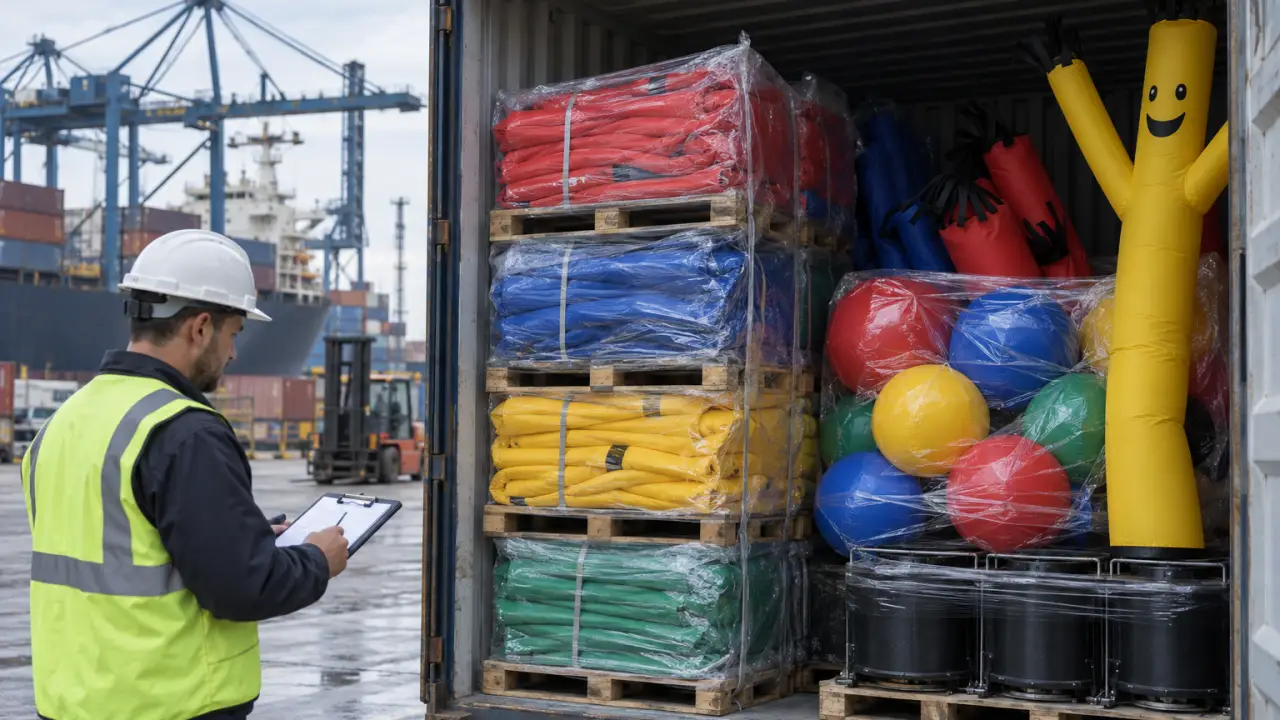
European importers bringing in a mixed order (arches, air dancers, balloons, custom-shaped inflatables) across multiple SKUs benefit from consolidating into a single container rather than separate shipments, both for freight cost efficiency and simplified customs clearance as one declared shipment rather than several. Confirm your supplier can properly pack mixed-format items together without damage risk — irregular shapes like arches and custom-molded pieces need different protective packing than flat-packed balloons, and a supplier unfamiliar with mixed consolidation may under-pack one format while over-packing another.
First-time European importers often default to whatever shipping terms a factory offers by default, but a freight forwarder with specific experience clearing advertising-inflatable imports (as opposed to general cargo) can often navigate the compliance-marking and classification questions above more efficiently than a factory's standard logistics partner. Ask your supplier whether they have an established forwarder relationship for European lanes specifically, or whether you should engage your own forwarder with EU import experience for your particular product category. Browse our full advertising inflatables range to confirm which formats and sizes apply to your planned order before finalizing shipping terms.
How much buffer should a European importer build in beyond the stated freight timeline?
Add at least 1-2 weeks beyond the quoted sea freight timeline for customs clearance variability and inland transport to your specific location, especially for a first shipment through a new port or with a new customs broker.
Does CE marking alone satisfy all EU country import requirements?
Not always — CE marking is the baseline, but some countries add national-level requirements for specific product categories or sizes, so confirm with your destination country's specific regulations rather than assuming CE marking alone is sufficient everywhere.
Is air freight worth the cost premium for a fixed campaign launch date?
If missing the launch date means an empty campaign window or a rushed substitute setup, yes — weigh the air freight premium against the cost of a delayed or diminished campaign launch that marketing budget has already been committed to.
Budget the proofing cycle separately from production time, confirm customs documentation and country-specific compliance marking before the shipment leaves China, and consolidate mixed-format orders into a single container where possible — that sequence is what keeps a custom-branded European import on schedule. Get in touch with your target country and launch date for an import-timed quote.