
This isn't a regional import guide — our UK & Ireland import guide covers BS EN 14960 and PIPA inspection registration in that market's specific context. This one is a deep-dive on the mechanical and documentation failure points that most commonly fail a first EN 14960 inspection, wherever you're operating.
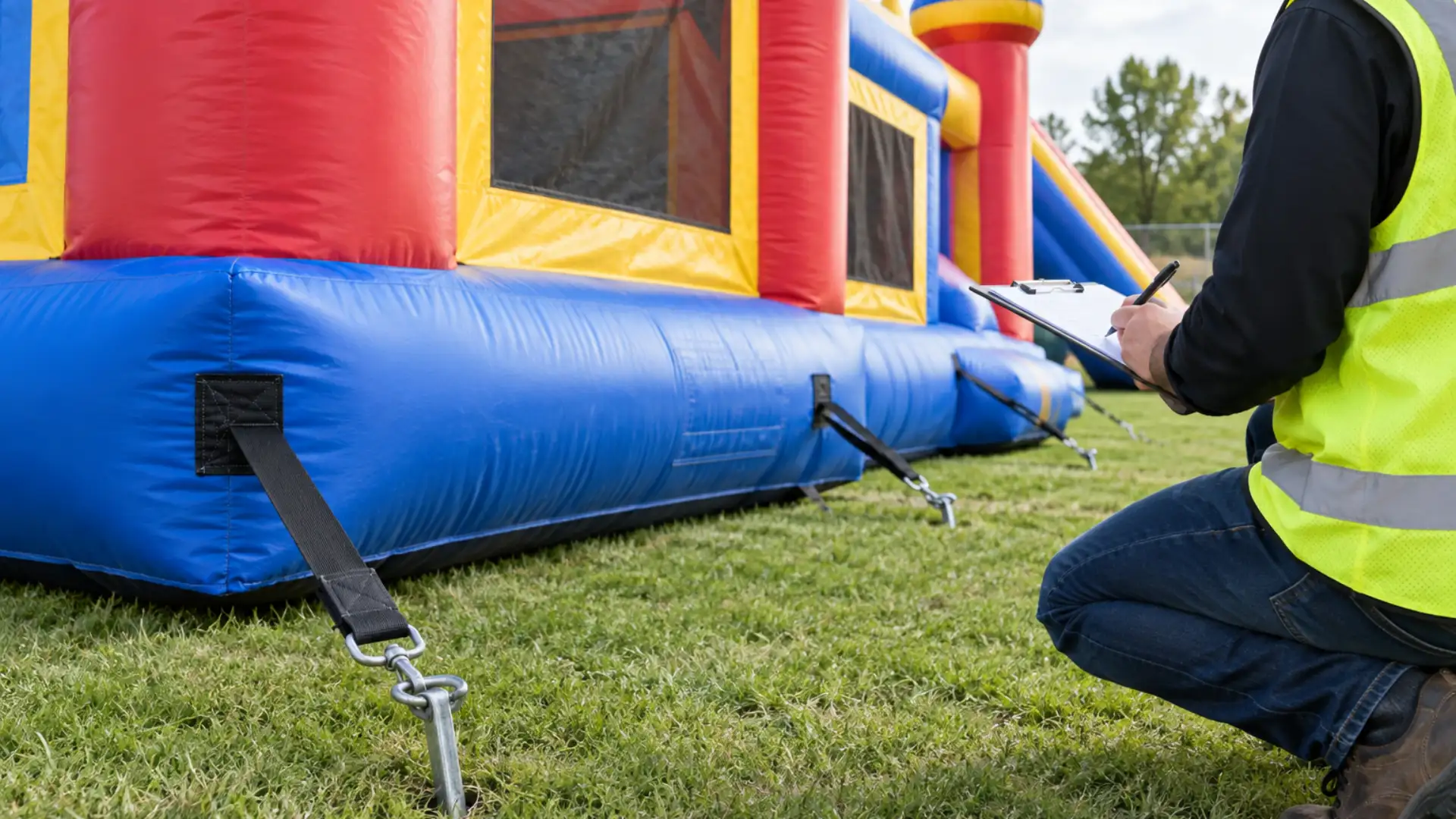
EN 14960 ties minimum anchor point count and spacing directly to the unit's rated wind resistance and footprint. Inspectors check this against the manufacturer's documentation, not by eye — a unit with visually adequate-looking anchor points can still fail if the count falls short of what the wind-rating calculation requires for that specific size and shape. This is one of the most common first-inspection failures because anchor requirements scale non-linearly with unit size, and buyers sometimes assume a slightly larger unit needs only slightly more anchoring.
Capacity limits, age/height restrictions, and operator instructions must be permanently and legibly displayed on the unit itself, not just in a separate manual. Signage that has faded, been removed, or was never applied in the correct location (typically at the entrance and on visible exterior panels) is a straightforward, avoidable rejection point. Reproduced signage in the wrong language for the operating market is treated the same as missing signage.
Constant-air units must maintain safe internal pressure if the primary blower stops, which typically means either a backup blower or a documented pressure-retention design. Inspectors specifically test what happens on simulated power loss. A unit that deflates rapidly enough to create a fall hazard during a blower interruption fails regardless of how well-built the rest of the structure is.
Seam strength testing under EN 14960 goes beyond a visual check for obvious damage — inspectors assess whether the seam construction method itself is appropriate for the unit's rated capacity and use case. This is where the gap between a welded seam and a sewn seam becomes a compliance issue, not just a durability preference: a sewn-seam construction rated for light residential use will not pass inspection at commercial-rental capacity ratings.
A surprising share of first-inspection failures are paperwork failures, not structural ones: missing manufacturer's declaration of conformity, absent or incomplete wind-rating calculations, or a missing maintenance/inspection log for units already in service. Inspectors need to verify compliance on paper as well as in the physical unit, and an otherwise-compliant unit can still fail on documentation alone.
Confirm anchor point count against documented wind rating, verify all required signage is present and in the correct market language, test blower cut-off behavior, confirm seam construction matches the rated capacity, and assemble the full documentation package before the inspector arrives. Buyers importing to the EU should also cross-check CE marking and HS code documentation covered in our EU import guide, and USA-bound shipments should confirm ASTM F2374 alignment alongside these EN 14960 points, since the two standards overlap but aren't identical on every requirement, as covered in our USA import guide.
Can a unit that fails inspection be corrected and re-inspected, or does it need to be rebuilt?
Most failures — missing signage, incomplete documentation, insufficient anchor points on a unit that has spare anchor loop capacity — can be corrected and re-inspected without rebuilding. Seam construction and blower redundancy failures are harder to correct after the fact and usually require sourcing a different unit or spec.
Does a supplier's factory-issued EN 14960 declaration guarantee a pass on local inspection?
No. A factory declaration confirms the unit was designed and built to meet the standard, but local inspection still verifies the physical unit, its signage, and its documentation independently — damage in transit, missing paperwork, or incorrect local signage can still cause a failure on an otherwise compliant unit.
Is anchor point failure more common on larger or smaller units?
Larger units fail more often, since anchor requirements scale with wind-exposed surface area rather than linearly with overall size, and buyers frequently underestimate how much additional anchoring a modest size increase requires.
Who typically catches these issues first — the supplier, the inspector, or the operator?
In practice, the operator often catches signage and documentation gaps first during pre-deployment checks, while structural issues like seam integrity and blower redundancy are more reliably caught by a formal inspector using load and pressure-drop testing rather than a visual walk-around. Building a pre-inspection checklist that covers both categories reduces the odds of a surprise failure on inspection day.
If you're specifying a new order and want to avoid these failure points before production starts, share your target market and unit size with our sourcing team for a compliance-checked quote.