This isn't a walkthrough of our full production timeline — our factory tour guide from CAD drawing to container loading covers the full 35-day process with QC as one step among several. This one goes deep on just that step: the actual pass/fail criteria, sampling method, and what happens when a unit doesn't pass.
Every unit is inflated to its rated working pressure and held for a fixed period — typically 24 hours — while we monitor pressure drop. A slow leak that a five-minute visual check would completely miss shows up clearly over a full day. The pass threshold isn't zero pressure loss (some drop from ambient temperature change is normal); it's a maximum drop rate calibrated to the unit's size and construction type. A unit that drops faster than that threshold gets pulled for seam-by-seam re-inspection before it's cleared or rejected.
Visual inspection catches obvious defects — incomplete welds, visible gaps, discoloration indicating heat damage during welding. But visual inspection alone misses seams that look fine but have reduced bond strength underneath. That's why every seam also gets a physical pull-test at multiple points along its length, not just at the ends where inspectors know to look. A seam that passes visually but fails the pull-test at even one point sends the whole panel back to the welding station. The construction method itself matters here too — our drop-stitch vs traditional airtight construction guide covers why some builds are inherently more seam-intensive than others.
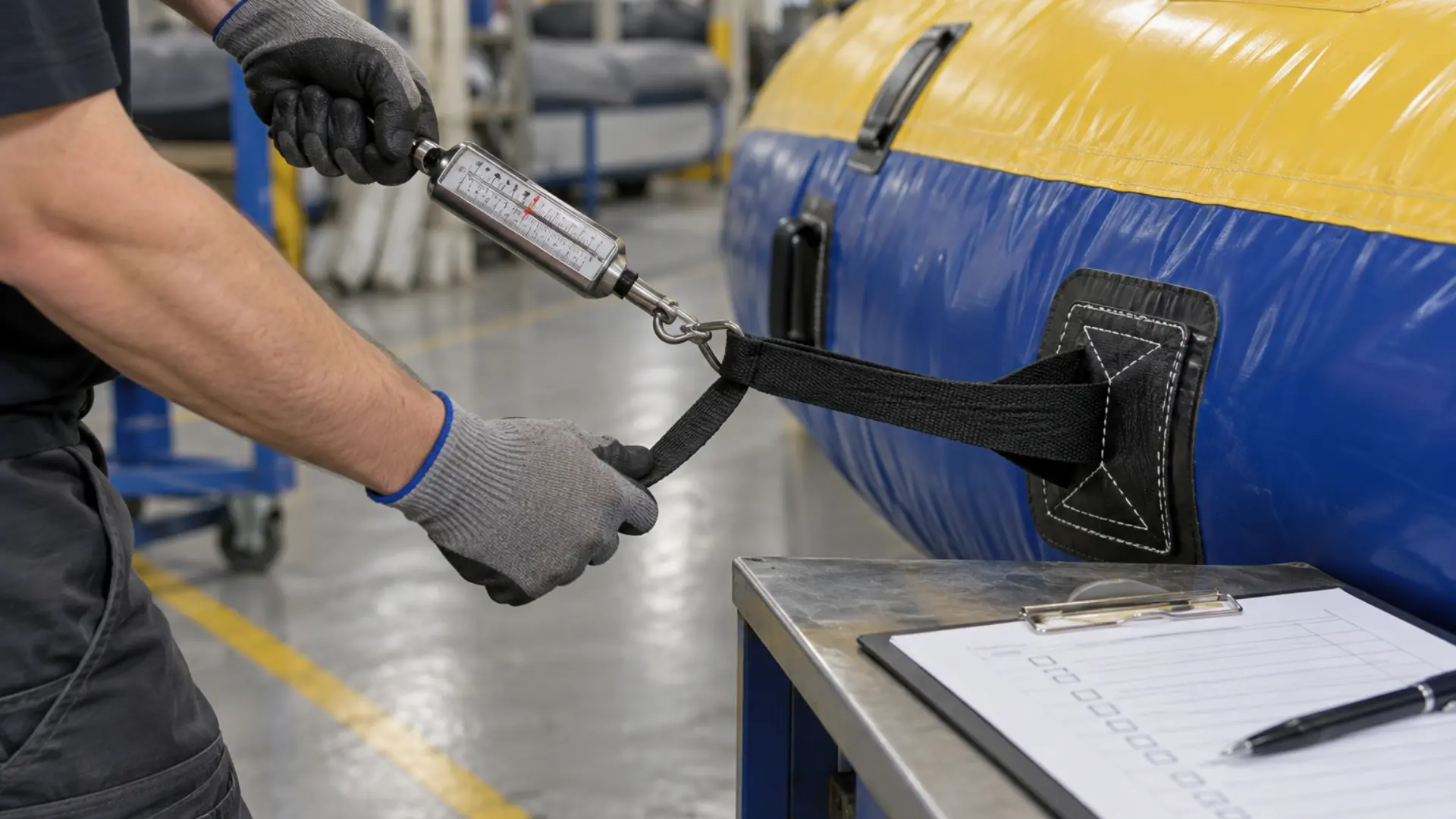
Anchor loops get pull-tested to a weight threshold well above their rated working load, and we test a defined percentage of anchor points per unit rather than just the ones that look weakest by eye — weak points aren't always visually identifiable. For larger units with more anchor points, this becomes closer to statistical sampling; for smaller units, we test every single point since the total count is low enough to make full testing practical.
Every blower unit runs a functional test checking output pressure, motor sound (an audible check for bearing issues that a spec sheet won't catch), and continuous run time under load before it's packed with the unit. This is separate from the inflatable structure's own pressure test — a structure can pass its pressure-hold test with a blower that still has a mechanical fault, which is why the two tests are never combined into one pass/fail decision. For buyers evaluating blower specs directly, our air pressure and PSI management guide covers the output and over-inflation thresholds these tests are checking against.
A failed seam gets sent back to rework if the defect is localized and repairable — re-welding a specific section is standard and doesn't require scrapping the panel. A failure that indicates a systemic problem (a batch of panels all failing at the same point, suggesting a material or process issue rather than an isolated defect) triggers a full batch hold until the root cause is identified, not just a fix on the one flagged unit. Units with structural damage beyond repair are scrapped rather than shipped with a documented exception, regardless of production schedule pressure.
Each unit's QC record (pressure test results, pull-test sample results, blower test log) is compiled into a batch QC report that ships with the container and is available on request before shipment. This is separate from certification documents like EN 14960 or ASTM compliance paperwork — the QC report is our internal manufacturing record, while certification documents verify compliance against an external standard.
Do all factories test to the same pass/fail thresholds?
No. Pressure-drop thresholds, pull-test weight targets, and sampling percentages vary by factory, and lower-cost producers sometimes skip pull-testing entirely in favor of visual inspection only. Buyers who want assurance on this should ask for the actual QC report format before ordering, not just a general "we do quality control" assurance.
Does 100% seam testing versus sampling affect price?
Full seam pull-testing on every unit takes more labor time than sampling, so it's typically reserved for higher-value or safety-critical units, while sampling is standard for high-volume production runs where statistical sampling gives adequate confidence without testing every single seam individually.
Can a buyer request to see the QC process directly?
Yes — third-party inspection services and buyer-side quality audits during production are common for larger orders, and a factory that resists this kind of visibility is worth treating as a red flag regardless of what its own QC documentation claims.
If QC documentation matters to your next order, ask for a sample QC report before production starts so you know exactly what gets tested and recorded on your specific units.