
A bounce house rental agreement should make the promised rental clear before the event: who is contracting, which equipment and services are included, what the customer will pay, and which documents explain the arrangement. A booking confirmation that lists a product and a date can leave important questions unanswered.
Use this checklist to prepare the business details and questions for your agreement. It is not a ready-to-sign contract or liability waiver. Have the final wording reviewed for your location, customer type and service model.
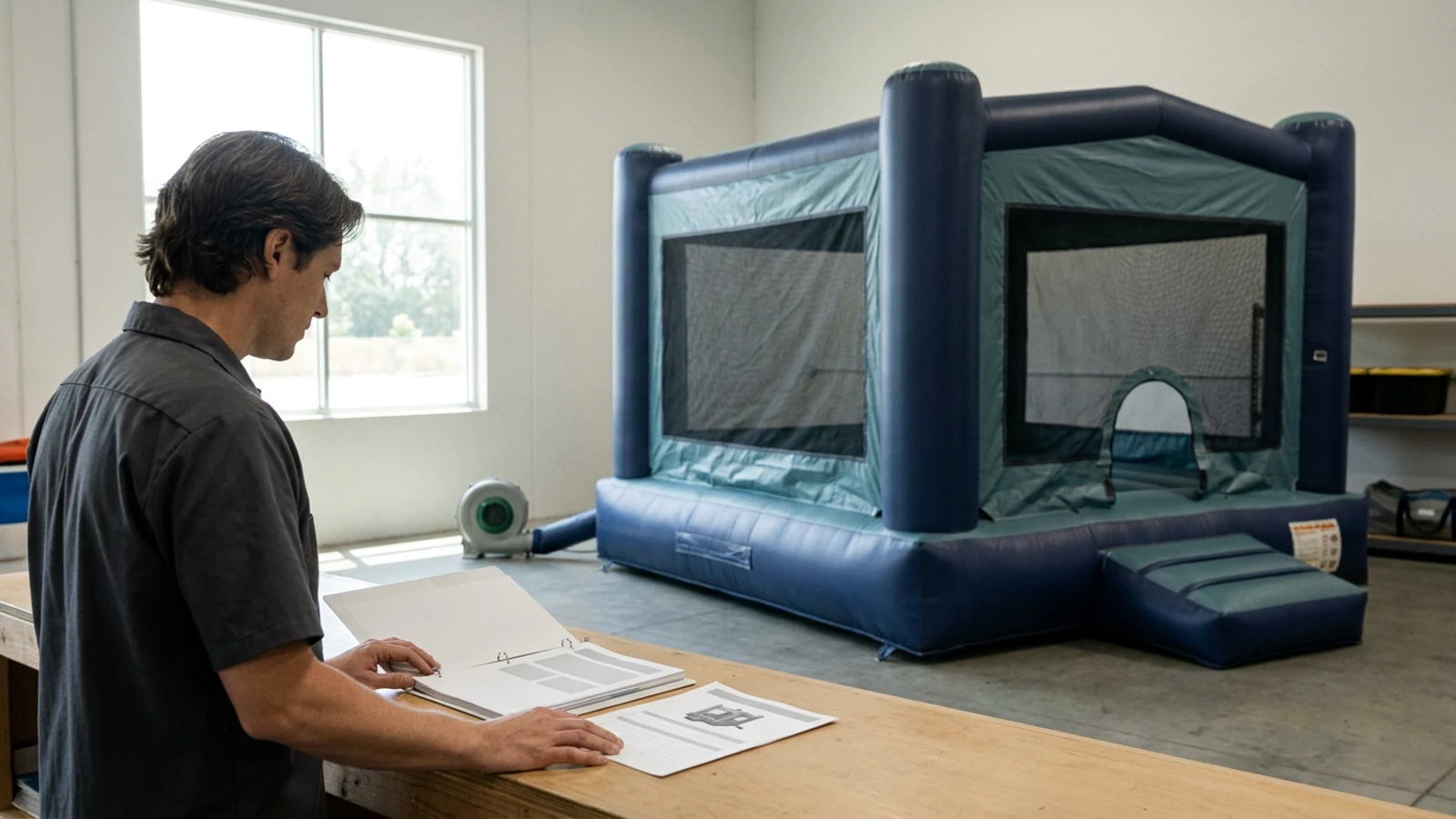
Start by separating the documents in the booking pack. They may reference one another, but they serve different purposes.
| Document | What to check |
|---|---|
| Rental agreement and equipment schedule | The parties, equipment, service scope, charges and applicable terms describe the same rental. |
| Quote or booking confirmation | The accepted offer matches the agreement; changes have not left conflicting dates, inclusions or prices. |
| Operating instructions and safety information | The information applies to the supplied equipment and reaches the people who need it. |
| Participant acknowledgment or waiver | Any proposed document has been reviewed separately for its intended users and jurisdiction. |
| Insurance documentation | Any required evidence has been confirmed with the insurer or broker. The rental agreement is not proof of coverage. |
Our commercial inflatable insurance guide covers that separate review. Signing a customer agreement does not replace insurance, equipment checks or safe operation.
Name the business providing the rental and the customer entering the arrangement. Record the customer's signing role where an organisation is booking. Distinguish that person from the event-day contact and the person receiving the equipment; they may be different people.
Describe the equipment precisely enough to match the quote and delivery. For commercial bouncers, use the agreed model or configuration and list the included blower, accessories and additional services. A package name alone may not explain what is supplied. Identify any proposed substitution for review and customer agreement rather than assuming that similar equipment is interchangeable.
State whether the offer includes delivery, installation, an attendant, collection or customer pickup. “Staff included” is ambiguous: a delivery crew leaving after installation is different from an attendant remaining throughout use. Confirm the actual work and responsibility with both sides; do not use a service description to imply that statutory duties disappear.
Separate the rental period from delivery and collection windows. Identify the event location and reference the confirmed site information. Use the venue access checklist for the physical survey. The agreement should reflect its findings without becoming another survey form.
List the rental charge and each agreed service or addition. Make clear what is included in the total, what remains subject to confirmation, and when payment is due. Compare these details with the accepted quote before presenting the agreement.
If an advance payment or security deposit is proposed, explain its purpose and ask your adviser to check how it will be treated. Avoid using “deposit” for several different arrangements without explanation. A payment toward the rental and money held against a possible later charge raise different questions.
For cleaning, late collection, missing equipment or damage, identify what the proposed terms actually cover. Ask what distinguishes normal wear from a chargeable condition, how an amount would be calculated, what evidence would be considered, and how the customer could raise a question. Have any proposed payment authorisation reviewed; recording a discrepancy does not itself establish a right to deduct money.
The rental return reconciliation checklist handles the later count and condition observations. Here, the task is to identify unclear charging terms before the customer accepts the rental, not to decide who caused damage.
Give each referenced document an identifiable title and version or date. Keep the equipment schedule, applicable operating information, site confirmation and relevant policies with the agreement being reviewed. Check that the customer can access the actual documents, rather than only a general website address.
Read the pack for contradictions. An offer describing an attended service should not be accompanied by instructions written for a different service model. A revised collection window should not leave the original window elsewhere in the pack. Resolve the wording and ask your adviser how the relationship between documents should be expressed.
For weather, cancellation and rescheduling, make the applicable terms and contact arrangements clear before booking. Keep the safety decision grounded in the equipment instructions and applicable requirements. Once an order changes, the existing cancellation and rescheduling workflow covers the administrative follow-through.
For a UK safety reference, the HSE's inflatable guidance addresses operating instructions, checks and supervision. A signed agreement is not evidence that those tasks have been completed.
Copy this worksheet into your preparation file and complete it from confirmed information. It records business facts and open questions for review; it is not a bounce house rental agreement form for the customer to sign.
| Review area | Information to prepare | Question to resolve |
|---|---|---|
| Parties and contacts | Providing business, customer, signing role and event contact. | Who is entering the arrangement, and is their role clear? |
| Equipment | Model or configuration, included items and schedule reference. | Does this match the offer the customer accepted? |
| Service scope | Delivery, setup, attendance, pickup or collection inclusions. | Are the tasks and responsible parties described consistently? |
| Time and place | Rental period, service windows, venue and confirmed site reference. | Are unresolved site or timing conditions still visible? |
| Charges and payments | Agreed items, total, payment timing and purpose of any deposit. | Which financial terms need clarification or legal review? |
| Additional charges | Proposed scope, calculation basis and supporting evidence. | How will notice, authorisation and disputed amounts be handled? |
| Documents and policies | Titles, versions and copies of the referenced attachments. | Are there missing documents or contradictory statements? |
| Final review | Open questions, reviewer, agreed corrections and final version. | What must be resolved before the agreement is ready? |
If a fact is unconfirmed, mark it as open and assign someone to obtain it. Do not turn a supplier's estimate, a customer's assumption or a blank field into an agreed commitment merely to complete the sheet.
Before adopting a bounce house rental contract template, ask an appropriate local legal adviser to review its fit. Identify the proposed customer type and service arrangement. Flag liability, indemnity, deposits, cancellation, additional-charge authorisations and signature provisions for specific attention.
In the UK, the Competition and Markets Authority's guidance on fair customer contracts explains the importance of fair, transparent consumer terms. It is a UK reference, not a rulebook for every market or transaction.
Compare the reviewed agreement with the quote and attachments once more. Keep the version provided to the customer and the record of acceptance together. If details change, preserve the previous version and record how the change was reviewed and agreed. Your team should be able to identify the arrangement accepted for that booking without reconstructing it from conflicting files.