
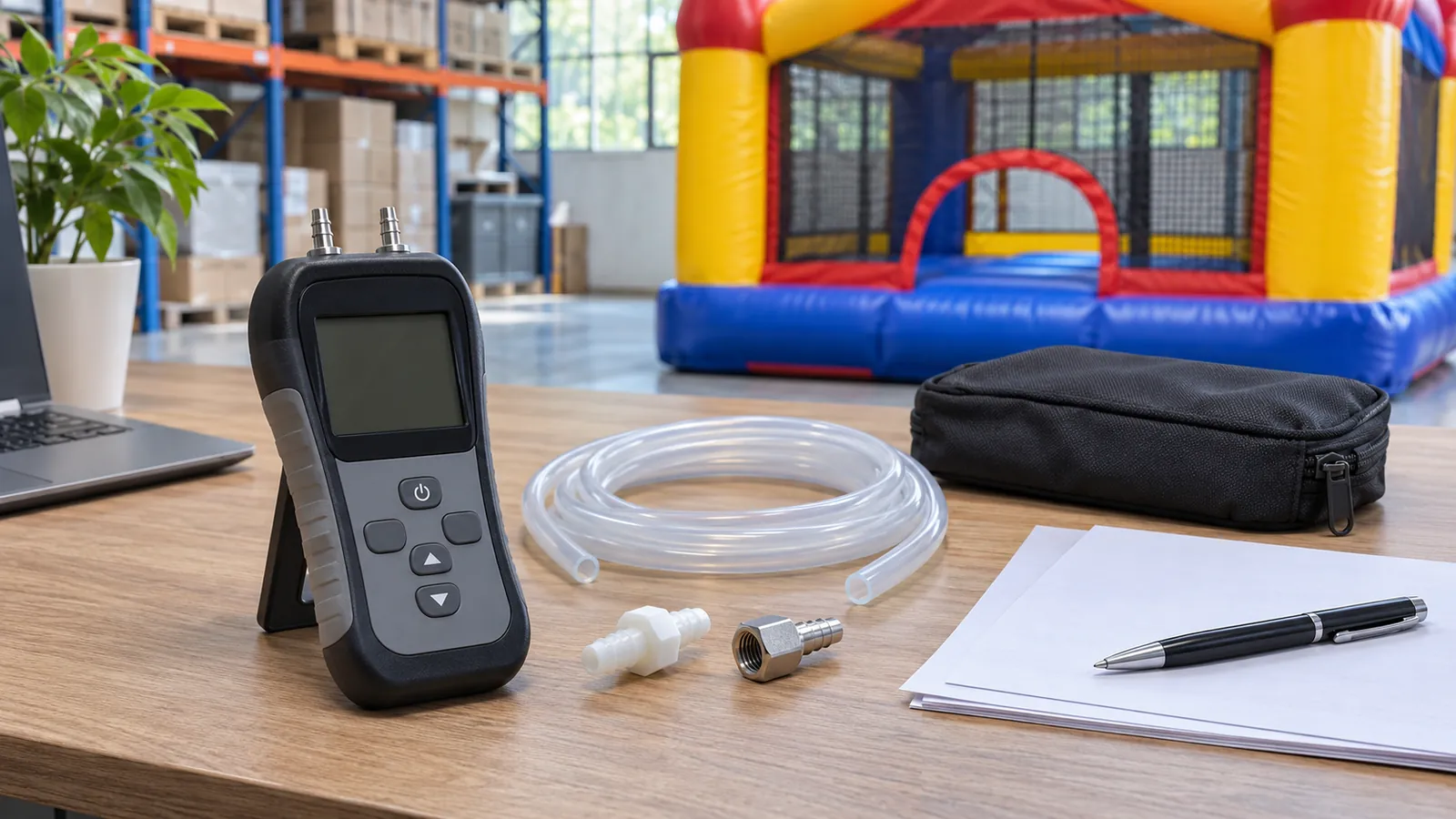
A pressure gauge and a length of hose are not yet a matched measuring kit. The instrument may use the wrong pressure reference, its range may be unsuitable for the required readings, or the supplied fittings may not match the equipment’s approved measurement interface. Resolve those questions before accepting a quotation.
This guide explains how to choose a low-pressure manometer for inflatables by connecting the equipment requirement to an exact instrument configuration. It covers purchasing checks, not measurement procedures or permission to operate a device.
Begin with the specific inflatable’s instructions and the manufacturer’s measurement requirements. Identify the relevant structure or chamber, the stated pressure limits and units, and the approved measurement interface. If those details are missing, obtain clarification before selecting an instrument.
For play equipment within its stated scope, the UK HSE inflatable safety guidance calls for suitable internal-pressure measurement, such as with a manometer, against the manufacturer’s specified limits. This is context for the purchase, not a universal operating-pressure value.
For commercial inflatable bouncers, do not infer the internal working pressure from a blower’s nameplate or substitute a specification from a similar-looking unit. Retain the equipment reference with the enquiry.
Gauge pressure describes pressure relative to the surrounding atmosphere; differential pressure describes the difference between two pressure points. Ask the equipment manufacturer and instrument supplier to confirm the reference required and whether the proposed configuration supports it. A differential instrument is not automatically a complete inflatable measuring kit.
| Equipment requirement | Instrument confirmation |
|---|---|
| Pressure reference and sign | Gauge or differential requirement; positive, negative or bidirectional range as applicable. |
| Documented units and interval | Exact displayed units, range endpoints and full model/range code. |
| Required readings | Applicable accuracy and display or scale increments across that interval. |
| Approved measurement interface | Confirmed instrument fittings, hose and equipment-specific adapters. |
Keep Pa, hPa, mbar and water-column units clearly identified. A familiar number with a different unit is a different specification. Ask for a written comparison in consistent units rather than treating matching-looking scales as equivalent.
Order by the complete code. A series name can contain several ranges and options. The range endpoints and reference must remain attached to the model throughout quotation, approval and delivery.
An accuracy expressed as a percentage of full scale is different from a percentage of the measured value. With a full-scale specification, a small reading does not automatically produce a proportionally smaller stated error. Selecting the largest range available can therefore work against the intended low-pressure measurement.
Ask the supplier to explain the complete accuracy expression over the required interval, including fixed terms, digits, range-dependent exceptions, temperature and orientation conditions. Do not replace that expression with one headline percentage.
Separate measuring range from overload or total-pressure limits. A pressure the instrument can withstand is not necessarily a pressure it can measure within specification. Neither value establishes an operating limit for the inflatable.
Request a parts list covering the instrument connection, hose specification and manufacturer-confirmed equipment adapter. A thread description on a gauge is not the same as a hose size, and a supplied hose does not establish compatibility with the inflatable.
Have the instrument supplier identify its connection requirements and the equipment manufacturer confirm the permitted measurement interface. Keep unresolved adapters or interfaces marked as pending. Do not fill the gap with a guessed universal fitting.
For wider inflatable accessories and spare-parts sourcing, make this kit a distinct line item. The purchase should identify which components are included, which are separate and who confirms the complete configuration. It should not require receiving staff to improvise a connection.
Two manufacturer examples show why the configuration matters. They are examples of reading specifications, not recommendations or confirmation of suitability for your inflatable.
| Source | Purchasing detail to preserve |
|---|---|
| DwyerOmega Series 2000 Magnehelic | Standard accuracy is ±2% of full scale at 70°F (21.1°C), with ±3% and ±4% exceptions on specified low ranges. Confirm the exact range and any -HA option separately. |
| Series 2000 connection and orientation | The listing specifies 1/8-inch female NPT high/low connections and a vertical diaphragm orientation. Confirm the offered accessories and intended configuration rather than assuming a portable kit is included. |
| Testo 512-1, order number 0563 1512 | Range: 0–200 hPa. Accuracy: ±(0.3 Pa + 1% of measured value) ±1 digit for 0–25 hPa; ±(0.1 hPa + 1.5% of measured value) ±1 digit for 25.001–200 hPa. |
| Testo listed delivery contents | The UK page includes a silicone connection hose and test protocol. Neither establishes that an equipment-specific adapter or a particular calibration service is included. |
Check the current documents for the offered model and options before ordering. HVAC applications on a product page do not themselves establish compatibility with inflatable play equipment. Likewise, the pressure instrument here measures a different quantity from the wind meter covered in our guide to choosing an anemometer for inflatables.
Use one record to connect the equipment requirement to the proposed instrument and connection kit. Keep the applicable technical documents with it, and review the same fields again if the supplier proposes a substitute.
| Matching field | Confirmation / reference |
|---|---|
| Equipment identity and instruction reference | To be confirmed |
| Pressure reference, units and required interval | To be confirmed |
| Instrument model, range code and accuracy conditions | To be confirmed |
| Instrument fitting, hose and approved equipment adapter | To be confirmed |
| Included parts, separate items and unresolved questions | To be confirmed |
For other equipment requirements, use the commercial inflatable accessories enquiry route. That listing does not establish manometer availability; this guide is not an Inflatablecn instrument supply offer.
A confirmed purchase identifies the instrument, its range and the agreed connection components. It does not replace the equipment’s instructions, competent assessment or the separate decision about whether the inflatable may operate.