
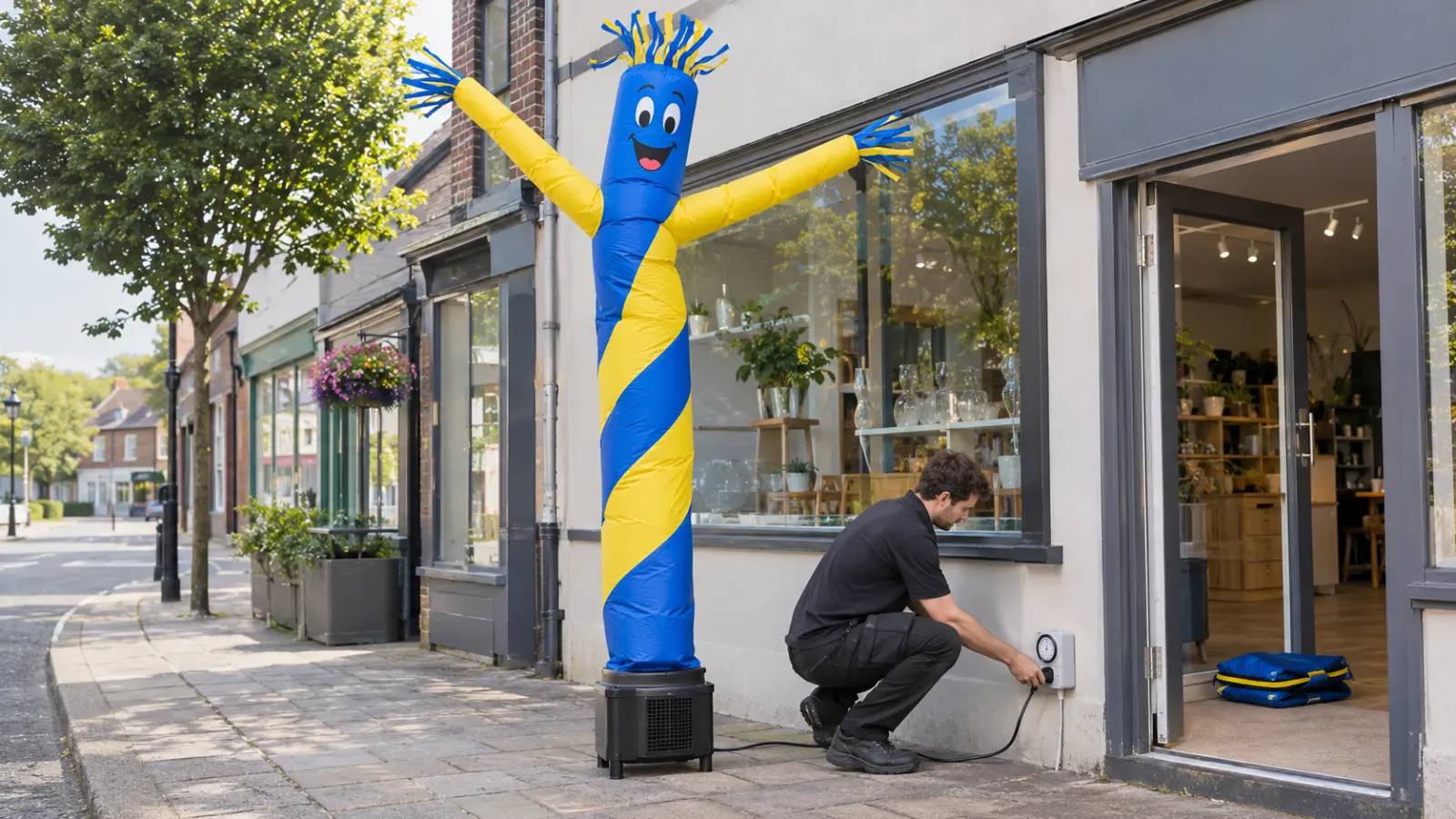
Run a shop-front air dancer on its own outlet that matches the blower's nameplate, switch it on and off with your opening hours, take it down when the wind approaches the supplier's stated limit, and bring it inside at closing time. Spend about a minute checking it when you start it and again when you pack it away. If you can't give it its own outlet, a dry spot near the door or a safe place for it overnight, solve that first. Don't let the unit run until you have.
Most problems with shop-front air dancers come from routine, not from the product: a blower sharing a socket with a fridge, a tube left out in the rain overnight, or nobody deciding who takes it down when the weather turns. Settle each of those once and the unit becomes a daily habit rather than a daily risk.
Start with the blower's nameplate. It states the voltage, frequency and power the unit needs. Check that your outlet supplies that voltage and frequency, and that the circuit can carry the blower alongside whatever else is on it. A blower that shares a circuit with a coffee machine, a freezer or a space heater is the most common reason for tripped breakers and blowers that stall mid-morning.
Use an outlet that serves the blower alone where you can. If the cable has to run outdoors, use an extension lead rated for outdoor use and for the blower's load, keep the connection off the ground and away from standing water, and route the cable where customers won't trip on it. If you're unsure whether a circuit can take the extra load, ask an electrician before you plug it in. It's a short visit, and far cheaper than a burnt-out motor.
An air dancer works as an "open" signal, so it should run when you're open and stop when you're not. A plug-in timer rated for the blower's load makes this automatic. Set it a few minutes after opening and a few minutes before closing, so staff can check the area before it starts and pack the unit away right after it stops.
Remember what happens when the blower stops: the tube drops to the ground. Check where it falls. It should land clear of the doorway, the footpath and parking spaces, where nobody will walk on it or drive over it. If the drop zone isn't clear, move the unit rather than relying on the timer.
Air dancers are light-wind products. Your supplier's manual gives the wind speed at which the unit must be switched off and brought in. Use that figure, not a general rule of thumb. Our guide to wind speed limits for commercial inflatables explains how to read forecasts and gusts against a stated limit.
Name the person responsible for the decision on each shift, and agree where they check the forecast. Bring the unit in for rain as well, because a wet tube that is folded and stored will mildew and lose its colour. If a gust catches the unit before anyone reacts, switch the blower off first and then gather the tube. Don't wrestle a fully inflated tube in the wind.
Leaving an air dancer outside overnight shortens its life. Dew and rain soak the fabric, the blower intake collects debris, and an unattended unit can be stolen or damaged. At closing time, let the tube deflate, shake off dirt, and fold it loosely. If the fabric is damp, hang it or lay it out indoors to dry before you bag it.
Store the blower indoors as well, upright and with its intake clear. If your shop has no room for the blower, a locked outdoor cabinet that keeps it dry and ventilated is the minimum. Never cover a running blower or store it while it is still warm.
Before you switch on, look at four things: the tube for tears or loose seams, the attachment to the blower outlet, the blower intake for leaves or plastic bags, and the stakes or weights holding the blower in place. After switching on, watch for a few seconds. The tube should stand fully and move freely, without a section that stays bent or soft.
At closing, repeat the tube check while you fold it. Write down anything you notice, such as a small tear or fading on one side. A note in a notebook by the till is enough. It tells you when the unit needs attention before a customer notices.
The fabric tube wears long before the blower does. Replace it when tears keep reopening after repair, when the colour has faded enough to look tired from the road, or when the tube no longer stands straight on a blower that still delivers full airflow. You don't need a new blower for a new tube. Our guide to ordering a replacement air dancer tube for an existing blower explains how to match the attachment and confirm the fit before you order.
In this illustrative example, a mobile phone shop in a German town centre runs a single air dancer beside its entrance. The shop has one outdoor socket, which also powers the illuminated window sign.
The owner moves the window sign to an indoor socket, so the air dancer's blower has the outdoor socket to itself. A plug-in timer starts the blower at 9:10 and stops it at 18:50, ten minutes inside opening hours. When the tube drops, it falls onto the shop's own forecourt, clear of the pavement. Staff check the forecast at opening against the limit in the supplier's manual, and the shift manager takes the unit down if wind is forecast above it. At closing, the tube is folded and bagged in the back room, and the blower is stored beside it. After four months, the note by the till shows a small tear repaired twice in the same place. The owner orders a replacement tube before the busy season.
If you're choosing an air dancer for a shop front, start from the commercial air dancer range and confirm the height, tube style and blower specification for your power supply. Our guide to air dancer purchase and operating costs helps you compare running a unit yourself with renting one. Air dancer blowers, sandbags and stakes are listed among our accessories.
When you request a product quote, include your outlet voltage, the space in front of your door and your opening hours, so we can recommend a unit that fits how you'll run it.
Planning to buy inflatables for your rental business or event?