
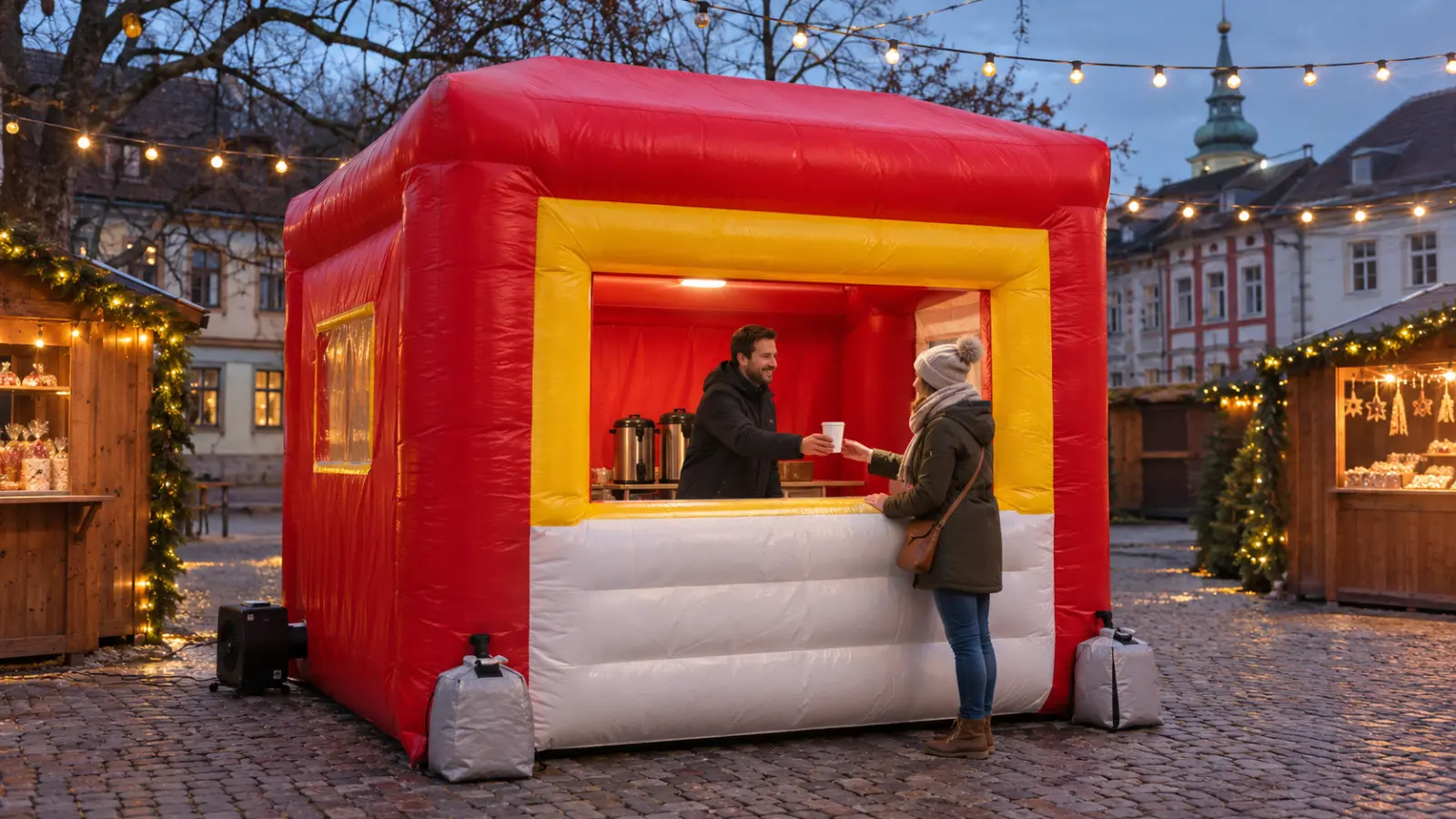
An inflatable sales tent suits traders who move between markets, fairs and pop-up locations, need to set up quickly, and want a structure that carries their brand from every side. Before you choose one, confirm four things in writing: that its footprint fits the pitch the organiser allocates, that its serving opening suits how you sell, whether it can be closed at night or has to come down, and how it will be held down on the ground you will stand on. If you trade from the same pitch for weeks, or the organiser does not allow blowers or ballast, a metal-frame tent is usually the better choice. Our comparison of air-sealed and metal-frame tents explains the trade-off.
Most problems with a sales tent show up on the first market day: a footprint that overlaps the neighbour's pitch, a counter opening at the wrong height, or a tent that cannot be left standing overnight. Each of these can be avoided at the ordering stage.
Markets, fairs and Christmas markets usually rent pitches in fixed sizes, and organisers often set limits on height and on anything that extends beyond the pitch. Measure the full footprint of the tent, including tie-down lines and ballast, against the pitch the organiser gives you, not just the floor area inside.
Check the height as well. Some locations sit under trees, lights or covered walkways, and an inflatable tent cannot be lowered once it is inflated. The inflatable selling booth tent in our range, model GTE-052, measures 4 × 4 m with a height of 4.5 m. Confirm the exact dimensions of the model and configuration you are quoted before you book a pitch.
A sales tent is a shop, not just a shelter. Think through where customers will queue, where you will hand over goods, and where you will keep stock and the till.
Serving opening. Check the width and height of the front opening and whether it gives a natural counter line. If you sell hot food or drinks, check that the opening leaves room for equipment behind the counter and for staff to move.
Other sides. Decide whether you need openings on more than one side, for example on a corner pitch, and whether the side walls can be closed when the wind turns.
Inside space. List the tables, shelves and equipment you will put inside and check them against the inner dimensions, not the outer ones.
Ask how the tent is closed at the end of the day. Some designs can be fully closed with zips or panels, which keeps out rain and casual access. Others are meant to be deflated and packed away every evening.
If you plan to leave the tent standing overnight, ask whether the blower is designed to run continuously and whether the organiser allows it, since many markets switch off power at night. A closed tent is not a secure store. Take valuable stock and cash away at the end of each day.
Markets usually stand on paving, tarmac or cobbles, where stakes cannot be used. The tent then depends on ballast at every anchor point the manufacturer provides. Ask the supplier for the required ballast per anchor point and how it attaches, and plan how you will transport it. Our guide to sandbag, water ballast and ground stake anchoring compares the options.
Wind matters more in a street market than in an exhibition hall, because buildings funnel gusts down a row of stalls. Agree in advance at what wind speed you will close and deflate, using the limit the manufacturer states for the tent. Our guide to wind speed limits for commercial inflatables explains how to measure it on site.
An inflatable tent needs power for its blower for as long as it stands, unless it is a sealed design. Ask the organiser whether the pitch has power, what supply is available and what it costs, and whether you can connect your own extension lead. Give them the blower's rating from its nameplate. If the pitch has no power, a constant-air tent is not an option there.
The roof and walls of an inflatable tent can carry printed artwork, so customers can see your name from further down the row than a sign would reach. Decide which surfaces to print and whether you need artwork you can change between events. Detachable banners let you switch between brands or seasons without reprinting the whole tent.
In this illustrative example, a trader selling hot drinks books a 4 × 4 m pitch at a German Christmas market. The pitch is on cobbles, the organiser provides a power point, and stalls must be closed at night while the market is shut.
The trader confirms that the tent, with its ballast, fits within the pitch, and that the front opening leaves room for a counter and a hot-water urn behind it. The organiser confirms that blowers may run overnight on the pitch supply. The supplier confirms the ballast per anchor point, so the trader orders water ballast to fill on site rather than transporting sand. The tent is printed with the trader's name on the roof and front, and the side panels zip closed each evening. The cash box and stock go home every night.
Browse the full inflatable tent range to compare sizes and shapes. When you request a quote, include your pitch size, the ground surface, whether you need to close the tent overnight, the power available and the artwork you want, so the supplier can confirm a model that fits how you trade.
Planning to buy inflatables for your rental business or event?