
Winter is the season when foot traffic and dwell time become measurable revenue. A well-placed inflatable snow globe or oversized winter figure turns a mall atrium, a store forecourt or an event plaza into a photo destination — and every phone that comes out is free reach for the venue. For retail buyers, event planners and rental operators, these are not props. They are high-visibility experience assets, and sourcing them well comes down to film clarity, walk-in design and the right customization.
"Winter display inflatable" covers a broad family of products, and it helps to know what each one is for before you request quotes.
The headline product. A walk-in snow globe is a transparent inflated dome, typically 3–6 m in diameter, large enough for a small group to step inside for photos. Many models add a light snow-blowing fan or hanging foam-flake effect so visitors are photographed "inside" a swirling globe. These are the strongest draw for retail and mall activations because the queue itself becomes advertising.
The giant inflatable snowman is the workhorse of outdoor winter décor. Cold-air (constant-blower) versions hold a rigid, sculpted shape day and night and can be built from 3 m up to 8 m and beyond. Because they read clearly from a distance, they work as landmarks at venue entrances, car parks and rooftop displays.
Any figure or globe can be built as a holiday display inflatable with internal LED lighting for after-dark impact — critical in winter when most footfall happens after sunset. Programmable RGB LED modules let one unit shift colour to match a brand palette or an evening light show.
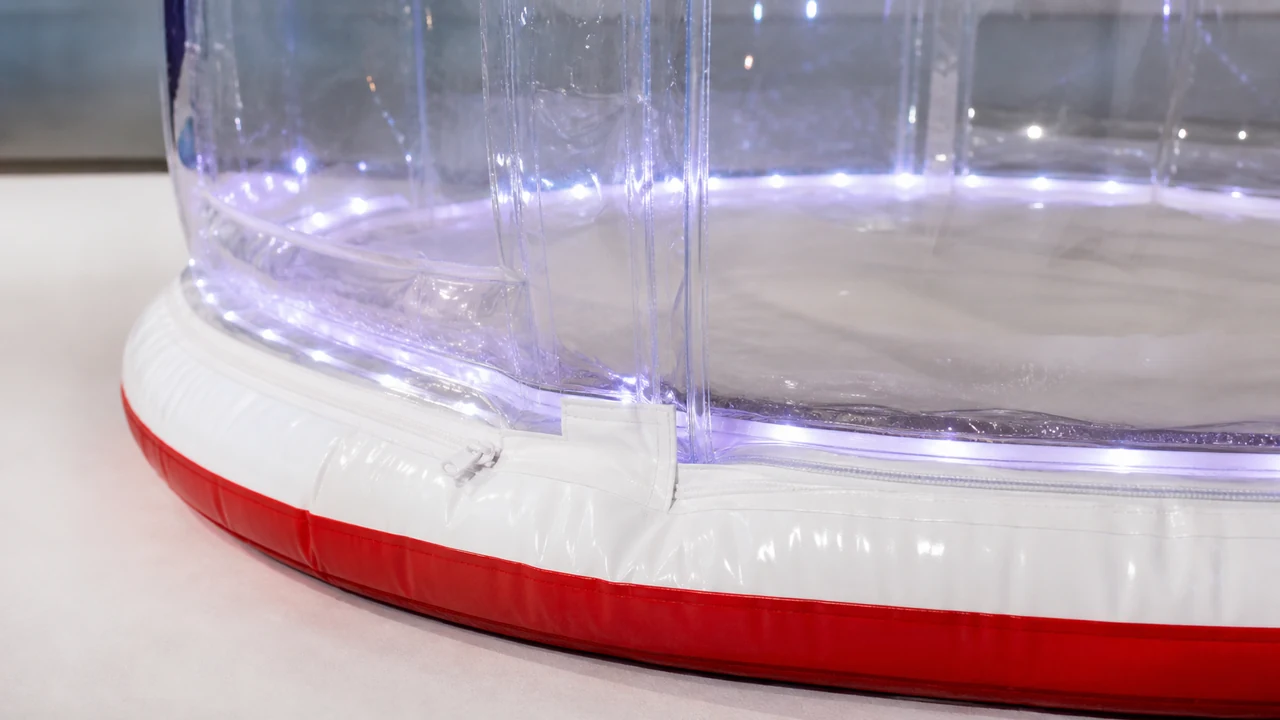
Photo quality is the whole point of a snow globe, so the transparent shell is the single most important spec. The best walk-in globes use a clear TPU film for the dome — it stays optically clear, resists yellowing better than cheap PVC, and holds up to repeated pack-down. The base ring and any coloured sculpted elements (a snowman body, a gift-box plinth) are usually heavier PVC tarpaulin for durability and print vibrancy.
Structurally, most walk-in units are continuous-air designs: a quiet, low-wattage blower runs constantly to keep the dome inflated and the interior comfortable to stand in. Confirm blower count, wattage and noise level, plus a sealed double-zip or airlock entry so the globe stays firm while people walk in and out. Cold-air sculpted figures use the same blower principle but hold detailed shapes rather than a smooth dome. For an adjacent build approach and film considerations, our guide to transparent inflatable domes & bubble tents covers clear-film construction in more depth.
Placement drives ROI, so match the product to the venue:
These sit within a broader seasonal holiday inflatables range that rental operators can build a full winter package around.
Anything tall and light outdoors is a wind risk, and a snow globe or 6 m snowman is no exception. Specify multiple anchor points — reinforced D-rings around the base — rated for ground stakes on grass or ballast weights and ratchet straps on hard standing. Ask the supplier for a recommended maximum operating wind speed and a clear tie-down layout. For the full framework on rating and deploying tie-downs, see our breakdown of anchor systems for inflatables.
The commercial value of a winter display is in the branding. Full-colour digital print lets you add a logo band to a globe base, a sponsor panel on a snowman, or a bespoke scene inside the dome. OEM buyers can commission entirely custom shapes — mascot figures, product-shaped displays, branded gift stacks — at agreed MOQ. When you plan the wider seasonal buy, treat display units as one line alongside the timeline logistics in our commercial Christmas inflatables sourcing guide, which handles the peak-season ordering calendar this article deliberately doesn't repeat.
Inflatables ship well because they compress. A deflated walk-in globe and its blower fold into a wheeled storage bag; several mid-size units consolidate into a single pallet. For volume orders, plan the container: a 40ft HQ absorbs a substantial mixed winter range, and getting the cube math right protects your FOB/CIF landed cost. Our comparison of 20ft vs 40ft HQ container loading shows how to maximise units per shipment. Confirm MOQ per design early — stock shapes carry low minimums, while fully custom OEM builds set their own.