
An inflatable dunk tank is a water attraction that combines a target-triggered release mechanism with a tank or pool. For buyers supplying schools, fundraisers and events, the purchase decision depends on the actual model, operating requirements and full event costs. Use this guide to prepare questions for the supplier before committing to an order.
An inflatable dunk tank is a large inflatable water pool or tank with a seat mounted above the water and a throwing-target trigger mechanism to one side. A volunteer sits on the seat above the water. Players line up and throw balls at the target board. When a throw hits the target squarely, the trigger releases the seat, and the person drops straight down into the water below. The seat is then reset, the volunteer climbs back up, and the next round begins.
The format combines a throwing game with a water drop. Confirm that the advertised model includes the seat, release mechanism and supporting structure shown in the quotation; an inflatable pool alone is not a complete dunk tank.
Compare the proposed model with our commercial inflatable sports range.
Choose the revenue basis first: a fixed rental booking and a staffed pay-per-play event require different calculations. For a rental, subtract the direct costs of delivering that booking. For a pay-per-play event, use paid rounds actually served, not spectator numbers or theoretical maximum capacity. Neither calculation establishes a guaranteed payback period.
| Decision | Record before quoting the event |
|---|---|
| Revenue basis | Use either the agreed rental fee or a conservative number of paid rounds multiplied by the actual charge. Do not count the same revenue twice. |
| Direct event costs | Include transport, loading, assembly, staffing, water supply and disposal, cleaning, drying, payment fees and event-specific charges. |
| Service time | Include preparation and pack-down as well as opening hours. Obtain a demonstrated reset procedure before estimating throughput. |
| Contribution | Revenue minus direct event costs must still cover storage, insurance, administration and equipment ownership costs. |
Run a lower-booking or lower-participation scenario before purchasing. Keep payback calculations separate from the supplier’s product specification, and do not promise a particular number of events to recover the investment.
Compare the complete quoted assemblies rather than the tank wall material alone. An inflatable tank may still require a rigid seat frame, a release mechanism and separate transport protection:
Ask for a written specification for the exact model. Keep unresolved items open in the RFQ instead of treating a generic material description as a purchase specification:
Request the fabric specification, construction method and water-retaining seam details for the quoted model. Do not prescribe one thickness or assume that stitched and welded construction are interchangeable. Ask the supplier to identify which components are inflatable, which retain water and which support the participant. Compare the product scope with our commercial water attractions.
Ask for a demonstration of the release, reset and locking arrangements for the actual model. Confirm the supplied components, inspection procedure, replacement-part references and availability. Do not infer cycle time from a promotional photograph.
Obtain the permitted participant limits, required water conditions, support requirements and drainage instructions in writing. Check these against the proposed venue and confirm how the rigid components connect to the tank. Do not assume adult suitability from the overall dimensions.
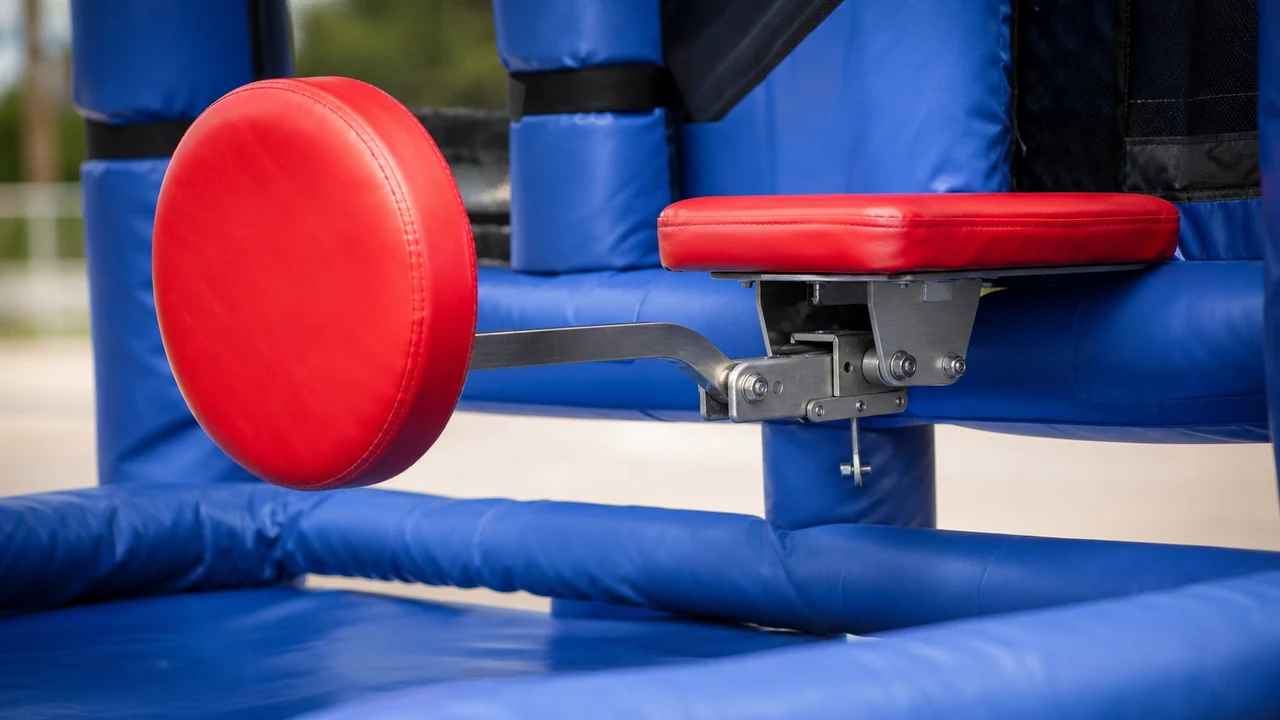
Mark the equipment location, water supply, drainage route, waiting area and access for delivery. Ask each bidder for the tank and release mechanism included, how the model is filled and emptied, and the model instructions. List any work the venue needs to arrange separately before comparing the quotes.
Use the model-specific instructions and the event risk assessment to plan operation. The following questions support that review; they do not establish that a model is suitable for every site:
A dunk tank is often grouped with the wider interactive and competition category, but it is a distinct product defined by its dunk-and-water mechanism. If your buyers also want throw-and-hit or head-to-head units, point them to our interactive competition games — but be clear that this specific attraction is about the water drop, not a scoreboard. For a fuller overview of that adjacent category, our guide to inflatable interactive and competition games covers the throw, score, and race formats that sit alongside the dunk tank. It sits at the crossover of sports-style play and water fun, which is exactly why it converts so well at mixed-audience events — much like the inflatable sports games for corporate events that many of our rental clients run in the same fleet.
When you move to a purchase order, confirm these commercial points:
Before ordering, resolve the model specification, venue requirements, package-level freight details and service-parts questions in writing. Compare the full cost of delivering the attraction with a conservative booking or paid-round scenario; the quotation alone does not establish profitability.
Request an inflatable dunk tank quote and OEM options
For related buying considerations, see our inflatable haunted house buyer's guide, our guide to inflatables for pumpkin patches and agritourism farms, and our year-round seasonal promotional inflatables calendar.
Planning to buy inflatables for your rental business or event?