
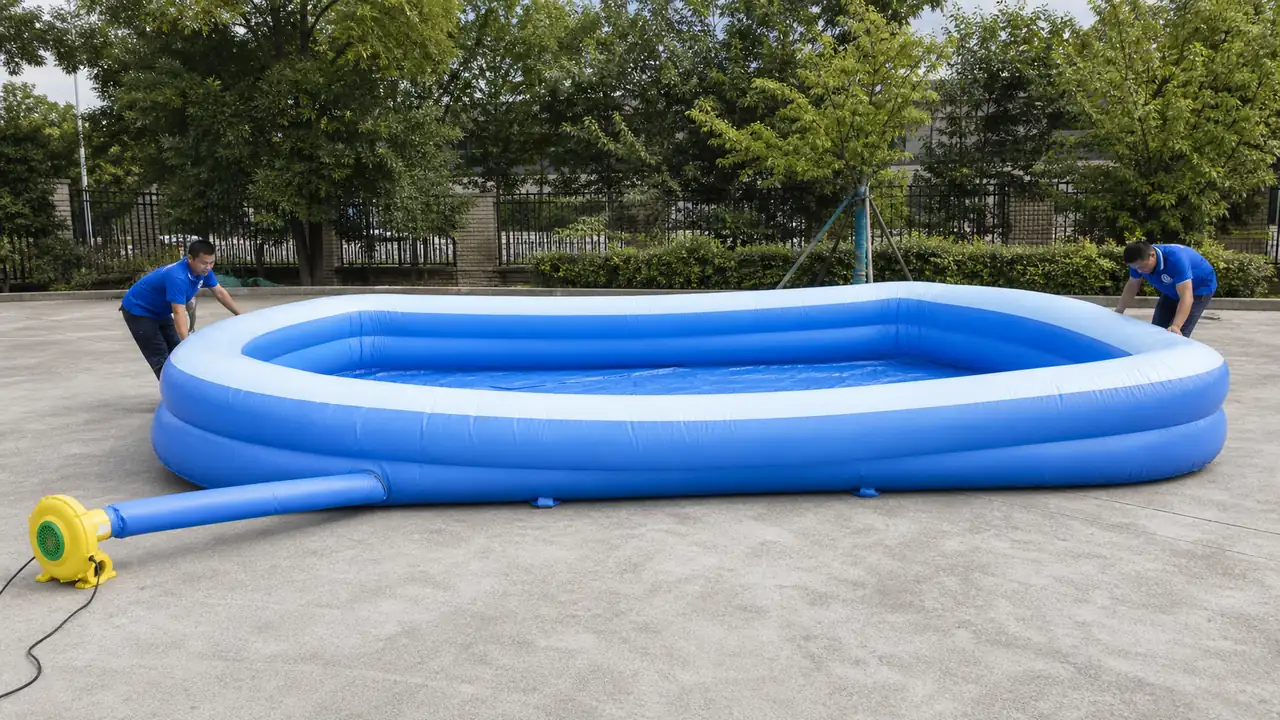
An inflatable pool is a self-supporting water container built from reinforced PVC that holds its shape through internal air pressure or drop-stitch panels, rather than through excavation, concrete, or fixed plumbing. A traditional pool is a permanently built structure set into the ground or a fixed shell. For a resort, hotel, event operator, or rental business, choosing between the two is not a matter of taste. It is a decision about capital, timeline, and how flexible your venue needs to be. This guide compares inflatable vs traditional pools across the five factors buyers actually weigh: cost structure, setup time, durability, portability, and seasonality.
The core trade-off is permanence versus flexibility. A built pool is a fixed asset that raises your property value and suits venues that need a single pool in one place for decades. An inflatable pool is a deployable asset you can install, relocate, store, or scale with demand. Below is the head-to-head comparison across the dimensions that drive most purchasing decisions.
Before the detail, here is the short answer buyers are looking for: an inflatable pool trades the long lifespan and fixed permanence of a built pool for dramatically lower upfront cost, same-day setup, and the freedom to move or store the unit. Which side wins depends entirely on whether your venue values a permanent fixture or an adaptable one. Read the five factors below against your own operating model.
To frame the choice of an inflatable pool vs built pool at a glance: choose the built pool for permanence, maximum single-location lifespan, and property-value gain. Choose the inflatable for speed, mobility, seasonal storage, lower upfront capital, and the ability to scale a fleet. Most commercial buyers who prioritise cash flow and flexibility over a fixed installation land on the inflatable side.
A built pool is the right call when you need one permanent installation that adds real-estate value, when the venue will never change, and when a decades-long single-location lifespan matters more than flexibility. If your pool defines the property and will never move, permanence wins.
An inflatable pool is the stronger choice for operators who value speed, mobility, and lower upfront risk. Event companies, rental fleets, seasonal resorts, and hotels testing a new attraction all benefit from installing in hours and storing in the off-season. Our airtight inflatable pools hold pressure without a continuous blower, while the broader commercial water product range covers slides, floating platforms, and aqua-park modules that pair with a pool deployment.
For venues weighing a full guest experience rather than a single pool, our guide to commercial inflatable pools for resorts and hotels covers layout and capacity planning. If budget modeling is your priority, the breakdown of what drives the cost of an inflatable water park details the variables that move the number. And for larger installations, our aqua park design for 200-guest capacity shows how modular units scale.
For European resort and hotel investors specifically, the decision often comes down to installation timeline and off-season handling more than raw cost. A property with a fixed pre-season opening date benefits from an inflatable installation's days-not-months setup, and a seasonal Mediterranean or Alpine property that closes for part of the year can fully deflate and store the pool, converting an entire off-season cost line to zero rather than paying for winterization or continuous maintenance. Labor cost also factors in differently by country — the gap between inflatable and traditional installation labor is widest in higher-labor-cost markets like Germany and France, and narrower in markets like Italy and Spain.
For a full 5-year total cost of ownership model built specifically around these European factors — including country-by-country labor cost differences — see our 5-year TCO guide for European resort investors.
Commercial inflatable pools are manufactured to order, which is where sourcing decisions matter. Confirm MOQ before committing, and ask about OEM and ODM options if you need branded graphics, custom dimensions, or a specific color scheme. Reinforced 0.9mm PVC and drop-stitch panels should be specified up front for commercial durability. Because deflated units ship compactly, freight is efficient — clarify FOB or CIF terms and whether your order consolidates into an HQ container for the best per-unit shipping economics.
If you need a permanent, value-adding fixture in one location for decades, a traditional built pool remains the answer. If you need a fast, flexible, storable, and lower-risk solution that redeploys season after season, an inflatable pool is the smarter commercial investment. For most resorts, event operators, and rental businesses balancing cash flow against flexibility, the inflatable option delivers more usable water, sooner, with far less locked-in capital.