
The question comes up on every first fleet purchase: the residential unit looks the same size, has the same colours, and costs a fraction of the commercial one. What exactly are you paying for?
Not size. The difference is four measurable specifications, and each one maps directly to a failure you will meet if you get it wrong. A residential unit put into rental service does not usually fail dramatically — it just wears out in one season, fails an inspection, or gets refused entry at a venue that asks for paperwork the manufacturer never produced.
1. Material and coated weight. Residential units are typically built from light PVC-coated fabric or coated nylon chosen to keep pack weight and price down. Commercial units use heavier reinforced PVC tarpaulin, specified by base fabric denier and total coated weight — 1000D and 1100D base cloth is the working range, with coating weight rising for high-wear and structural applications. The practical consequence is abrasion resistance at the entrance step and the jump surface, where a season of daily loading either holds or thins out. How to read those specifications is covered in our guide to PVC tarpaulin grades for commercial inflatables.
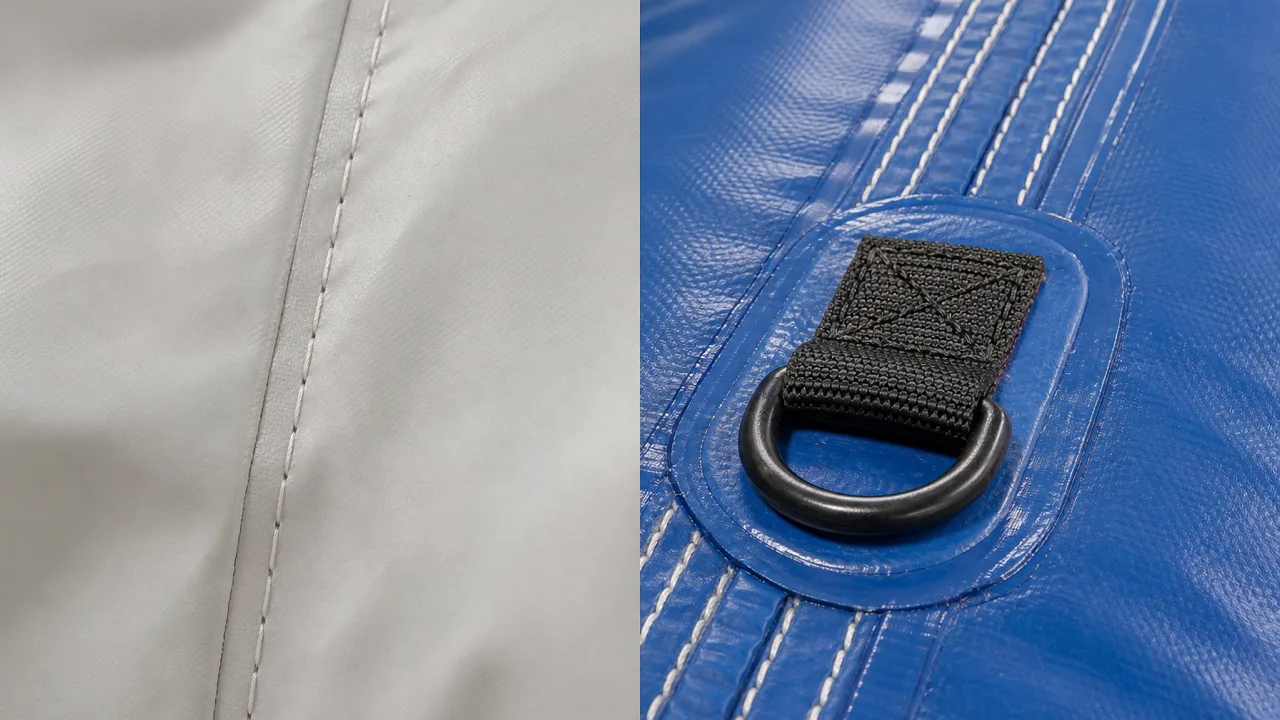
2. Seam construction. This is the most reliable single tell. Residential units are commonly single or double stitched with light thread and no reinforcement over the stitch line. Commercial units use double or quadruple stitching with glued or welded seam tape, and reinforcement patches at every anchor point and high-stress corner. Under repeated loading, needle holes in an unreinforced seam enlarge until the stitch line becomes the failure. Our comparison of welded versus sewn inflatable seams explains which method belongs where and how to check a sample.
3. Blower duty cycle. Residential blowers are built for intermittent use — a few hours, then off. Commercial blowers are continuous-duty motors expected to run for a full operating day, repeatedly, with an outdoor-rated enclosure and thermal protection. A residential blower asked to run eight hours a day for a season overheats and dies, usually in the middle of a booking. Sizing, power and maintenance by product type is covered in our commercial blower selection guide.
4. Anchor points and load rating. Count them. Residential units carry a handful of light stake loops intended for a calm back garden. Commercial units carry substantially more anchor points, positioned by load path, with reinforced webbing and D-rings rated to take real force, plus a stated user capacity and per-user weight limit. Anchoring is what stands between a gust and a serious incident, and the anchor point count is the easiest specification to verify on delivery.
A residential bounce house is designed around a handful of uses a year — birthdays, a few summer weekends, children from one household. A commercial unit is designed for repeated events every week through a season: continuous inflation, mixed ages, unsupervised enthusiasm, transport in a van, setup and teardown by different crews, and storage between jobs.
That is roughly two orders of magnitude more loading cycles, plus mechanical stress from folding and unfolding that a garden unit never sees. The material and seam specification is not a marketing tier — it is the engineering answer to that cycle count.
This is where residential units fail commercially even when they are still physically fine.
Commercial operation is a documented activity. Schools, councils, shopping centres, corporate clients and festival organisers routinely ask for evidence before a unit comes on site: which standard the product was built and tested to, an inspection record, and public liability cover that names the activity. In the EU, EN 14960 is the recognised standard for inflatable play equipment; US buyers reference the ASTM standards for inflatable amusement devices; operating and annual inspection rules are usually a separate obligation that falls on the operator.
A residential product is generally built and sold as a consumer toy, not as commercial play equipment, and will not carry that documentation. That has two consequences worth being blunt about: your insurer may decline a claim involving a unit used outside its intended purpose, and the venue may simply refuse it at the gate. Neither risk is worth the saving.
The purchase price comparison is the wrong comparison. Divide the unit cost by the number of events it will deliver before retirement.
Work it out with your own figures, because they vary by market:
Run it honestly and the cheaper unit usually loses, because the denominator collapses. A unit that retires mid-season also costs you the bookings you cannot fulfil and the customer relationships that go with them — a real cost that never appears in a purchase comparison. When a unit does start to age, the retire-or-repair decision is worth structuring: see our repair versus replace decision matrix.
To be fair to the category: residential units exist for a reason and are the right purchase when all of the following hold.
If any of those does not hold — in particular if money changes hands or the public has access — you are operating commercially and need equipment specified for it, whatever the unit is called in the listing.
Ask any supplier for these six numbers in writing. A supplier who answers precisely controls their process; a supplier who answers with adjectives does not:
For fleet planning, the commercial bouncer range covers the workhorse units most rental businesses start with; themed builds and larger footprints sit in the inflatable castle range.
Four verifiable specifications: heavier reinforced PVC with a stated coated weight, reinforced and taped or welded seams, a continuous-duty outdoor-rated blower, and a higher anchor point count with rated webbing and D-rings — plus documentation showing which standard the unit was tested to.
In practice, no. Beyond wearing out within a season, it will not carry the documentation that schools, councils and event organisers ask for, and using equipment outside its intended purpose can affect an insurance claim. Venues may refuse it on arrival regardless of its condition.
Service life depends on events per season, UV exposure, storage discipline and repair response, not on a fixed number of years. Units that are dried before folding, stored dry and repaired early last substantially longer than identical units that are not — the maintenance regime matters as much as the original specification.