
An inflatable water tractor — a ride-on inflatable shaped like a tractor that players pedal, paddle, or balance on across open water — shows up on leisure park and campsite wish lists more often than it shows up in actual purchase orders, mostly because buyers can't find a straight answer on whether it's worth the investment next to more familiar attractions like a floating obstacle course. This guide covers what the product actually is, what it takes to run safely, and the honest revenue case.
Unlike a fixed floating platform, a water tractor is a standalone, mobile inflatable unit — typically featuring a seat or standing platform, pedal or paddle mechanism, and oversized inflatable wheels or floats that provide both buoyancy and the visual tractor shape. Players propel themselves across a defined water area, often as a race or timed-lap format rather than a fixed installation. This makes it fundamentally a game unit, closer in operating logic to our broader Water Games range than to a static water park module.
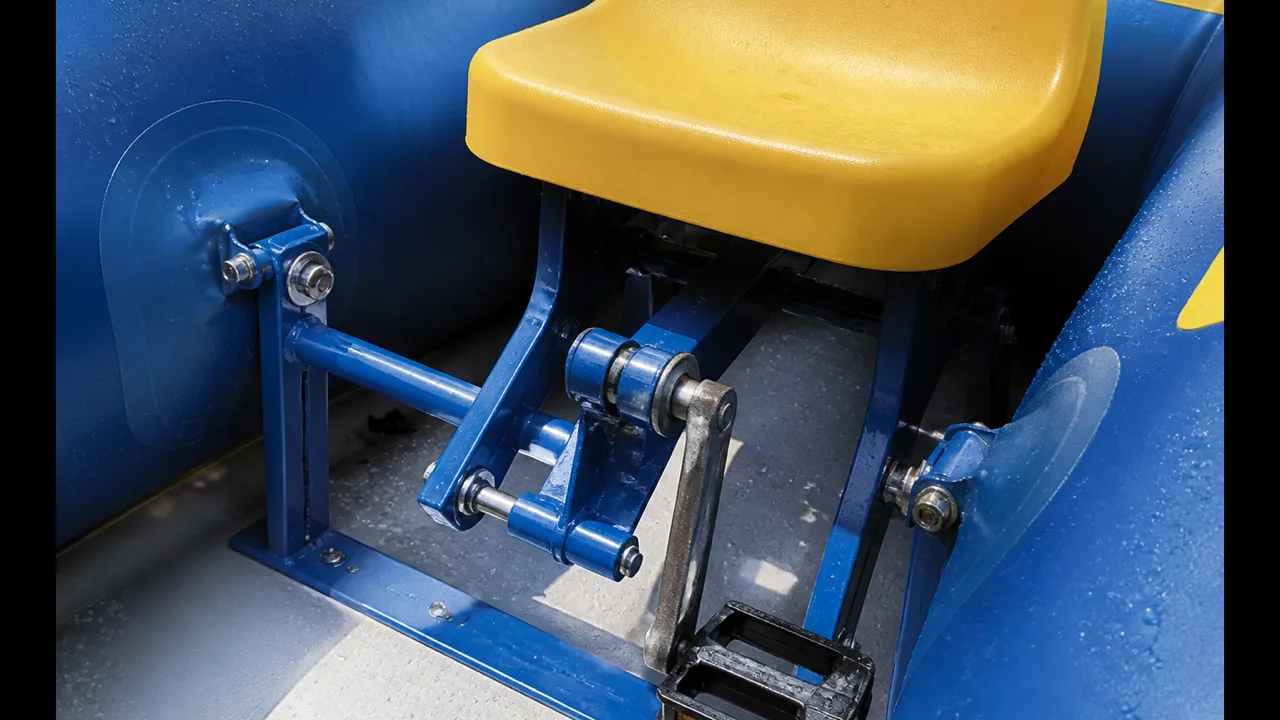
Commercial-grade water tractors use reinforced PVC tarpaulin construction with heat-welded seams at load-bearing points — the seat mount and wheel attachment points carry repeated dynamic stress from a player's body weight shifting during use, which is a different load pattern than a static platform sees. Confirm wall thickness and seam type specifically at these two points when requesting a quote, since a unit spec'd for casual pool play won't hold up to the throughput a campsite or leisure park puts it through in a single season. Buoyancy is typically provided by the wheel/float sections rather than a separate flotation chamber, so ask your supplier how the unit performs with a fully loaded adult rider before ordering for adult use.
A water tractor is a supervised ride, not a passive float. Build these into your operating plan:
Campsite lakes and leisure park lagoons are the most common setting, where the tractor operates within a roped-off zone of open water — confirm water depth is sufficient for the unit fully loaded and that the lake bed in the operating zone is free of obstructions a capsized rider might contact. Pool-based installations work too but are less common given the format's inherent compatibility with a larger, more casual open-water setting where a race or lap format has room to work. Either way, plan for seasonal removal and storage given the format's typical use in outdoor, warm-season settings.
A water tractor earns primarily through novelty and photo-worthiness rather than high hourly throughput — it's a slower, one-or-two-rider-at-a-time attraction compared to a floating obstacle course that moves groups through continuously. For campsites and leisure parks, that makes it a strong complement to an existing water attraction lineup rather than a standalone draw: it extends average guest dwell time and adds a differentiated photo moment that helps market the site, but it shouldn't be the only water attraction on a new site's opening lineup. Operators who already run a modular water park installation report the tractor performing best as an add-on rather than a first purchase. Our maintenance and profitability guide for camping and leisure park water attractions covers the broader utilization math this kind of add-on purchase should be weighed against.
The pedal or paddle mechanism is the component most likely to need attention — inspect the drive linkage and wheel attachment points at the start of each season and after any reported hard impact. Standard PVC maintenance applies otherwise: full drain and dry before folding, seam inspection, and dry, covered off-season storage. Our water management guide for inflatable pools and water parks covers the broader water-treatment side of running a water attraction if the tractor sits within a treated pool or lagoon setting.
How many water tractors does a leisure park need?
Most operators start with one or two units as a complement to an existing attraction lineup rather than building a standalone tractor zone — the format works best as variety within a broader water attraction mix.
Can a water tractor be used by children?
Depends on the unit's rated weight and the pedal/paddle mechanism's minimum operating force — confirm the rated age and weight range with your supplier, since some configurations require enough body weight and strength to operate the propulsion mechanism effectively.
If you're weighing a water tractor against other additions to your water attraction lineup, our team can walk through throughput and installation requirements for your specific site.