
This isn't a ranking of which inflatable categories sell best — our Best-Selling Commercial Inflatables 2026 guide covers that. This one is about a different question: what materials, colors, and interactive formats are buyers specifying more often on the orders themselves, regardless of which product category they land in.
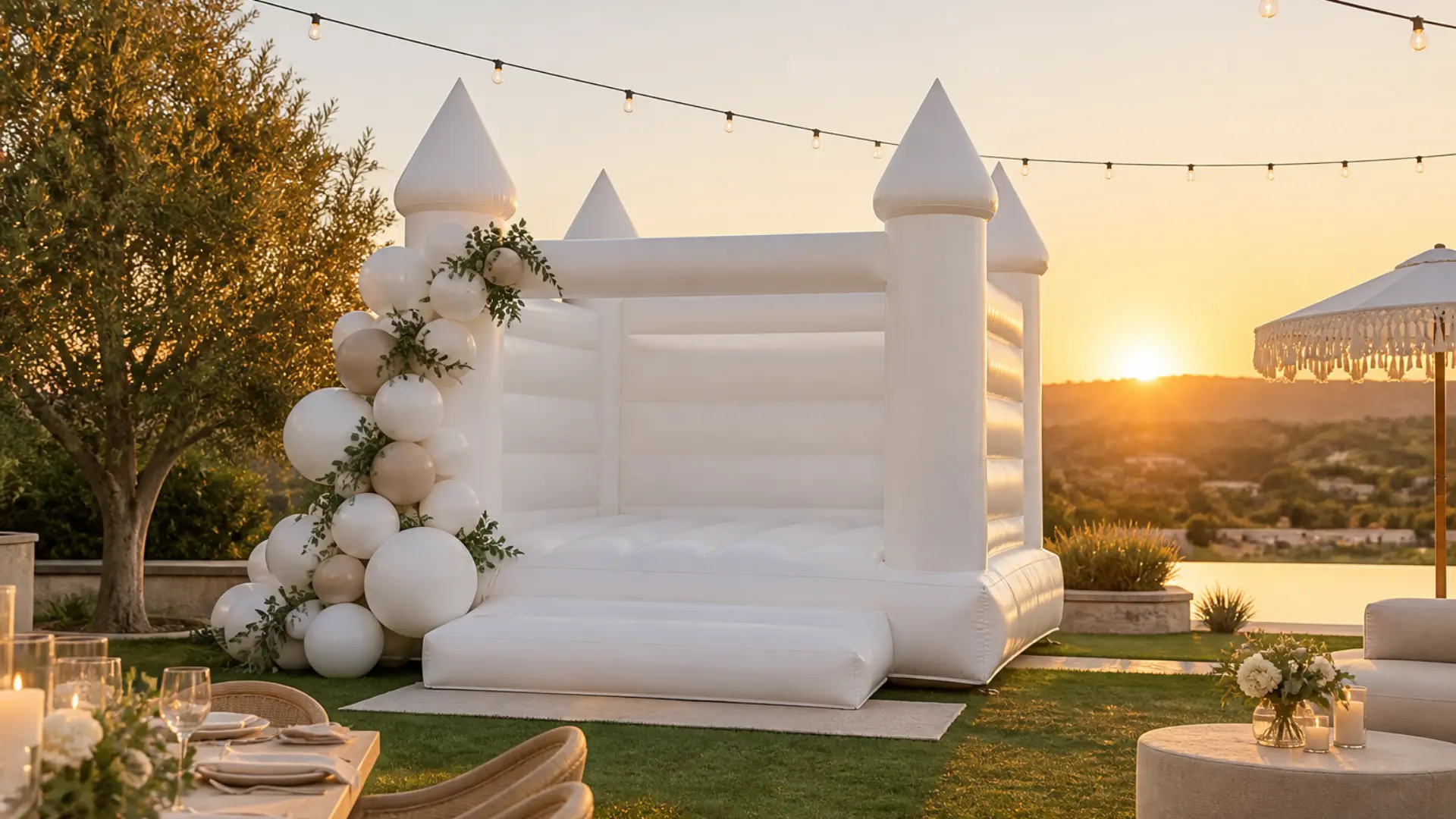
For several years, bright primary-color schemes were the default assumption for commercial inflatables. That's shifting. Event planners and premium party rental operators are increasingly requesting white, cream, or muted pastel color schemes — driven by wedding and corporate-event bookings where a saturated red-and-yellow bounce house clashes with styled photography. The white units command a rental-rate premium in markets where operators serve upscale events, and several buyers this year specified white as a standard SKU rather than a one-off custom order.
Interactive Projection System (IPS) games — where a projector casts a reactive light-and-graphics game onto a bounce or interactive surface — used to be a high-cost niche add-on. Falling projector-module costs and simplified plug-and-play controller units have brought IPS light games into range for mid-size FEC (family entertainment center) and rental-fleet buyers, not just flagship installations. Buyers ordering these are typically pairing them with a fixed indoor installation rather than a mobile rental unit, since the projection setup benefits from a controlled light environment.
Thermoplastic polyurethane (TPU) coated fabric remains more expensive per meter than standard PVC tarpaulin, but 2026 orders show it moving from an experimental spec into a defined premium tier — mainly on water-contact products and units marketed with an eco-conscious or premium positioning. Buyers citing TPU specifically are usually targeting European retail or hospitality clients who ask about material composition directly, rather than reacting to a cost pressure. If your team is still deciding between construction methods, our drop-stitch vs welded single-wall construction guide breaks down which build belongs on which product regardless of coating material.
Obstacle courses have historically been sized and priced around school-carnival and birthday-party rental use. That's no longer the dominant buyer profile for mid-to-large-format courses: corporate team-building bookings, which run longer sessions with higher per-participant weight tolerance requirements, are pushing orders toward reinforced-seam, higher-clearance configurations. See our obstacle course buyer's guide for the spec differences between school-event and corporate-fleet configurations.
Orders explicitly scoped for adult body weight and clearance dimensions — obstacle courses, freefall jumps, and oversized slides sized for adult participants — continued climbing through 2026, largely driven by corporate team-building events and adult-focused FEC concepts. These aren't simply oversized versions of kids' units; buyers are asking for reinforced seam specifications and higher-capacity blowers to match continuous adult-weight use, similar in principle to the resort-grade reinforcement covered in our adult inflatable water slide guide, applied here to dry-use formats.
None of these trends replace the core category decisions covered in our best-sellers guide — a water slide is still a water slide. What's changed is the specification layer sitting on top of that category choice: color scheme, interactive tech, material grade, and target-demographic sizing. Buyers who flag these preferences early in the sourcing conversation get more accurate quotes and shorter development cycles than those who leave them for a change order mid-production.
Worth noting: none of these are passing fads driven by a single viral product. White units track a multi-year event-industry aesthetic shift, IPS games track projector-hardware cost curves, TPU tracks broader coated-fabric supply trends, and adult-format demand tracks the corporate events market's own growth. Expect all four to keep expanding through 2027 rather than plateau this year.
Is TPU worth the added cost for a standard rental fleet unit?
For a general-purpose rental unit facing typical outdoor wear, PVC remains the more cost-effective choice. TPU makes more sense for water-contact products or units marketed specifically on eco or premium positioning where the client base asks about material directly.
Do IPS light games require a dedicated indoor space?
Not strictly, but the projected graphics perform best in controlled lighting, which is why most 2026 orders for IPS formats are going into fixed indoor FEC installations rather than outdoor mobile rental units.
Can white units be cleaned as easily as standard colored units?
Yes, with the same PVC tarpaulin cleaning process, though white surfaces show dirt and scuff marks more visibly, so operators running white units typically budget more frequent cleaning cycles between rentals.
If any of these specification trends fit your next order, our sourcing team can walk through color, material, and interactive-tech options against your target market before you commit to a final spec sheet.